Children's Games and Social Gatherings


Togyz Qumalaq (Nine Pebbles)
Togyz Qumalaq can be played in individual or team formats. The game uses a wooden board featuring eighteen small oval pits, known as "small homes," and two large "granaries." These are often colored white and black to distinguish the two sides. Each player starts with 81 stones—such as beans or corn—for a total of 162, with nine stones placed in every small pit. If a board is unavailable, the layout can be sketched on paper or dug into the ground.
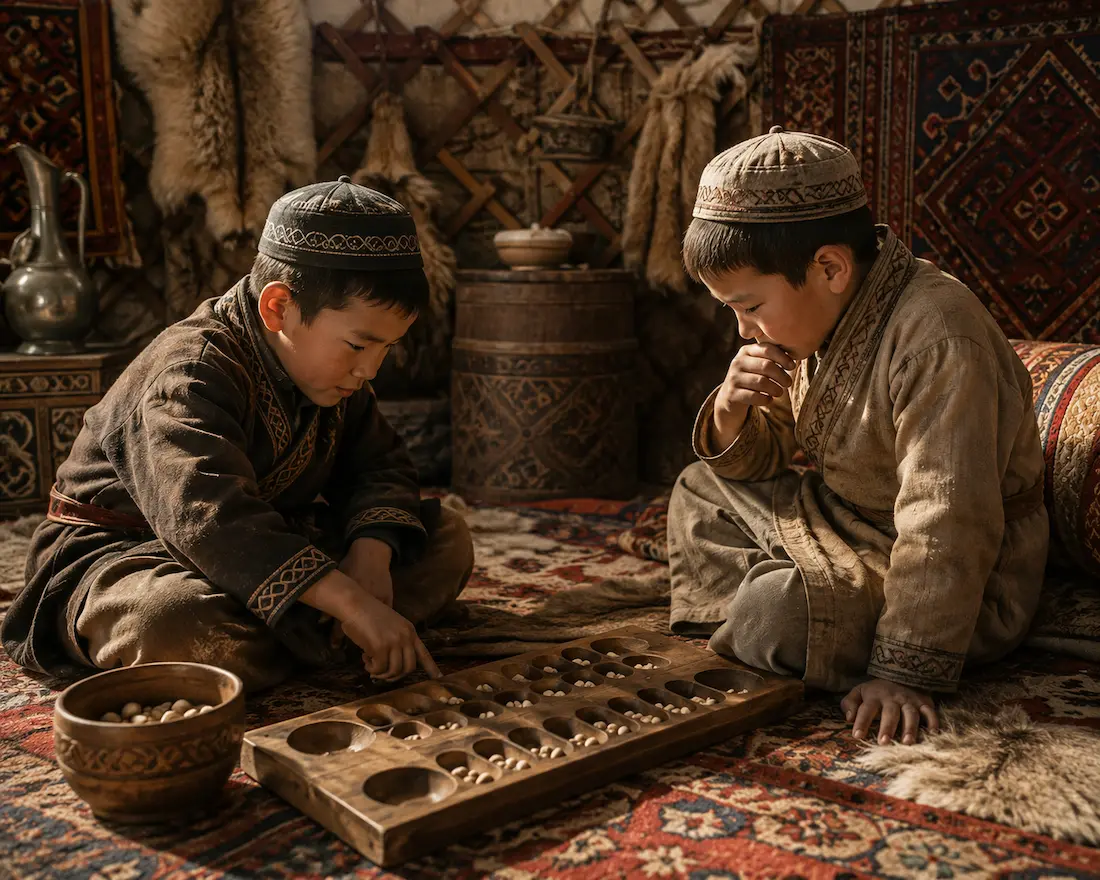
Rules dictate that a turn consists of moving stones from a pit; the player takes all but one, then distributes them counter-clockwise one by one into the following holes. If the last stone lands in the opponent's pit and results in an even number (2, 4, 6, 8, etc.), the player collects those stones and moves them to their own granary. If a player leaves two stones in a pit and the opponent completes the set to three, that pit becomes a tuzdyq (a "salt-pit") for the rest of the game, and all future stones landing there belong to the owner. Each player can own only one tuzdyq on their rival's side. The person who collects 82 stones in their granary emerges as the winner.
Asyq Oyyny (Knuckle-bone Game)
Asyq Oyyny is a classic activity played by boys. The most essential tool is the saka (a heavy shooting knuckle-bone), often weighted with lead on one side and smoothed on the underside for accuracy. It is played on flat, dry ground, and two or more children can participate to win the opponent’s bones. Two popular variants are Ushtaban (Three-step) and Altyatar (Six-shooter).
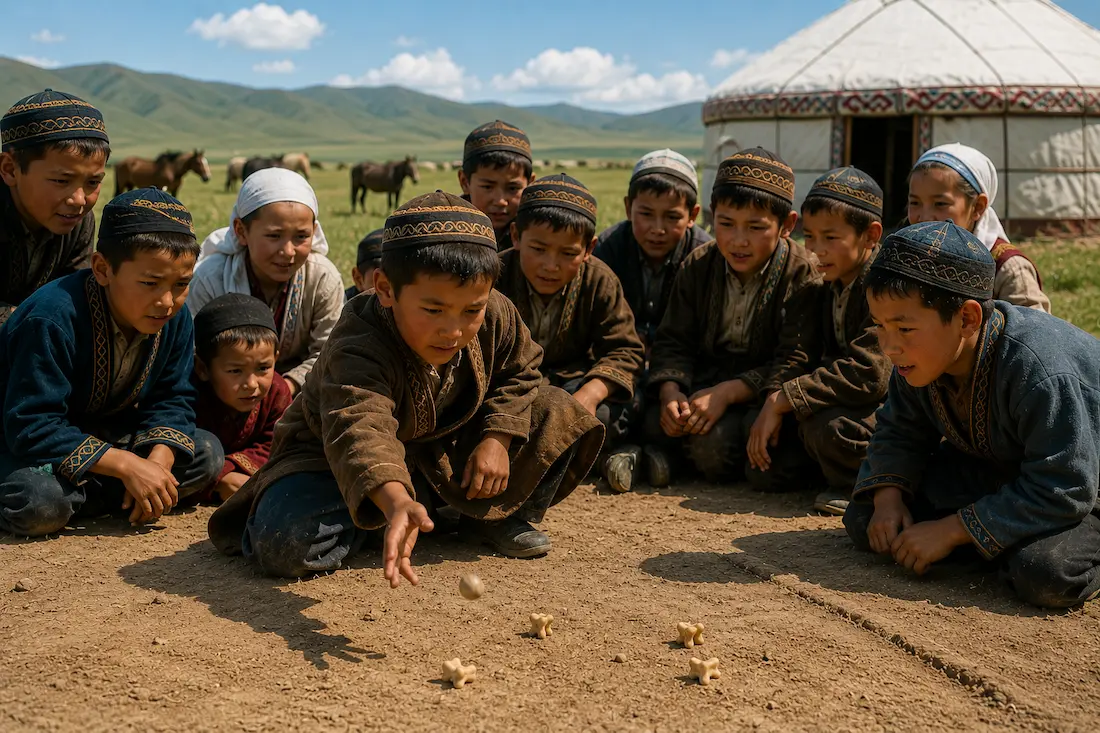
In Ushtaban, a line is drawn, and players place their bones along it at regular intervals. Everyone throws their saka toward a starting line; the player whose bone lands furthest starts first. They must strike the targets and knock them beyond a certain distance; if they miss, the next player takes over. Altyatar differs in that the bone of the player who failed to win any pieces is placed at the end of the row. There are specific boundaries, and a player gets six attempts to strike. If they manage to knock the "base" bone out of the marked area, they win all the pieces in the row. If they miss the base but strike others, they keep only the ones displaced.
Aq Süyek (White Bone)
Aq Süyek is a joyous game played on bright, moonlit summer nights. Historically, participants used a bleached knuckle-bone from cattle; because these bones become stark white and visible in the dark, the game earned its name. The group divides into two teams, and the leader throws the object far into the distance. Once it hits the ground, the leader shouts, "Go, find it!" The teams scramble in search. Whoever discovers the prize yells, "I found it!" and runs toward the finish line. Opponents must pursue and catch the runner; if they succeed, the finder must surrender the bone, and the chase continues. The side that brings the bone to the goal wins, while the losers must perform a forfeit, such as singing songs.
Saqina Salu (Ring Hiding)
Saqina Salu starts by drawing lots to select one girl and one boy to enter the center of a circle. The rest of the participants sit, holding their hands cupped together over their knees. The girl walks around the group, pretending to drop a ring into each player's hands. Afterward, she commands the boy, "Find the ring!" Every player mimics the action of holding the object to confuse the seeker, who must scrutinize their faces for clues. The boy then asks a specific person to reveal what they are holding. If he guesses correctly, the player caught with the ring pays a forfeit; if he is wrong, he pays the penalty himself. The group decides the nature of the "fine," which often includes singing a song, solving a riddle, or reciting a tongue twister. Girls only act as the "hiders," while boys serve as the "seekers."
Ine Zhasyrmaq (Hide the Needle)
Ine Zhasyrmaq is a lively indoor activity. The essential items are a needle and a dombra (a traditional two-stringed lute). First, the group selects a leader and a musician. The leader chooses two players: one leaves the room, while the other hides the needle on their own clothing or on another guest. Once the seeker returns, they search the collars and headwear of the participants. The musician plays the dombra to guide the search; the volume swells when the seeker approaches the hidden object and fades when they move away. If the seeker identifies the person holding the needle, they perform a search to confirm. If the hider avoids detection, the seeker pays a penalty; otherwise, the loser pays the fine.
Tympi (The Game of Silence)
Tympi is a hilarious game of discipline played in a circle. One person is appointed as the leader, who commands: "Let the game begin; everyone must be silent and stay still!" From that moment, no player is allowed to make a sound. Only the leader is free to speak. He uses funny movements, clever jokes, and humorous verses to provoke the group, attempting to make someone laugh. If a joke fails, the leader employs silly facial expressions, odd gestures, or awkward dances. He may even lean in close and ask confusing questions. If a player accidentally speaks or bursts into laughter, they must pay a penalty, such as dancing or reciting a poem.
Alty Bakan (Six Pillars)
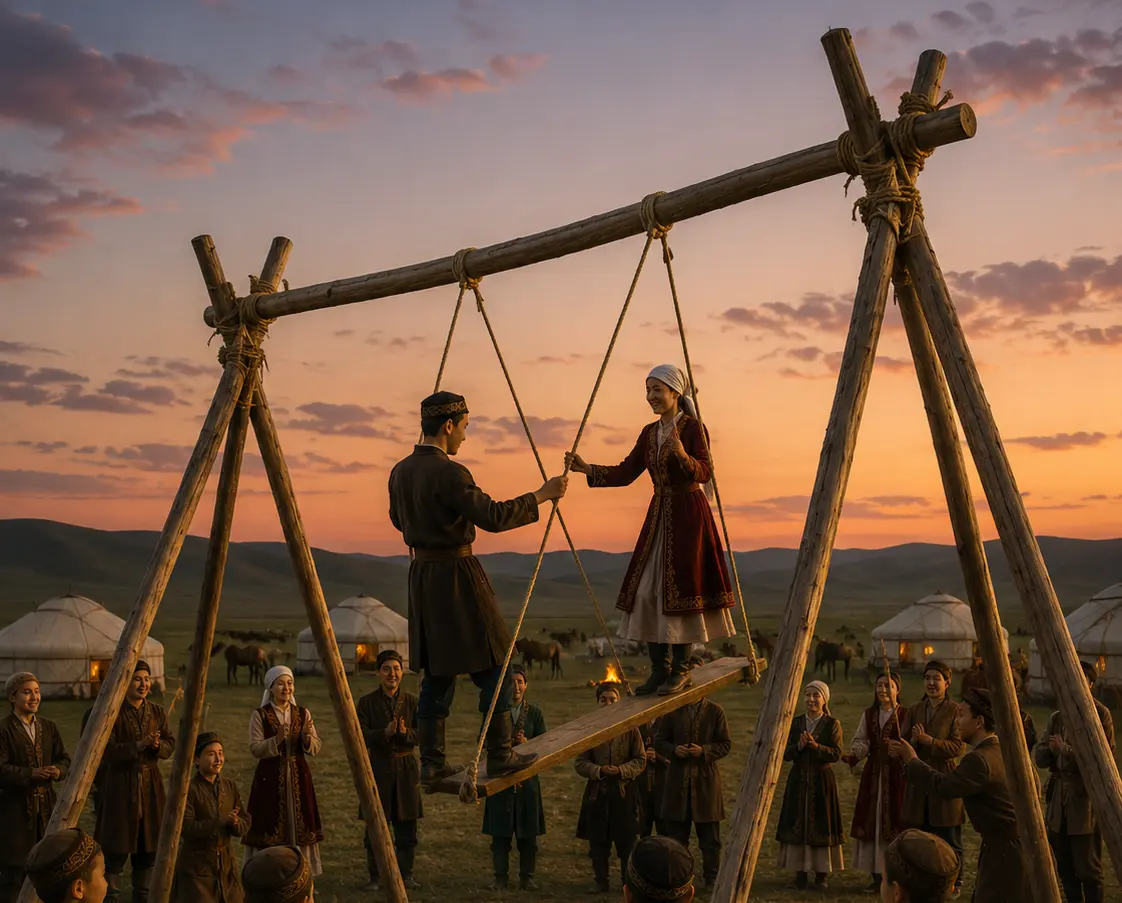
Alty Bakan has no limit on participants and is usually held on open fields during warm evenings. To set up the swing, you need six poles, each 3.5 to 4 meters long, and three sturdy ropes. The poles are arranged in pairs like tripods, placed 50 to 70 centimeters apart, and secured at the top to support a horizontal beam. The three ropes are attached to this beam: one is used for standing, and the other two serve as seats. Boys and girls pair up, taking turns to swing high into the air while singing beautiful, melodic songs. The remaining participants join the chorus, filling the night with joy.
Bastangy (The Gathering of Beginnings)
Bastangy is a social gathering for young women that occurs when village elders leave for a feast or other business. In Kazakh custom, honoring guests is a prestigious duty, so elders are expected to attend these events, leaving the girls behind. During their absence, the young women seize the opportunity to bond, share stories, and laugh freely without the constraints of strict social etiquette. Usually, young sisters-in-law also join.
Kazakh culture traditionally enforces the "Forty Prohibitions" to protect a girl’s honor, discouraging them from wandering without permission. Bastangy allows them to manage their own household affairs independently. Each attendee brings treats like dried curds, butter, or sweets to share. This gathering teaches them the practical art of hosting guests and serving traditional portions. A strict rule is that they must avoid loud noise; to prevent being discovered by returning elders, they post alert children as scouts around the house. They view being caught as a breach of propriety, making this a cherished, secret tradition.