Traditional Kazakh Embroidery Techniques


Embroidery and decorative needlework were fundamental to the traditional Kazakh art of decorating textiles. Although embroidery is practiced by cultures around the world, Kazakh needlework is distinguished by its strong folk character, remarkable technical diversity, and wide range of ornamental and practical applications.
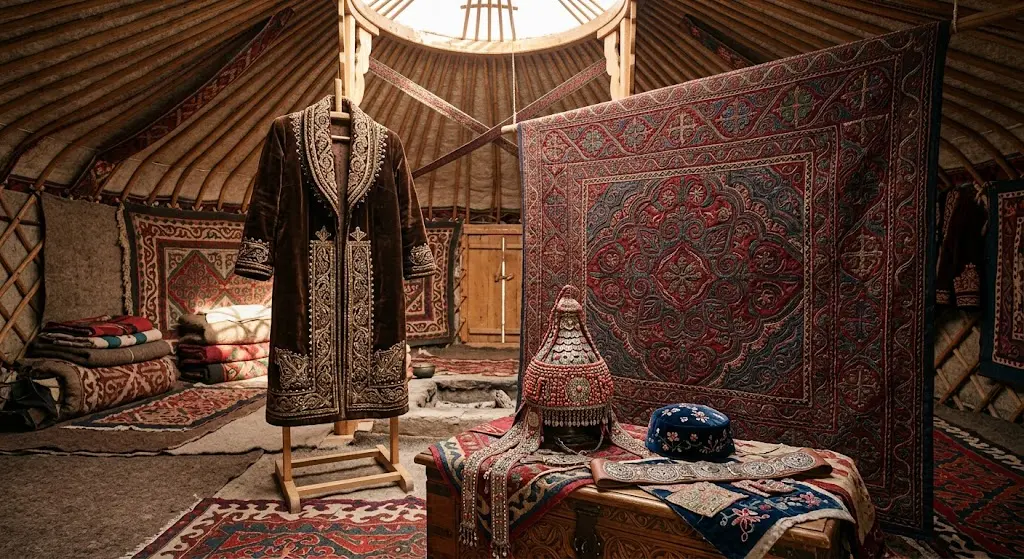
Traditional Kazakh embroidery includes biz keste (hook-needle embroidery), aiqas tigu (cross-stitch), aiqys-uiqys tigu (criss-cross or complex intersecting stitching), basyp tigu (couched or overlay stitching), and qaiyp tigu (backstitch). The biz keste technique itself has two distinct forms: shym keste and aredik keste.
Biz Keste: Two Distinct Styles
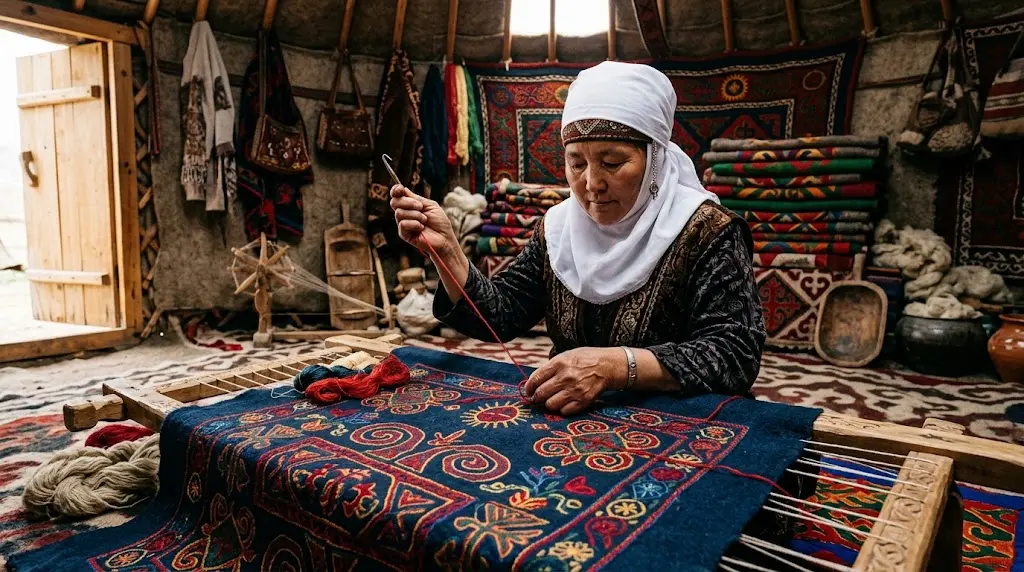
The biz keste technique is worked on fabric stretched over a circular or rectangular wooden frame called a kergish (embroidery frame). Following a pre-drawn ornamental pattern, the artisan uses a hooked needle known as a biz to pull and loop the thread through the fabric in a continuous, flowing motion.
Shym Keste
Shym keste is a dense, full-coverage embroidery technique in which almost the entire surface of the fabric is covered with stitches, leaving little background visible.
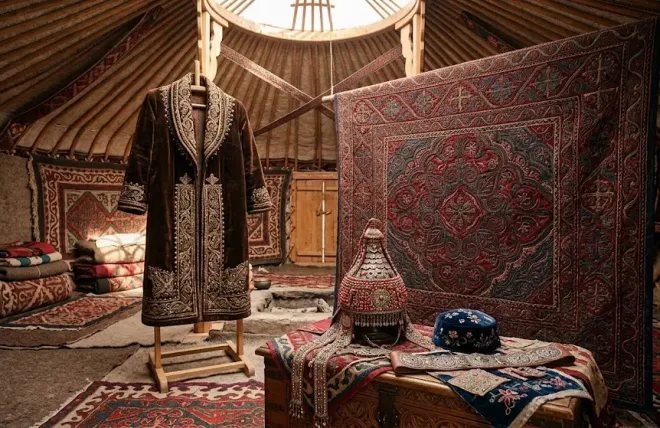
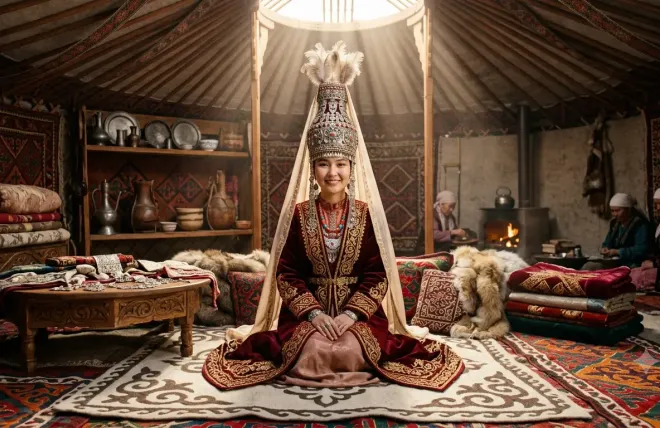
Because it is labor-intensive and produces a rich, elaborate appearance, shym keste was traditionally used for important and prestigious objects, including tus kiiz (decorative wall hangings), sandyq-kap (chest covers), velvet shapan (robes), headscarves, cushion covers, kejimi (ceremonial horse blankets), and sauk ele (bridal headdresses).
The embroidery could be worked directly onto the finished object or carefully stitched onto separate fabric panels that were later attached to it.
Aredik Keste
In contrast, aredik keste is a scattered decorative technique. Individual motifs are placed at intervals across the fabric, leaving substantial areas of the background exposed.
This style was commonly used to decorate smaller or functional parts of garments and household textiles, including taqiya (skullcaps), trouser cuffs, onir (decorative chest panels), collars, hems, the corners of wide-shaft boots, and curtain borders.
As with shym keste, the motifs could be embroidered directly onto an object or worked on separate pieces of fabric and then appliqued onto the finished garment or textile.
Traditional Kazakh Decorative Stitching
Kazakh artisans developed a sophisticated repertoire of stitching techniques, each adapted to a particular material, construction method, decorative effect, or practical purpose.
Aiqas Tigu: Cross-Stitch
Aiqas tigu is one of the most widely practiced forms of decorative needlework. It creates regular, square-shaped stitches by crossing one thread over another to form an X-shaped pattern. It remains one of the most familiar and accessible embroidery techniques.
Tesip Torlap Tigu: Openwork and Hemstitching
In tesip torlap tigu, the artisan pierces the fabric according to a predetermined pattern, creating a grid-like structure through which threads are looped to form intricate designs.
The technique can include looping or darning stitches worked between the openings, producing a delicate, web-like appearance. It was used for pillowcases, bedspreads, the chest and hems of women's undershirts, decorative mats, tablecloths, sofa covers, and wall tapestries.
Bederlep Tigu: Raised Embroidery
Bederlep tigu creates tactile, three-dimensional patterns. The artisan places cotton, scraps of fabric, paper, or cardboard on the fabric according to a prepared design and then embroiders over these materials.
This creates a raised, richly textured surface. Because of its delicate internal structure, textiles decorated with bederlep tigu should not be washed frequently.
Kopirtip Tigu: Puffed or Textured Stitching
Similar to raised embroidery, kopirtip tigu follows a predetermined pattern but leaves loops of thread on the surface, producing a soft, raised texture.
The technique is particularly suitable for depicting fruit and plant motifs, including apples, grapes, strawberries, currants, and melon buds.
Textiles decorated with this technique can be washed and ironed. After ironing, however, they should be shaken out to restore the volume of the textured stitches.
Tuktep Tigu: Pile or Tufted Embroidery
In tuktep tigu, the artisan creates loops approximately 1–2 cm long on the front surface of the fabric. Once the embroidery is complete, the loops are carefully trimmed to an even height, producing a surface resembling a multicolored pile carpet.
To achieve a uniform height, artisans sometimes place a thick twisted thread, a strip of fabric, or a soft metal rod beneath the stitches. These temporary supports are removed after the embroidery has been completed.
Gold and Silver Embroidery: Altyndap, Kumistep Tigu
Altyndap, kumistep tigu (gold and silver embroidery) was reserved for some of the most prestigious garments and decorative objects.
Artisans worked on luxurious materials such as velvet, plush, satin, and qyrmyzy (crimson silk), using gold or silver thread or fine metallic braids known as zer to create elaborate ornamental designs.
Because metallic materials were expensive and difficult to manipulate, every stitch had to be placed carefully. The technique could combine raised and flat couching and was often enriched with marjandap tigu (bead or pearl embroidery).
Women's qamzol (vests), formal ton (fur coats), shapan (robes), aiyr qalpaq (felt hats), kemer belbeu (ornamental belts), formal shalbar (trousers), and the regal saukele (bridal headdress) represented some of the finest examples of Kazakh craftsmanship.
The Craft of Hand-Sewing
Kazakh needlework was not limited to decoration. The nomadic way of life required households to be largely self-sufficient, particularly when families moved between seasonal pastures far from industrial centers.
Clothing, leather goods, and household textiles were therefore made and repaired by hand. These included saba (leather containers for fermented mare's milk), torsyq (leather vessels for liquids), and kiiz (felt).
Different needles were selected according to the material and the type of work required:
- Jualdyz (heavy awl-needle) was used for demanding work on items such as camel saddle covers, thick syrmaq (felt rugs), and leather horse trappings.
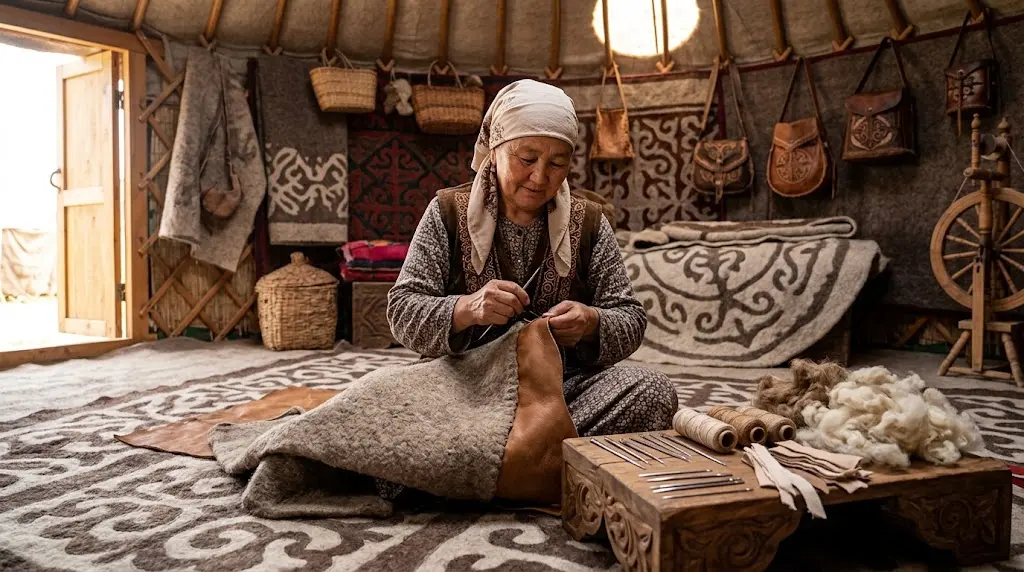
- Juan ine (thick needle) was used for the edges of syrmaq, felt walls of the yurt, fur clothing, and felt boots.
- Juantyq ine (medium needle) was used for bags, shekpen (cloaks), kupi (padded coats), and tymaq (fur hats).
- Basen ine (darning and button needle) was used to attach buttons and hooks and to sew garments made from thin fabrics.
- Jinishke ine (fine needle) was used for delicate silk and intricate embroidery.
The choice of needle was therefore not arbitrary: its size and strength had to match the material being worked.
Preparing Thread: The Art of Suyrtpaq
Traditional artisans also prepared their own thread from available fabrics and natural fibers.
A strip of fabric approximately 3–4 cm wide and 30–40 cm long, prepared for extracting threads, was called a suyrtpaq. The artisan carefully began to unravel the fabric, gradually pulling the individual threads straight out as the fringe became longer.
This required patience. If the fringe became too long, the threads could become tangled and break.
The extracted threads were then doubled, tripled, or quadrupled and twisted between the palms or fingers to achieve the desired strength. This process was known as jip shiratu (thread twisting).
For making suyrtpaq, artisans generally selected loosely woven fabrics without a pile. They also spun thread by hand from shuda (camel hair), sheep's wool, cotton, silk, and hemp.
Traditional Kazakh Hand-Stitching Techniques
Kazakh hand-stitching techniques were highly varied. Their names reflected the material being sewn, the structure of the stitch, its visual effect, or the specific task for which it was intended.
Batyp Tigu: Pressed Stitching
Batyp tigu was used for thick and durable materials such as leather, felt, and quilts.
The artisan made frequent, closely spaced stitches on the surface while drawing the lower thread taut over a longer distance. This caused the upper thread to sink into the material, keeping it as inconspicuous as possible on the finished surface.
Buzau Tis: Calf-Tooth Stitch
Buzau tis, literally "calf tooth," was a simple and efficient way of joining two edges, particularly when working with thick felt or jabagy (coarse, unwashed sheep's wool).
The artisan pierced the material alternately along the two edges and looped the thread through the seam, creating a secure join.
Tumarsha: Amulet Stitch
Tumarsha was another simple and fast stitching method. It was primarily used to finish the edges of headscarves.
The stitch reinforced the fabric edge, after which a secondary overcasting stitch was applied to secure the edge and prevent it from unraveling.
Burme Tigu: Gathering Stitch
Burme tigu was used to attach ruffles or gather several layers of fabric. Applications included qos etek (a layered skirt hem), gathered collars, and the attachment of a boot upper to its insole.
The stitch was usually worked in two parallel rows. The needle penetrations were spaced relatively far apart, and the thread was then pulled to draw the fabric into folds or pleated ripples.
Esip Jormeu: Twisted Overcasting
Esip jormeu was used to finish the edges of objects such as qaryn (stomach-skin bags) and mes (skin containers) for transporting liquids, as well as canvas bags and headscarves.
The artisan twisted and folded the edge with the left hand while overcasting it. The resulting seam was rounded and rope-like, giving it an appearance similar to a braid.
Japsyrma Tigu: Applique Stitch
Japsyrma tigu was used to attach patches, decorative trims, and ribbon-like borders to garments.
The needle passed through the applique and then into the base fabric immediately beside its edge. Repeating this movement secured the applique while keeping its edges neatly pressed and flat against the underlying fabric.
Kabyrga: Rib Stitch
Kabyrga is a decorative hand-sewing technique used to create linear patterns, inserts, or structural ribbing.
It is worked with even horizontal stitches across particular bands or threads of the fabric, producing long parallel lines of varying lengths.
Kusyru: Construction Seaming
Kusyru refers to the process of joining the main parts of a garment, such as the body, trousers, or sleeves.
It is not a single stitch but a structural stage of garment construction that can incorporate several techniques, including jormeu (overcasting), tepshu (running stitch), qaiyp (backstitch), obistiru (joining), and tebe tigu (tension stitch).
Qaiyp Tigu: Backstitch
Qaiyp tigu was valued for both strength and appearance. On the front of the fabric, it produces a continuous seam resembling modern machine stitching.
It was used for garment hems, sleeves, collars, taqiya (skullcaps), kimeshek (a traditional hooded headdress worn by married women), jaulyq (headscarves), and parts of footwear.
The artisan brings the needle up through the fabric, moves it forward, and then inserts it again at the point where the previous stitch ended. Repeating this movement creates a continuous, unbroken line of thread.
Tebe Tigu: Tension Stitch
Tebe tigu was used for leather garments such as ton (fur coats), trousers, and tymaq (fur hats).
Although similar to a running stitch, it was adapted for tough, resistant materials. Thick leather could not always be pierced easily in a single motion, so the artisan held and tensioned the material with the left hand while moving the needle back and forth with two fingers.
This produced a finer and more secure stitch than an ordinary running stitch.
Tep shu: Running Stitch
Tep shu was among the most frequently used hand stitches. It was essential for garment edges, seams, and finishing folds in lightweight fabrics.
Depending on the thickness of the material, the artisan could make three or four needle penetrations before pulling the thread through, allowing the work to be completed quickly while maintaining an even finish.
Tandai: Palate Stitch
Tandai is a decorative technique worked across three parallel guide lines. It creates a double-rib effect using repeated diagonal stitches.
It was traditionally used to decorate the edges of kimeshek, collars, sleeve openings, and the borders of various embroidered textiles.
Tyshkan Iz: Mouse-Track Stitch
Tyshkan iz, literally "mouse track," is an intricate decorative stitch worked between three parallel lines or within a grid.
The needle emerges from the lower line and passes through the upper line, forming a loop that is held temporarily with the thumb. On the next movement, the needle emerges through the central line, skips two stitch lengths, and passes through the previously held loop.
When the thread is pulled tight, the stitches form a distinctive elongated triangular pattern.
A Highly Specialized Craft
Traditional Kazakh embroidery and hand-sewing were far more than forms of decoration. They combined practical knowledge, material expertise, craftsmanship, and artistic expression.
From everyday garments and household textiles to ceremonial clothing and richly embroidered bridal headdresses, every technique had a particular purpose. The variety of stitches, needles, threads, materials, and construction methods reflects a highly specialized textile tradition developed within the practical realities of nomadic life.
These techniques allowed Kazakh artisans to create objects that were durable enough for everyday use while also carrying the distinctive ornamental language and artistic traditions of Kazakh culture across generations.