Kazakh Cattle Terminology


The history of domestic cattle goes back to the Tur, the wild cattle traditionally identified as the ancestor of modern domestic cattle. Over generations, pastoral communities developed and maintained cattle populations suited to different environments and practical needs.
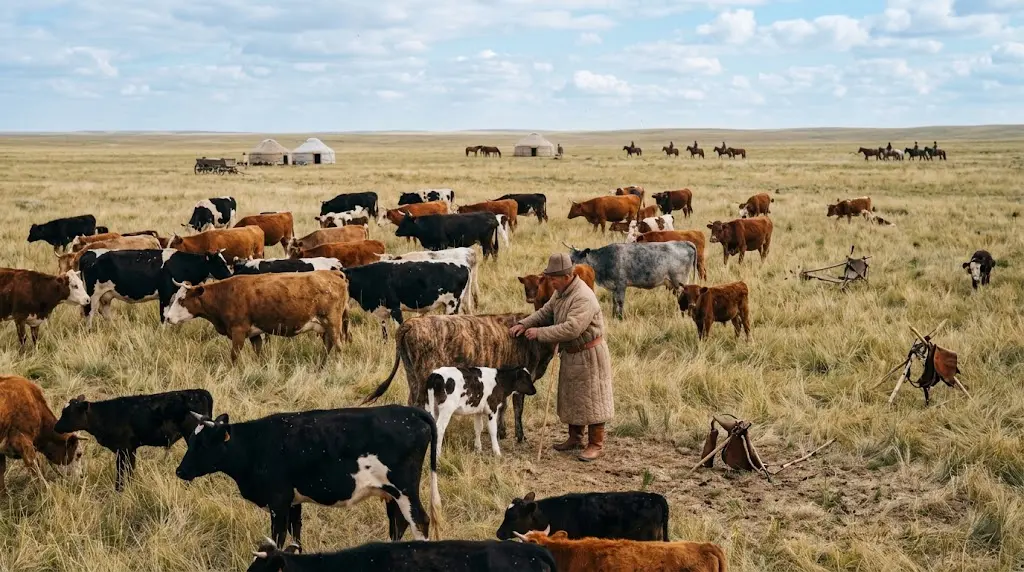
Traditional Kazakh cattle terminology reflects this close relationship between people and livestock. Cattle could be distinguished according to their purpose, place of origin, breed, color, physical characteristics, age, reproductive status, temperament, productivity, and condition. Features such as the shape of the head, coat, horns, back, tail, and udder could all be described with specific terms.
The domestication and later development of cattle produced animals that differed considerably from their wild ancestors. Domestic cattle generally developed shorter legs, larger and more robust bodies, and other physical characteristics associated with domestication. Over time, the breeding and crossing of different lineages contributed to the diversity of cattle populations found across Central Asia.
Cattle became widespread across what are now Kazakhstan, Uzbekistan, Kyrgyzstan, Tajikistan, Turkmenistan, and neighboring regions. In Kazakhstan, cattle traditionally served several important purposes: they provided meat and milk, while some animals were also valued as draft animals.
This practical importance is reflected in the richness of traditional cattle vocabulary. The terminology below illustrates how closely Kazakh pastoral knowledge was connected with the observation and management of livestock.
Classification by Physical Condition and Vitality
Traditional terminology could describe the physical condition of an animal with remarkable precision. These terms reflected observations of body condition, resilience, illness, feeding, and seasonal changes.
- Mamyrlagan siyr (a cow in peak fattened condition): A cow that has reached an exceptionally high level of fatness, combining reserves accumulated during summer with those retained through winter. The expression could also be used ironically for a cow so heavy that it moved with difficulty and appeared to limp on all four legs.
- Shailagan siyr (an excessively fat cow): An extremely fat cow whose great body mass makes movement difficult, resulting in slow and heavy steps.
- Koterem siyr (a severely emaciated cow): A cow that has reached an extreme state of emaciation because of illness, poor grazing, or a severe shortage of winter fodder. In this condition, the animal may be unable to rise after winter.
- Kauka buzau (a stunted, neglected calf): A sickly, underdeveloped calf, particularly one born early and inadequately cared for. Its coat may be sparse, matted, and unkempt.
- Tu siyr (a barren mature cow): A mature cow, traditionally described as around three or four years old in this classification, that has never produced a calf, either because it failed to conceive or because it remained well-fed without being exposed to a bull.
- Bosalang siyr (a cold-sensitive cow): A cow with poor resistance to cold that loses weight and body condition rapidly during winter.
- Biteu siyr (a permanently barren cow): A cow that never produces a calf and remains consistently well-fed and fat throughout its life.
Classification by Reproductive Status
Reproductive history was another important way of distinguishing cows.
- Tugan siyr (a cow that has calved): A cow that has successfully given birth to a calf.
- Tumsa siyr (a first-time mother): A cow that conceived relatively late and is giving birth for the first time, traditionally described as being around four or five years old.
- Erte siyr (an early-calving cow): A cow that calves earlier than expected in the normal seasonal cycle.
- Kesh siyr (a late-calving cow): A cow that calves significantly later than the other cows in the herd.
- Jyldym siyr (an early-cycling cow): A cow that enters reproductive heat early and consequently calves relatively quickly.
Classification by Gender and Age
Age and sex were particularly important in traditional livestock terminology. A single English word such as calf, heifer, bull, or ox often cannot reproduce all of the distinctions contained in Kazakh terminology.
- Aktamak (a young female heifer): A young female animal, traditionally described in this classification as being between one and three years old.
- Kashar (a young heifer): A female heifer at a specific young age. The exact age assigned to this term can vary between classifications and regional traditions.
- Taiynsha or Tana (a yearling or young female): Terms used for young cattle, with their precise age distinctions varying in traditional classifications.
- Torpak (a young calf): A young animal that has not yet reached one year of age.
- Baspak (a young calf): A young calf in an early stage of development.
- Siyrkeni or Buka (a bull): A male of the cattle species, particularly a breeding bull.
- Kuzhban buka (a mature breeding bull): A fully mature breeding bull, traditionally described as around seven years old, with a calm and dignified temperament.
- Azban buka (a traditionally late-castrated working bull): A bull that underwent a traditional form of partial castration in which the reproductive function was interrupted without complete removal of the testicles. Because some natural vigor was retained, such an animal could remain highly active during the breeding season and could also be used for work.
Classification by Milking Practices
Milking was not simply a routine task. It required detailed knowledge of a cow's behavior, the presence of her calf, and the process by which milk was released.
- Tuski sauym (midday milking): The midday milking of a cow that has a calf.
- Ak kongil or Igish siyr (a cooperative milking cow): A cow that requires her calf to initiate the milk let-down process but then releases her milk readily for the milker. After the initial stimulation, she may continue to release milk even without the calf being present.
- Keshki sauym (evening milking): The evening milking traditionally carried out shortly before sunset.
- Iiu (milk let-down stimulation): The practice of allowing a calf to suckle briefly before milking in order to stimulate the cow's milk let-down reflex.
- Songhy iindi (the second milk let-down): A second stage of milk let-down in which the calf is allowed to suckle again so that the cow releases the remaining milk.
Classification by Udder and Teat Structure
The appearance and structure of the udder could also be described through comparisons with familiar household objects.
- Tegene zhelin (a bowl-shaped udder): An udder shaped like a tegene, a broad, large wooden bowl or basin.
- Astau zhelin (a trough-shaped udder): An elongated udder resembling an astau, a wooden trough traditionally used for feeding livestock.
- Synghar emshek (a cow with one functional teat): A cow in which one of the four teats is unusually small or does not produce milk.
- Ush emshek (a three-teated cow): A cow with only three functional teats because one teat is missing or non-functional.
- Tutam emshek (a large-teated cow): A cow with long, thick teats approximately the size of a fist, described by comparison with a tutam, a fist or handful.
Classification by Physical Build
Body shape provided another set of distinctions.
- Arkaly siyr (a muscular-backed cow): A cow with a long spine and prominent vertebral processes, associated with a well-developed, muscular, and fleshy back.
- Dong arka siyr (an arched-back cow): A cow with a strongly convex back, in which the central vertebrae rise noticeably.
- Topal or Tukyl siyr (a naturally hornless cow): A cow born without horns.
- Synghar muyizdi siyr (a one-horned cow): A cow that has lost one horn, for example as a result of fighting or an accident.
- Kyr arkaly siyr (a lean, ridge-backed cow): A cow with a pronounced, sharp spine and visible vertebral processes, indicating a relatively lean body.
- Kaiky bel siyr (a swaybacked cow): A cow with a pronounced dip in the middle of the back, causing the front and rear portions of the body to appear higher.
- Shazha siyr (a stunted cow): A small, poorly developed cow, often associated with an inferior or less productive type, with a low-slung and relatively undeveloped body.
- Shozhe bas siyr (a small-headed cow): A cow with an unusually small head.
- Shanyrak muyizdi siyr (a curved-horn cow): A cow with large horns that curve inward and downward, resembling the circular framework of a yurt roof known as the shanyrak.
- Shubalang kuyryk siyr (a long-tailed cow): A cow with an exceptionally long tail.
Classification by Temperament
Pastoralists also distinguished cattle by temperament and behavior, particularly when those traits affected handling and herd management.
- Jyndy or Suzegen siyr (an aggressive cow): An aggressive cow prone to attacking or goring people or other animals. Such animals could be especially dangerous during calving, milking, or feeding.
- Zhemir siyr (an insatiable cow): An exceptionally voracious cow that eats almost anything within reach. Besides fodder, such an animal might consume objects such as laundry, blankets, bones, or pieces of wood.
- Zherigish siyr (a temperamental, rejecting cow): A temperamental cow that rejects her own calf, refuses to nurse it, or does not allow it to approach. Such a cow might also refuse to drink water from a trough.
- Juas siyr (a docile, gentle cow): A calm and cooperative cow that poses little danger to people or other animals and remains manageable during milking, tethering, and leading.
Herd Categorization
Cattle could also be grouped according to their practical role within the herd.
Cows and Heifers
- Buzauly siyrlar (cows with calves): Cows accompanied by their calves.
- Buzaulamaityn boidak siyrlar (barren cows and heifers): Cows and young females that are not producing calves.
Males
- Bukalar (breeding bulls): Male cattle kept for breeding.
- Ogizder or Ogizsheler (oxen and steers): Castrated males used for draft work or, depending on their condition and purpose, for meat production.
Calves
- Buzaular (calves): Young cattle collectively classified according to age and other characteristics.
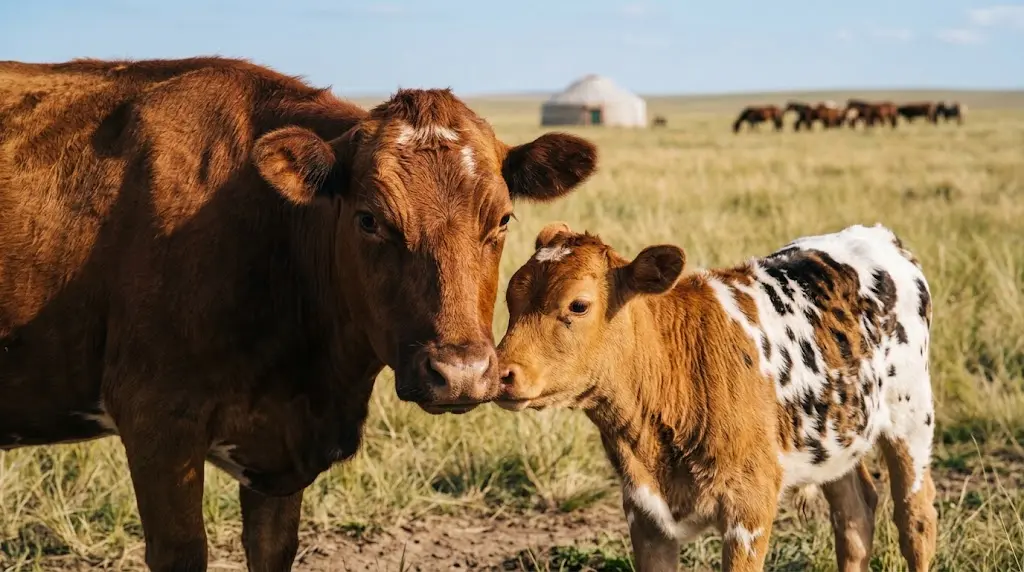
Classification of Female Cattle
Female cattle were particularly important because they combined reproductive and dairy functions. Traditional terminology therefore distinguished between pregnant cows, nursing cows, barren females, and cows displaying particular reproductive behaviors.
Nursing and Breeding Cows
- Buaz siyr (a pregnant cow): A cow that has been mated but has not yet given birth.
- Kashkan siyr (a mated cow): A cow that has been covered or mated by a bull.
- Buzauly siyr (a cow with a calf): A cow that has recently given birth and has a calf at foot.
- Sauuly siyr (a nursing or milked cow): A term with two related meanings: a cow nursing a calf, or a cow being milked without her calf present. In the latter case, a stuffed calf skin called a tulyp could be used as a decoy, or the cow could be trained to release milk without the calf.
Non-Breeding Heifers and Barren Females
- Boidak siyr (a barren female): A collective term for female cattle that have not conceived. In some classifications, this category includes young females of different ages.
- Kashar (a young heifer): A young female cattle term whose exact age may vary among traditional classifications.
- Beiseuet siyr (a stray cow): A lost or stray cow, particularly one that has wandered far from the herd or refuses to settle after being moved to a new territory.
- Toktagan siyr (a confirmed pregnant cow): A cow that has successfully mated and is believed to be pregnant.
- Tabany kyzgan siyr (a cow in active heat): A cow in reproductive heat that actively seeks the bull and remains close to him.
- Kashak or Muyizgek siyr (a chronically heat-active cow): A cow that repeatedly comes into heat and persistently attempts to mate, often showing agitation.
Classification of Bulls and Steers
Breeding males were carefully distinguished from castrated working animals.
- Buka (a breeding bull): An uncastrated adult male kept for breeding. Bulls are substantially larger and heavier than cows and were expected to remain in good physical condition. Excessive fattening, however, was undesirable for breeding animals.
- Besti buka (a mature five-year-old bull): A fully mature breeding bull traditionally identified by its age.
- Donen buka (a three-year-old breeding bull): A bull described according to a three-year stage of development or breeding service.
- Kunan buka (a young bull): A young bull traditionally associated with the two- to two-and-a-half-year age range.
- Bukasha (a young uncastrated bull): A young male that has not yet been castrated.
- Bukashyk (an early-born male calf): A male calf over six months old, traditionally described as having been born early in the season.
- Taiynsha buka (a male yearling bull): A male approximately one year old.
- Kenzhetaiynsha buka (a late winter-born bull calf): A very young, uncastrated bull calf born during winter and consequently smaller than calves born in spring.
Steers and Oxen
Castrated males had their own terminology according to age, condition, and use.
- Kur ogiz (a free-grazing castrated male): A castrated male allowed to graze freely rather than being used for draft work, allowing it to develop a particularly fat and muscular condition.
- Ogiz (a draft or beef ox): A castrated male used for draft work or meat production.
- Atan ogiz (a fully mature ox): A large, fully mature castrated male.
- Azban ogiz (a late-castrated working ox): A bull castrated at around six or seven years of age and subsequently used for heavy work.
- Ogizshe (a young steer): A castrated young male above the first year of life.
- Tai ogiz (a yearling steer): A castrated male around one year old.
- Shaban or Kyzhyr ogiz (a slow draft ox): A slow-moving, inefficient ox characterized by a heavy and lazy gait.
Classification of Calves and Related Behaviors
Calves were distinguished according to their season of birth, physical condition, feeding history, and behavior.
- Buzau (a spring calf): A calf born during spring.
- Buzau kozy and Buzau lak (fostered cross-species nursing): When a cow's calf died, a lamb (kozy) or kid (lak) could be fostered onto the cow so that she would continue to release milk. The terminology describes this unusual cross-species nursing arrangement.
- Aramza buzau (a premature winter calf): A calf born prematurely during winter.
- Barak buzau (a shaggy calf): A calf with unusually shaggy or unkempt hair.
- Jalky buzau (a single-born calf): A calf born alone rather than as one of twins.
- Mayekti buzau (a well-nourished calf): A calf allowed to drink its mother's milk fully and freely and consequently raised in particularly good condition.
- Marka buzau (a winter calf): A calf born in winter. In the classification used here, such calves are described as smaller than yearlings but larger than spring-born calves.
- Topal buzau (a hornless calf): A calf that has not yet developed visible horns at around two or three months of age.
- Shaka buzau (a hairless premature calf): A premature calf born with unusually sparse hair.
- Kylau buzau (a sickly calf): A weak or unhealthy calf suffering from digestive problems such as diarrhea, sometimes accompanied by reddish patches on the tongue and loss of weight.
- Jetim buzau (an orphaned calf): A calf whose mother has died.
- Jamyrauly (unassisted calf nursing): The natural behavior of a calf moving freely among the herd and finding its mother on its own to nurse.
- Janasu (unauthorized nursing): An unwanted nursing behavior in which a calf, tethered too loosely, manages to approach its mother and nurse without permission, causing her to release milk prematurely.
Vocalizations and Behavioral Terms
Kazakh pastoral vocabulary also distinguished among different sounds made by cattle.
- Ynghyranu (tender lowing): A soft, tender lowing made by a cow toward her calf, especially while licking it after birth or during nursing. Cows may also make this sound when they hear their calves, while bulls may vocalize similarly when following a cow in heat.
- Mongireu (loud bellowing): A loud, searching bellow made by a cow separated from her calf or herd, or by an animal that has become lost.
- Okiru (defensive roaring): A deep and forceful roar produced when cattle feel threatened, for example by wolves, the smell or sight of slaughter, or the presence of rival bulls.
- Kuzhildeu (a guttural bull challenge): A strained, guttural sound made by a mature bull when challenging a rival or attempting to attract a cow away from another herd.
- Kuyseu or Kuyis kayyru (rumination or chewing the cud): The process of bringing partially digested food back from the rumen and chewing it again.
- Zhusauly (resting after feeding): The state of lying quietly and resting after a full meal, without actively feeding.
Classification by Color and Coat
Color and coat patterns were also important identifying characteristics. Such descriptions could help pastoralists distinguish individual animals within a herd.
- Kara siyr (a black cow): A cow with a completely black coat.
- Kara kongyr siyr (a dark brown cow): A cow with a dark brown or brownish-black coat.
- Kara ala siyr (a black-and-white cow): A black-and-white piebald cow.
- Sary ala siyr (a yellow-and-white cow): A yellow-and-white piebald cow in which yellow patches are particularly prominent.
- Ala siyr (a piebald cow): A general term for a cow with a mixed or patchy coat containing white, brown, yellow, or other contrasting areas.
- Kok siyr (a grey or blue-roan cow): A cow with a grey or blue-roan coat.
- Ak siyr (a white cow): A cow with a solid white coat.
- Kyzyl siyr (a red cow): A cow with a solid reddish or red coat.
- Kara kaska siyr (a black blaze-faced cow): A black cow with a white marking running from the forehead toward the nose. The white facial marking is described as a kaska.
- Kyzyl kaska siyr (a red blaze-faced cow): A red cow with a white marking on the forehead.
- Ak bas siyr (a white-headed cow): A black, brown, or red cow whose entire head is white.
- Targhyl siyr (a brindle cow): A cow with a brindle or striped coat, typically involving a yellowish base with darker brown or black stripes or blotches.
- Kara shubar siyr (a spotted black cow): A cow with numerous irregular black spots distributed across its coat.
- Ala bel siyr (a saddle-marked cow): A cow with a distinct contrasting patch across the back or loin, while the remainder of the body is predominantly another color.
- Jalbyr siyr (a shaggy-coated cow): A cow with long, shaggy, and matted hair.
Coat Management Terms
Seasonal changes in the cattle's coat were also observed and named.
- Oli zhun (old winter hair): The previous winter coat that remains after the arrival of warmer weather.
- Tiri zhun (new summer coat): The fresh summer coat growing beneath the old winter hair.
- Tuleu (seasonal shedding): The seasonal shedding of the thick winter coat, traditionally beginning in spring, particularly around April, as the new summer coat develops.
Traditional Herding Commands and Expressions
Livestock management depended not only on physical control but also on a rich vocabulary of calls and commands. Short vocal signals allowed herders to direct animals without physical intervention.
Working Commands
- Abylai: A call used to stop cattle from wandering away from the herd.
- Aukim-aukim: A gentle vocal sound used when approaching or calming a cow.
- Shaugim-shaugim: A call used to bring cattle toward a watering place or trough.
- Aukau-aukau: A call used to bring a cow and her calf for milking.
- Ai, A, zhanym, a, and A, A: Various soothing calls used to make a cow stand still while being tethered or milked, or to prevent animals from goring one another.
- Ai, ek: A firmer command used to drive away a cow that is threatening a calf or crowding other animals.
- Ak, shu or Ok: Commands used to drive or lead cattle forward.
- Kuzh-kuzh: A sound used to encourage a bull to mate.
Exclamations and Expressions of Frustration
Traditional herding vocabulary also included emotionally charged expressions used when animals were difficult to control.
- Kakpysh kelgir: An expression of frustration when a cow refuses to cooperate and wanders away.
- Karatalak kelsin, Karasan kelgir, and Salemalik kelgir: Expressions invoking particular severe livestock diseases and used in moments of intense frustration when animals refused to obey or were difficult to manage.
Traditional Veterinary Terms
Traditional pastoral knowledge included a vocabulary for recognizing and naming animal diseases and physical ailments. Some of these historical terms do not correspond exactly to modern veterinary diagnoses, so their English equivalents should be understood as approximate descriptions rather than definitive modern diagnoses.
- Kara san (blackleg): Traditionally associated with a severe infectious disease involving muscle damage and gas-filled swellings.
- Kara talak (spleen disease or necrosis): A condition associated with enlargement and damage or necrosis of the spleen.
- Malik or Ala okpe (bovine pleuropneumonia): A disease associated with inflammation of the lungs and surrounding tissues.
- Shuryk (severe digestive disorder with diarrhea and bloating): A condition characterized by severe diarrhea and abdominal distension.
- Saryp (interdigital inflammation): An inflammatory condition affecting the area between the hooves.
- Ausyl (foot-and-mouth disease): A highly contagious viral disease affecting cloven-hoofed animals and associated with lesions of the mouth, udder, and feet.
- Kyzyl shu bolu (stress-associated miscarriage): A term describing miscarriage associated with severe environmental stress or illness.
- Kara tuynek (intestinal torsion): A condition involving twisting of the intestine and obstruction of normal digestion.
- Aiyr bakai or Bakai kurt (severe foot rot and associated infestation): A severe condition affecting the tissues between the hooves, traditionally associated with mud, filth, infection, and, in advanced cases, maggot infestation. Bakai kurt refers to the larvae associated with the condition.
- Muyizgek (venereal infection): A contagious reproductive infection affecting cattle.
- Ak baipak (hoof or skin inflammation): A broad traditional term for an unidentified infectious or inflammatory condition affecting the hoof or skin.
- Buzau taz (ringworm or skin sores in calves): A contagious skin condition affecting calves and producing inflammation and sores.
- Ak tyshkan (severe neonatal diarrhea): A serious and potentially fatal diarrheal condition affecting newborn calves.
- Tentek or Ainalma (circling disease or staggers): A neurological condition associated with abnormal circling or loss of coordination and traditionally attributed to damage affecting the brain.
- Kotyr (mange): A skin disease caused by microscopic mites.
- Okyra (warble fly infestation): An infestation caused by the larvae of warble flies, traditionally recognized among cattle in Kazakhstan.
A Vocabulary Shaped by Pastoral Life
The sheer range of traditional cattle terms reveals more than linguistic richness. It reflects a system of practical knowledge developed through close observation of animals over generations.
A pastoralist did not simply see a "cow" or a "bull." The animal could be identified by its age, sex, reproductive history, physical condition, body structure, coat, temperament, behavior, milking characteristics, or role within the herd. Even the sounds an animal made and the way it responded to commands could have their own names.
This vocabulary was closely connected with everyday survival in a pastoral environment. Knowing which animals were suitable for breeding, which cows were good milk producers, which bulls were appropriate for reproduction, which oxen were suitable for heavy work, and which calves required special care was essential to maintaining a productive herd.
Traditional Kazakh cattle terminology therefore represents a form of ethnozoological knowledge: a body of observations and classifications through which pastoral communities understood, managed, and interacted with the animals on which their livelihoods depended.