Law and Justice


Aktyk: Ritual Compensation
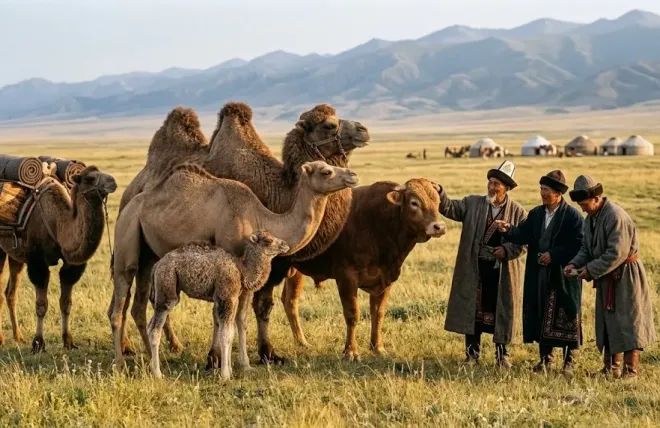
Aktyk refers to a specific, legitimate payment made for non-commercial, life-sustaining services. For example, when a herder brought their female camel or mare to mate with a neighbor’s prized stallion or bull camel, they compensated the owner of the male animal with an Aktyk.
Note on social taboos: Historically, the word was also twisted to mean payouts given for espionage or bribery. The community viewed this form of transactional treachery with absolute disgust; anyone caught accepting illicit hush money was stripped of their standing and faced severe financial penalties.
Aiyp: Restorative Fines
In the Kazakh legal system, committing a crime—such as theft, cattle rustling (Barymta), instigating public brawls, or violating cultural taboos—resulted in a mandatory financial penalty known as an Ayyp. Rather than using prisons, the steppe relied on these strict property forfeitures to restore balance between families. The severity of the punishment dictated the type of Aiyp:
- Minor Offenses: The culprit surrendered their horse or their finest robe (Chapan).
- Major Crimes: Judges (Biys) imposed a standard penalty called Togyz (The Nine). The highest tier required paying nine premium head of livestock starting with camels (3 camels, 3 horses, 3 cattle).
- Petty Theft: Criminals were routinely penalized with a "triple-nine" fine (27 animals) or worse.
These penalties served an important educational, societal, and human rights purpose, ensuring peace without unnecessary bloodshed.
Barymta: Retributive Cattle Rustling

Unlike petty, secretive theft—which was viewed with utter contempt—Barymta was a sanctioned, armed raid used to enforce tribal law and reclaim unpaid debts. If Clan A refused to pay a legal fine imposed by the judges (Biys) to Clan B, Clan B would ride out openly with weapons and drive away a large herd of Clan A’s horses. If the target clan failed to negotiate or settle their legal debts, the raiders would permanently absorb the captured livestock (Singiru). While Barymta was not classified as low-level theft, it was a high-stakes, dangerous practice that frequently escalated into blood feuds, as famously dramatized in Mukhtar Auezov’s epic novel The Path of Abai through the fierce hostilities between the characters Bazavali and Takezhan.
Dau: Tribal Court and Restorative Arbitration
The nomadic legal system classified conflicts into three intense categories: land disputes, property/livestock disputes, and marital/widow disputes (Zhesir Dauy). To prevent these arguments from escalating into warfare, parties appealed to a council of respected judges (Biys).
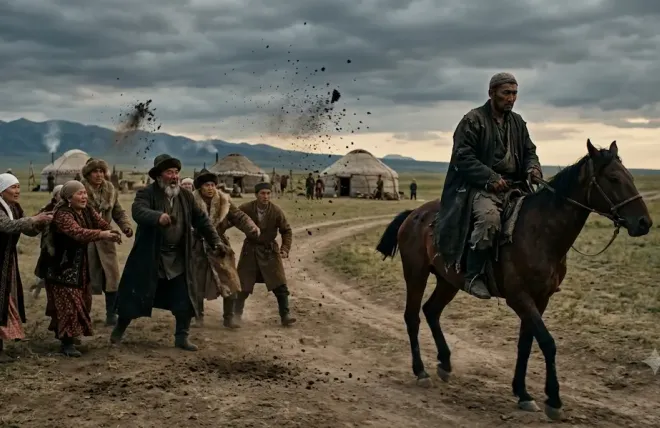
Rules of Arbitration: During these public trials, eloquent orators from both sides demonstrated their mastery of rhetoric to argue their case. When a speaker wished to claim the floor, they forcefully threw their riding whip (Kamshy) into the center of the circle. The trial was presided over by a Chief Judge (Tobe Biy), whose ultimate goal was reconciliation. Once the Tobe Biy and the assembly of elders delivered their final verdict, the ruling was absolute and could not be appealed. To fund the legal system, one-tenth of the recovered fine was paid to the Tobe Biy, while the remainder was paid in livestock to the victims.
Kek Alu: Blood Feuds and Restorative Compensation
Historically, intense border friction and livestock raids often boiled over into lethal violence. When a member of a clan was killed, the principle of Kek Alu (Vengeance) was triggered, launching retaliatory attacks under the philosophy of "blood for blood, a life for a life." Seeking vengeance was historically viewed as a mark of bravery; failing to do so branded a family as cowards. This cycle of endless violence was fundamentally broken by the legendary statesman Kazybek Biy of the Middle Juz. He systematically dismantled the old law of blood retaliation and replaced it with a brilliant economic framework called Kun (Restitution/Blood Money), establishing a peaceful judicial solution to homicide.
Kun: The Blood Money Restitution Scale
When a tribal brawl or border conflict resulted in the loss of human life, the legal system relied on Kun (Restitution) to prevent endless cycles of blood vengeance. The criminal's clan and the victim's family argued their case before a council of elders. If the victim's family agreed to settle for financial restitution rather than physical execution, the legendary legal code of Tauke Khan (Zheti Zhargy) imposed a standardized scale:
- The Price of a Free Man: 100 fine horses, 50 prime camels, or 1,000 sheep.
- The Price of a Woman: Exactly half of a man's restitution value.
- Miscarriage Liabilities: If an assault caused a woman to miscarry, the offender paid a mandatory fine of 1 horse and 1 camel.
- Physical Injury: Splitting or breaking a person’s thumb during a fight carried a fixed fine of 100 sheep.
- Domestic Homicide: If a wife murdered her husband, she was sentenced to death, and she could only escape execution if the late husband's immediate family granted her an absolute, unconditional pardon.
Salt: The Ancestral Legal Framework & Unwritten Law
For the Kazakh people, centuries-old customs and traditions (Salt) are not merely casual lifestyle choices; they function as an unwritten common law. Neglecting or violating these societal protocols carries severe social consequences and community condemnation. Foundational practices like hosting weddings (Toi), cooking the ceremonial Nauryz Kozhe, offering hospitality (Konakasy), scattering treats (Shashu), and welcoming newcomers (Erulik) are living legacies passed down through generations. These rich traditions serve as the cornerstone of youth education, moral discipline, and communal unity.
Saugha: High-Level Clemency and Ransom
When a criminal was sentenced to execution or another severe legal penalty, influential community leaders or respected elders could step forward and request Saugha (clemency) from the victim's family or the judges (Biys). If the request was granted, the mediator would arrange to pay Kun (blood money) on behalf of the offender. Saugha served as a vital diplomatic mechanism to de-escalate tensions, encourage reconciliation, and spare human lives through financial restitution.
Zhaza: The Penal Code of the Plains
Following a formal trial by the council of judges (Biys), a criminal received a specific, targeted sentence (Zhaza). Beyond public floggings (Dure) and the procession of shame, steppe law featured very specific rulings.
Historical Note: While traditional steppe law was primarily governed by customary law (Adat), certain regions and periods experienced strong Islamic legal influence (Sharia). The following rulings reflect areas where canonical Sharia principles significantly shaped or merged with local penal practices:
- Alcohol-Induced Fatalities: If a person died due to severe public intoxication, they were denied burial in the communal cemetery and had to be buried at least 100 paces away from regular graves.
- Adultery: Under the influence of Sharia regulations in regional courts, a wife caught cheating on her husband was branded a Karabet (black-faced shame); her hair was publicly shorn off, and the husband could instantly grant a formal divorce (Talaq), banishing her from the home.
- Apostasy: In regions where Islamic law strictly governed religious adherence, if a member of the tribe abandoned their faith for an outside religion, their entire property and livestock were instantly confiscated by the judges and redistributed among the community.