Kazakh Dairy Products


Traditional Kazakh Dairy Beverages
Ayran
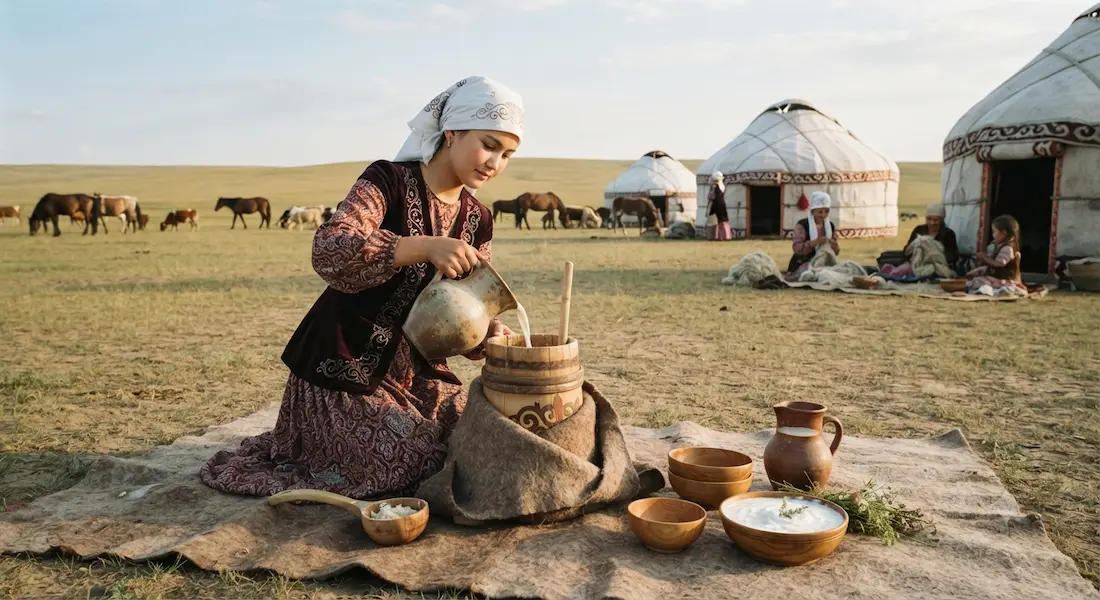
Ayran is a staple fermented milk drink in Kazakh culture. It can be prepared using either skimmed or whole milk. The process begins by boiling the milk for 5–10 minutes, then allowing it to cool until it reaches a lukewarm temperature. A starter culture is stirred in, and the vessel is wrapped securely to maintain warmth. The milk typically ferments within one to two hours. To prevent it from becoming overly sour, the finished Ayran should be uncovered and moved to a cool environment. It is consumed both as a refreshing beverage and as a key component in various meals.
Katyk
Katyk is a dense, nutritious fermented drink made from the unskimmed milk of cows, sheep, or goats. It can also be prepared from previously boiled milk. To create it, a starter is added to warm milk, and the container is covered and left in a dark, warm place for two to three hours. If prepared from whole milk, a thick layer of natural cream forms on top, while raw, unskimmed milk results in a rich, velvety layer of heavy cream. Katyk made from exceptionally high-fat milk produces the thickest layers of cream. It can be consumed directly or strained through a canvas bag to extract the whey, creating a curd known as Suzbe. This Suzbe can be salted to produce Kurt or stored in animal skins for later use. Adding Katyk or Suzbe to soups and porridges significantly enriches their flavor.
Qoyyrtpaq
Qoyyrtpaq is a hearty, sustaining drink made by combining Katyk, Ayran, or other fermented milk products with fresh milk. Historically, travelers carried this mixture in leather pouches (torsyk) tied to their saddles. The constant motion of the horse naturally churned the liquid during their journey; this consistent mixing ensured the drink remained perfectly blended, masking any sharpness from fermentation and keeping it refreshing to drink.
Shalap
Shalap is a vital, thirst-quenching beverage, particularly during the hot summer months. To prepare it, Ayran or Shubat is poured into a large vessel and diluted with water—ideally crisp, cold, and clear water from a spring or well. A typical ratio is one liter of water for every liter of fermented milk. The mixture is stirred thoroughly with a spoon. If the base Ayran or Shubat is particularly tart, the amount of added water can be adjusted to balance the acidity to one's preference.
Shubat
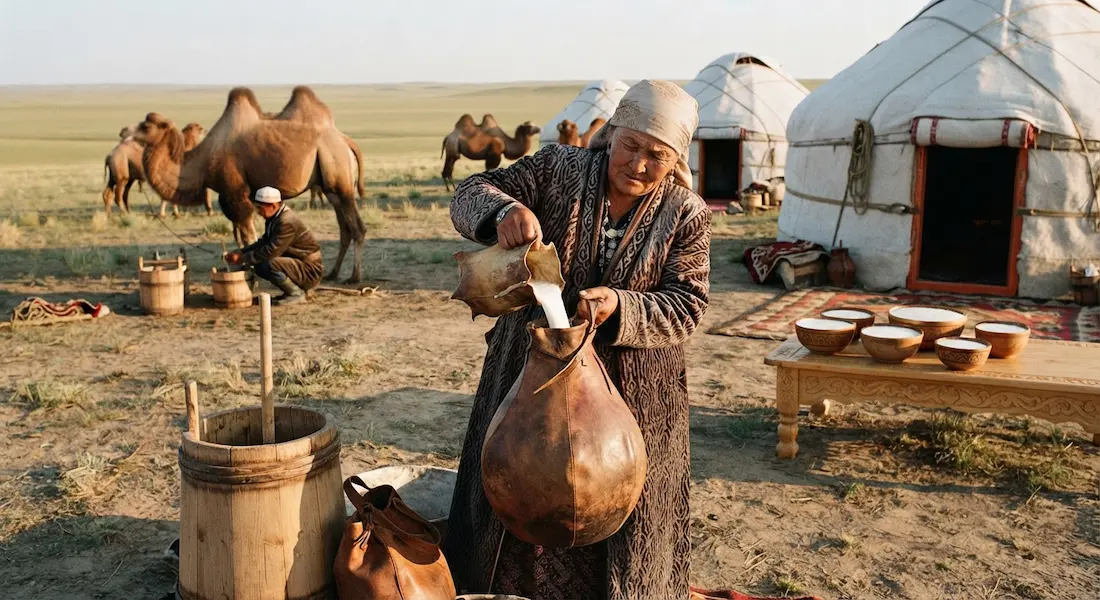
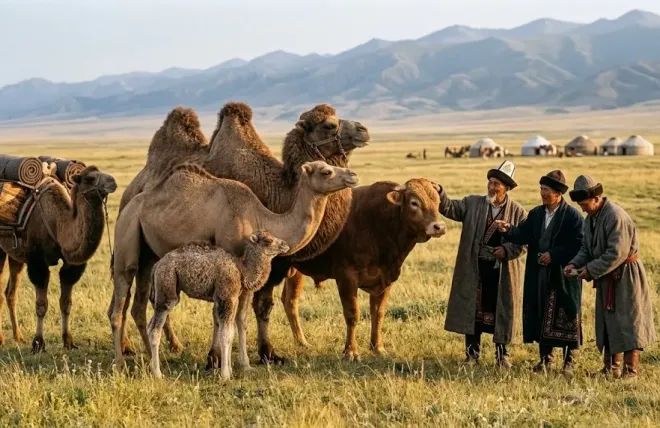
Shubat is fermented camel’s milk, serving as both a nourishing food and a therapeutic drink. It is significantly fattier than mare’s milk and possesses recognized healing properties. The technology for fermenting Shubat is simpler than that of Qymyz; once an initial batch is successfully fermented, subsequent batches will ferment naturally without the need for additional starters. Unlike Qymyz, it does not require constant, rhythmic churning. A quick shake just before serving is sufficient to blend the consistency and reduce excess foam. It is essential to periodically release the gas from the storage vessel, or the pressure can cause the container to expand and even burst its stopper.
Qymyz (Fermented Mare’s Milk)
Qymyz is an iconic Kazakh beverage, widely celebrated for its health-giving properties and immense nutritional value. It is perhaps the most esteemed delicacy offered to guests in a traditional home. Its preparation is an art form, typically carried out in a saba (a leather vessel made from horse hide, often smoked over juniper wood for a distinct aroma) or a wooden vat called a kubi.
The fermentation starter, known as qor, is tied in cheesecloth and placed into the vessel with fresh, cold saumal (freshly milked mare’s milk). The container is then wrapped in warm fabrics to encourage fermentation. As the qor dissolves and integrates with the milk, the liquid begins to sour. This mixture acts as a new starter for future batches. Fresh, cooled saumal is added to this base; after each addition, the mixture must be churned with a wooden dasher (pispek) for about 30 minutes to ensure a uniform consistency. To enhance the richness, some add a piece of cured fat or smoked horse meat (qazy or zhaya) to the vat, which mellows the acidity and adds a fatty, savory depth. Natural fats from the milk often rise to the surface as a dark, oily sheen.
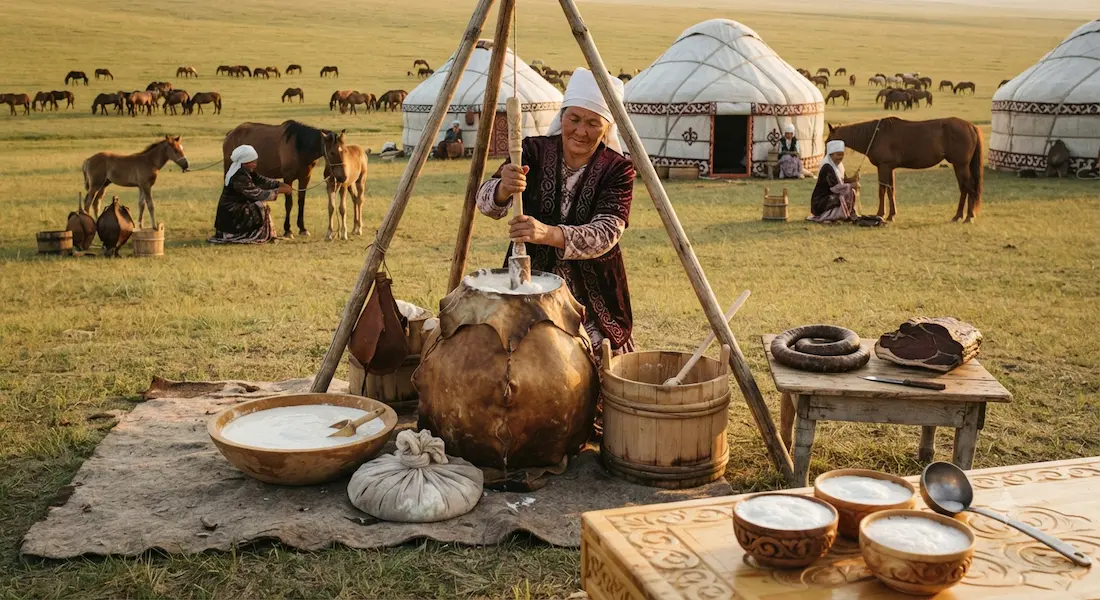
Fermented in the evening, the Qymyz is kept wrapped and warm, then collected only after the next morning’s milking is finished. To maintain quality, the saba or kubi must be cleaned and dried at least once a week and smoked periodically to prevent mold, which would otherwise impart an unpleasant "old" taste to the drink. As Qymyz is consumed, fresh saumal is added to the remaining qor at the bottom of the vat, a process that continues until the end of the milking season.
There are many varieties of Qymyz defined by the skill of the maker, the origin of the milk, and the season:
- Uyz Qymyz: The first batch of the season, often celebrated with a feast.
- Bal Qymyz: A mellow, refined Qymyz infused with animal fat; it is notably yellower and thicker than standard versions.
- Besti/Donen/Qunan Qymyz: Named for the number of days (five, four, or three) the milk has been fermenting; these are stronger and more acidic than a simple overnight brew.
- Zhuas Qymyz: A milder version softened by adding fresh saumal, making it easier to drink for those who prefer less acidity.
- Qysyraq Qymyz (Tu Qymyz): Made from the milk of a mare that has foaled for the first time; this is considered particularly potent and nourishing.
- Qysyr Qymyz: Produced during the winter from barren mares kept and fed in the stables.
- Sary Qymyz: A thick, golden-yellow batch made when summer pastures are at their most lush.
- Sirge Zhiyar: The final batch of the season, marked by a ceremonial gathering before the mares are released.
- Tuneme Qymyz: Created by adding fresh saumal to aged Qymyz and letting it ferment for another full day.
Qoryqtyq (Stone-Boiled Milk)
Qoryqtyq is a unique field dish historically prepared by shepherds while out with their flocks. To make it, they milk a sheep directly into a wooden bowl or ladle. They then take river stones, heat them in a fire until they are scorching hot, and drop them one by one into the milk. The intense heat from the rocks brings the raw milk to a boil, cooking it thoroughly in just two to three minutes.
Balkaimak
Balkaimak is a decadent, honey-infused cream treat. To prepare it, raw heavy cream is poured into a deep pan and simmered over a very low flame. As it cooks, it must be stirred continuously until the butterfat begins to separate. Once it reaches a full boil, honey, granulated sugar, and a small amount of wheat flour are whisked in. The mixture is then cooked for an additional 8–10 minutes. When ready, the finished product is transferred to a bowl and served—most commonly as a rich accompaniment to tea. A standard batch requires one cup of cream, two teaspoons of honey (or a tablespoon of sugar), and a teaspoon of flour.
Kilegei (Fresh Cream)
Kilegei refers to the rich, yellow layer of cream that naturally accumulates on top of fresh, raw cow's milk. After milking, the warm liquid is poured into a wide vessel and placed in a cool environment. As it settles, the fat rises to the top, forming a distinct, golden-hued, flakey layer. This is carefully skimmed off with a spoon. Because it beautifully enhances the color and flavor of tea, it is a favorite dairy addition. Kilegei is also highly versatile; it is often served mixed with tary (millet), talkan (roasted grain flour), toasted wheat, or pieces of both white and red artisanal cheese.
Kaimak
Kaimak is the fatty, nutrient-dense layer that forms on the surface of boiled milk. The thickness of this layer depends on the richness of the milk and the care taken during the boiling process. Because sheep's milk is naturally thicker than cow's or goat's milk, it yields a more substantial kaimak. To achieve the best results, the milk should be brought to a gentle simmer rather than a rolling boil. Once it has completely cooled, the cream is skimmed off and stored in wooden, birch bark, or seasoned metal containers with tight-fitting lids. Properly prepared kaimak is soft and creamy; however, if the milk is boiled too vigorously, the cream becomes stringy and loses its delicate flavor. It is a wonderful addition to tea and pairs excellently with millet or wheat.
Kurt (Dried Cheese)
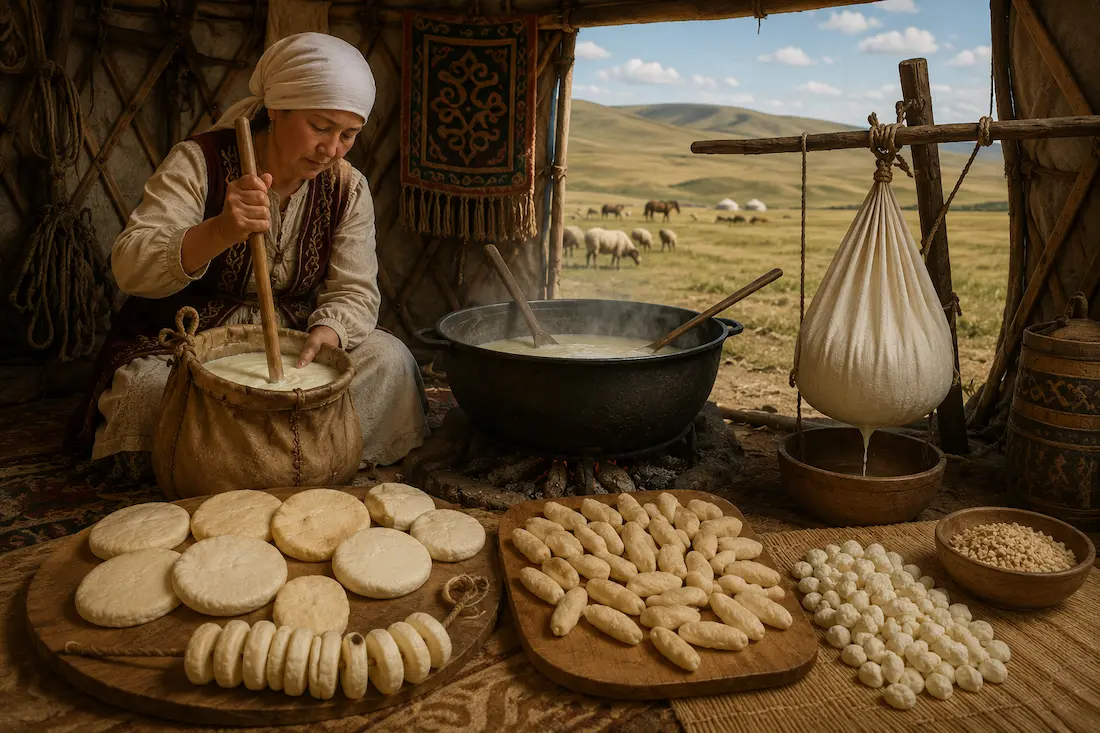
Kurt is a long-lasting, nutrient-dense food designed for long-term storage. It is made by gathering soured milk in a leather bag (saba) and churning it until it turns into irkit (buttermilk) and butterfat separates. The butter is skimmed off, salted, and stored, while the irkit is boiled in a cauldron until all the moisture evaporates. During this reduction, the bottom and sides of the pot must be scraped to ensure even cooking. Once the mixture is sufficiently thick, it is transferred to a cloth bag and hung from a frame to drain away the remaining whey.
After 24 hours, once it is completely dry, the kurt is removed, hand-shaped, and laid out to air-dry on a mat or board. There are several traditional forms:
- Kulshe: Large, flattened rounds shaped between the thumb and four fingers, designed for long-term storage. These are sometimes threaded onto a string like beads and hung to dry, though they must be thoroughly desiccated to prevent molding.
- Syqpa: Small, oblong pieces shaped by squeezing the mass through one's fingers.
- Shuyirmek: Even smaller morsels, about half the size of a syqpa, which dry very quickly.
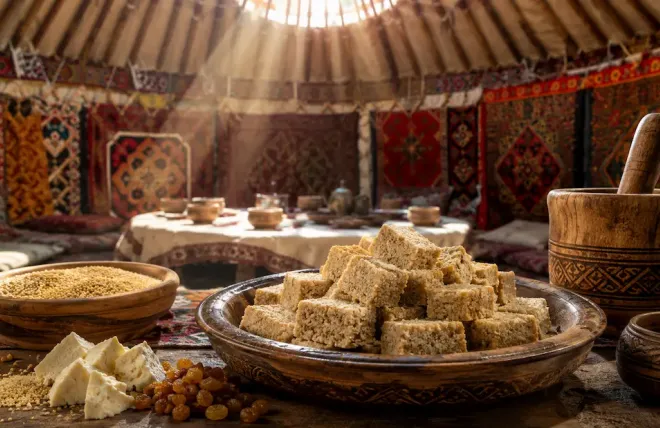
Depending on the season, kurt can be categorized as "White Kurt" (made from well-strained, low-fat buttermilk, eaten in summer and autumn) or "Black Kurt" (made from richer, more fermented buttermilk, often used in winter to create hearty soups). The granular leftovers from grinding dried kurt are known as malta. This dried cheese is incredibly potent and satisfying; it can be rehydrated in hot water or broth to create a nutritious drink or added directly to traditional grain porridges. Suzbe-Kurt is a specific variant produced by further drying the curdled Suzbe after the whey has been fully extracted.
Here is a detailed and natural English translation of these traditional Kazakh dairy staples.
Traditional Kazakh Dairy Essentials
Sary Mai (Yellow Butter)
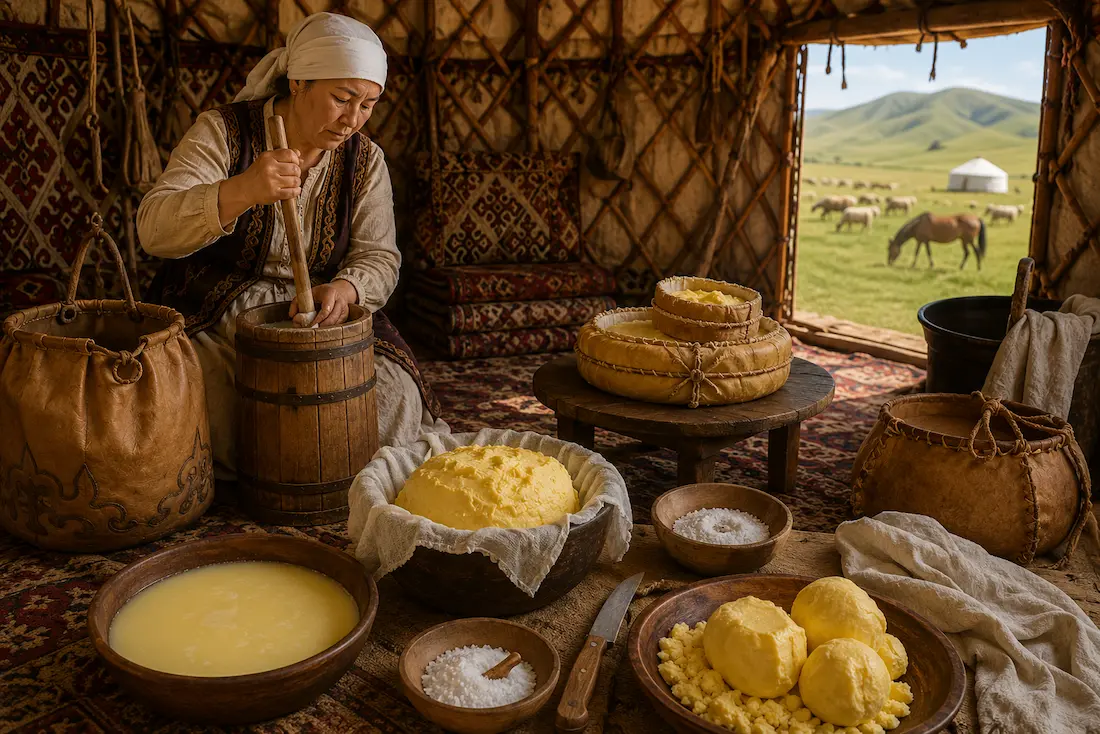
Sary Mai is produced from the milk of cows, sheep, or goats. Historically, it was crafted in leather vessels (saba or torsyk) or wooden churns (kubi). The process involves collecting soured milk, Ayran, Katyk, or raw milk in the churn and agitating it until the fat naturally separates from the buttermilk (irkit). Once separation is complete, the butter is strained through several layers of cheesecloth and squeezed by hand. Traditionally, any remaining hair or impurities were removed with a knife. The butter is then washed in cold water to remove residual buttermilk and cooled. After that, it is placed in a shallow dish, kneaded, and patted with palms to expel excess moisture. Finally, it is salted and packed for storage, typically in animal stomachs (qaryn) or intestines. These are named based on the source; for instance, Atan Qaryn Mai uses the stomach of a mature male sheep or goat, while Qozy Qaryn Mai utilizes that of a lamb or kid. Modern methods often involve churning cream separated by a mechanical separator, though this prevents the production of Kurt, as the resulting milk is no longer suitable for further fermentation. Those who prefer unsalted butter often clarify it by boiling; the salt rises to the surface as foam, which is skimmed off, leaving behind a pure, golden fat known as tortasynan ayyrgan mai.
Suzbe (Strained Curd)
Suzbe is a versatile curd made from either Ayran or boiled buttermilk (irkit). The preparation is simple: the fermented base is poured into a canvas bag and hung up to drain. As the whey drips away, a thick, creamy curd remains. This product is often salted, stored in animal skins, and dried. It serves as a flexible ingredient that can be diluted into soups, added to porridges, or mixed with water and milk to create a refreshing drink called Shalap.
Uyz (Colostrum)
Uyz is the thick, nutrient-rich milk produced immediately after an animal gives birth. It is categorized into "yellow" and "white" types: the former is dense and sticky, while the latter is lighter in color and more fluid. The yellow variety is traditionally reserved for the newborn offspring, while the white variety is harvested for culinary use.
- Pressed Colostrum (Qatyrgan Uyz): The milk is poured into an intestine or a metal container and submerged in boiling water. As it heats, it sets into a firm, cartilage-like texture resembling a hard-boiled egg. It is then removed and cooled. Sliced and served alongside smoked meats, it is a traditional celebratory dish prepared for neighbors when a new animal is born.
- Simmered Colostrum (Pisirilgen Uyz): Here, the Uyz is thinned with regular milk and gently simmered. To ensure a smooth consistency and prevent it from curdling, it must be stirred continuously with a ladle. Millet is often added to this mixture to enhance the dish.
Irkit (Buttermilk)
Irkit is the liquid byproduct remaining after butter has been churned from soured milk. The flavor of irkit depends heavily on both the type of milk used and the storage environment. If stored in direct sunlight, it ferments quickly and becomes quite tart; if kept in the shade, it retains a mild, fresh taste. This substance is the primary foundation for boiling down traditional Kurt.
Irimshik (Artisanal Cheese)
Irimshik is a cooked cheese specialty that comes in two main varieties:
- Aq Irimshik (White Cheese): This is prepared by adding a splash of Ayran to raw milk to curdle it, then bringing the mixture to a boil. Once the yellow whey separates, the solids are strained through a mat. Aq Irimshik is delicious on its own, especially when enriched with fresh butter, Kaimak, or Kilegei. If dried and crushed in a mortar, it becomes a fine, millet-like powder that can be eaten with tea or mixed with other dairy fats.
- Qyzyl Irimshik (Red Cheese)
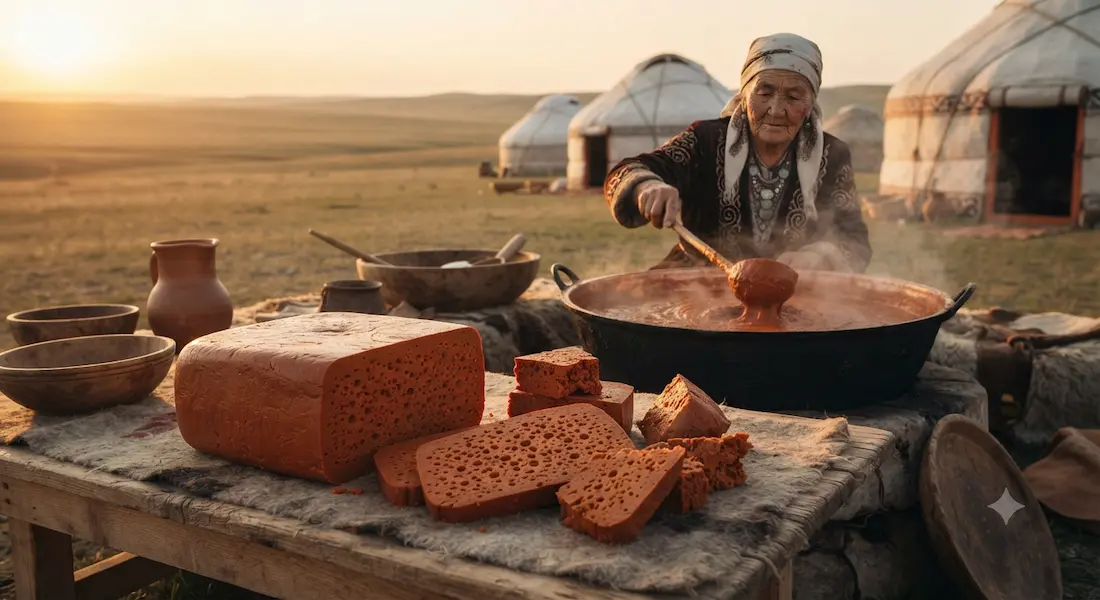
This is a prized delicacy. To make it, the maker adds a starter—traditionally a specialized curd from a lamb’s stomach—to warm milk. After sitting for 30 minutes, the curdled milk is boiled. As it cooks, the curd is sliced into cubes with a special wooden knife called a qylysh. The cheese slowly darkens, eventually turning a deep, rich red as the whey caramelizes. Once the liquid thickens and the color deepens, it is cooled, strained, and air-dried. It has a unique, sweet, and nutty flavor. It is often served alone, mixed with cream, or incorporated into zhent (a traditional sweet). If the curdling agent is replaced by Ayran or irkit, the resulting cheese tends to be darker and less appealing in texture.