Shi Weaving in Kazakh Culture


Shi orau is the traditional Kazakh craft of wrapping shi (steppe reed) with colored wool and weaving the wrapped stalks into intricately patterned mats. One of the distinctive forms of Kazakh decorative and applied art, this craft has been practiced for centuries and was closely connected with the practical needs and aesthetic traditions of nomadic life.
The Art of Shi Weaving
One of the most distinctive forms of Kazakh ornamental artistry is the practice of wrapping reed stalks, known as shi, with dyed wool to create intricately patterned mats. Like many other traditional crafts, shi weaving developed over centuries and became an important part of everyday nomadic life.
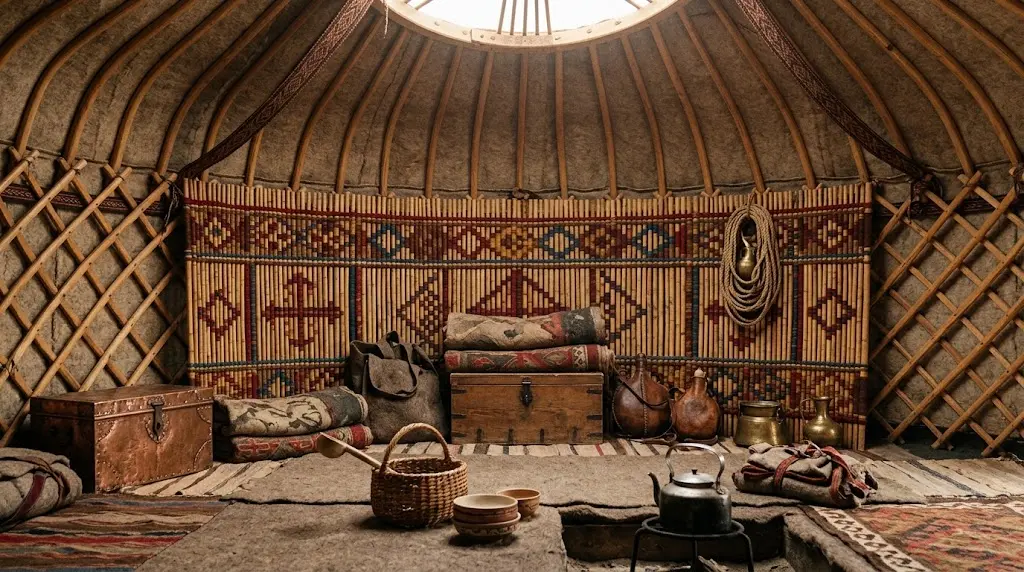
These decorative reed screens, especially shym shi, were used in and around the yurt. They could be placed around the kerege (the lattice wall of the yurt), helping separate the living area from spaces used for storing food, dishes, and household items. They also provided protection from wind and dust. Because the mats were lightweight and could be rolled up, they were well suited to a mobile way of life in which households regularly dismantled and transported their yurts.
Shi was valued not only for its decorative qualities but also for its practicality. Compared with many other traditional crafts, it required relatively simple and readily available materials, yet the finished mats were durable and versatile.
Inside a yurt, reed mats complemented the wooden lattice, colorful kur bands, and other woven and felt decorations. Their natural texture also added visual contrast to the brightly patterned textiles and felt coverings that characterized the traditional nomadic interior.
The combination of lightness, durability, and portability made shi particularly well suited to pastoral life. Reed mats could be moved easily whenever a household relocated, while serving a wide range of practical and decorative purposes.
Kanat Shiler: Decorative Reed Screens
In traditional Kazakh craft, reed products were classified into three main types according to how they were prepared and decorated: ak shi (plain, unwrapped reed), orauly shi (partially wrapped reed), and shym shi (reed wrapped throughout with patterned wool).
Craftswomen and artisans referred to patterned reed screens as kanat shiler. Each type had its own practical function within the nomadic household.
- Ak shi: The reed was left unwrapped and was used mainly for practical purposes. It was used in felt-making, for drying dairy products such as kurt and irimshik, as a strainer, and for placing beneath meat during butchering. It could also be used in the construction and covering of parts of the yurt.
- Shym shi: The entire length of the reed was wrapped with colorful wool, often arranged into decorative patterns. These mats served as interior screens in the yurt, particularly around areas used for food preparation and the storage of dishes and other household items. In some contexts, they could also function as decorative wall coverings.
- Orauly shi: Only selected sections of the reeds were wrapped, creating patterns at intervals rather than covering the entire length. This type combined practical construction with decorative elements.
This classification is an important reminder that Kazakh reed weaving was not simply decorative. Different forms of shi were adapted to different needs within the household.
Community Crafting and Harvesting
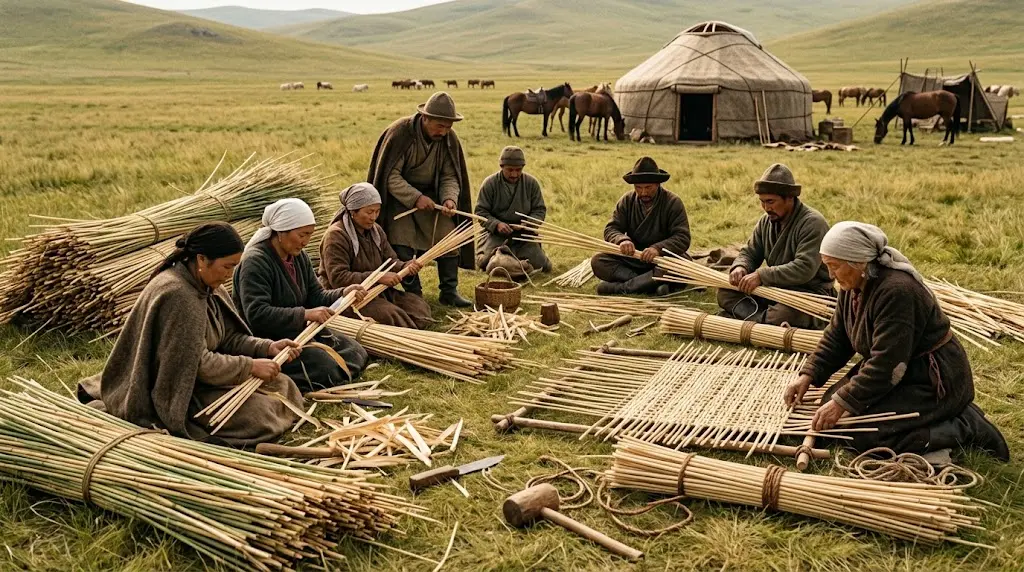
The preparation of shi involved several stages, including gathering the reeds, removing their outer covering, preparing and drying them, wrapping individual stalks, and finally weaving them together.
Reed harvesting could be a communal activity, bringing people together for seasonal work. Such gatherings were accompanied by music, singing, and social interaction. The tradition of collective craftwork reflects a broader feature of Kazakh nomadic culture: many labor-intensive household activities were carried out cooperatively and could also become occasions for cultural exchange and celebration.
The reeds were traditionally gathered during the summer from areas where suitable stalks grew. After harvesting, the outer covering was removed and the reeds were bundled and dried before the decorative work began.
Wrapping and Weaving Techniques
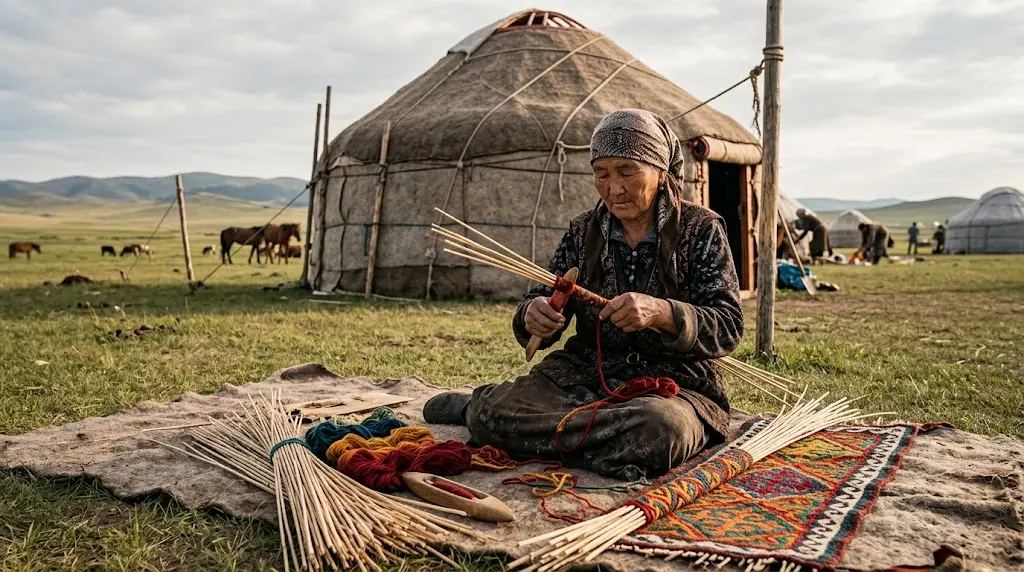
There were two main approaches to preparing a patterned shi mat.
Replication: The artisan followed the design of an existing finished mat.
Original design: The reeds were measured and arranged according to a newly prepared pattern.
Each individual stalk had to be counted and placed in the correct order. Once the reeds had been wrapped with colored wool, they were lightly secured to their neighboring stalks with fine wool thread. This helped preserve the sequence of the reeds before and during the final weaving stage.
The artisans also alternated the thicker and thinner ends of the reeds when arranging them. This helped keep the finished mat even, balanced, and easier to roll and transport.
The weaving itself was carried out on a simple horizontal setup using a sturdy rod known as the arkalyk. The yarn was twisted into two-ply strands and wound into weighted balls so that the necessary tension could be maintained. The weaver passed the threads over the rod and alternated the balls, crossing the strands as each reed was inserted. In this way, the individual stalks were gradually joined into a firm and durable mat.
Particular attention was given to the two ends of the mat. Three reeds were layered together and secured with a sparse cross-hatching pattern. Artisans called this design shybyn kanat (fly wing), referring to its delicate, wing-like appearance.
The reinforced end section was known as the karakus. It provided a strong base for attaching ties and allowed the finished screen to be securely fastened to the yurt or another structure.
Utility and Products
The uses of shi extended far beyond decorative screens. Reed mats and structures were also used in everyday agricultural and domestic life, including animal shelters, snow fences, food preparation areas, storage, and various household mats.
The material was especially valuable in a nomadic environment because reeds were locally available, relatively inexpensive to prepare, lightweight, and easy to transport. A single material could therefore be adapted to many different purposes.
Traditional items made from shi included:
- Asha shi: Decorative floor mats.
- As shii: Partitions used around food preparation areas.
- Ayaq kap: Protective cases for storing bowls and dishes.
- Eshik: Reed coverings for doors.
- Kilem shi: Decorative wall mats.
- Kiyiz basatyn shi: Specialized mats used during the felt-making process.
- Kurke: Portable reed shelters or temporary tents.
- Kazan japkysh: Covers for large cooking pots.
- Masaqana: Protective enclosures designed to keep mosquitoes away.
- Terize japkysh: Protective coverings or shutters for windows.
- Etkana: Sheltered enclosures used for storing meat.
- Zholym: Portable reed mats used during travel.
- Shi kora: Reed-walled enclosures for livestock.
- Shi kalpak: Protective covers made from reeds.
- Shyny kap: Specialized containers for glassware.
More Than a Decorative Craft
The history of shi orau shows how closely beauty and practicality were connected in traditional Kazakh material culture. A simple reed could become a patterned interior screen, a food-processing surface, a protective covering, a portable household item, or part of a livestock enclosure.
For nomadic communities, such versatility was essential. Objects had to withstand everyday use, serve more than one purpose when possible, and remain practical to transport during seasonal migrations.
Shi weaving therefore represents much more than a decorative technique. It is an example of how Kazakh artisans transformed locally available natural materials into durable, functional, and visually sophisticated objects that fitted the demands of nomadic life.