Traditional Kazakh Felt and Wool Crafting


For millennia, the fleece of the "four livestock" (tört tülik — horses, camels, cattle, and sheep) has been fundamental to Kazakh existence, with ancient methods developed for its sophisticated utilization. In the traditional pastoral economy, the most highly valued materials were sheep's wool, camel hair (including the soft down and coarse fibers), and goat cashmere. Horsehair, harvested from manes and tails, also played an essential role.
Types of Wool and Their Practical Uses
Camel Hair
Camel hair is exceptionally versatile. Artisans spin it into robust yarn for weaving shekpen (traditional woven cloaks), storage sacks, belts, decorative cords, carpets, and saddlebags. It is ideal for braiding sturdy tack—such as girths, breastplates, and halters—as well as ropes. Because it is lightweight, warm, and remarkably durable without shedding, it is a prized filler for blankets and robes.
The coarser hair found on a camel’s neck, knees, and humps is known as shuda (coarse camel hair). This fiber was once vital for crafting the durable threads—historically called sherter or keruish—used to sew heavy-duty leather items like saba (large leather skins for fermented mare's milk) and torsyk (portable leather flasks), as well as various household vessels.
Sheep's Wool
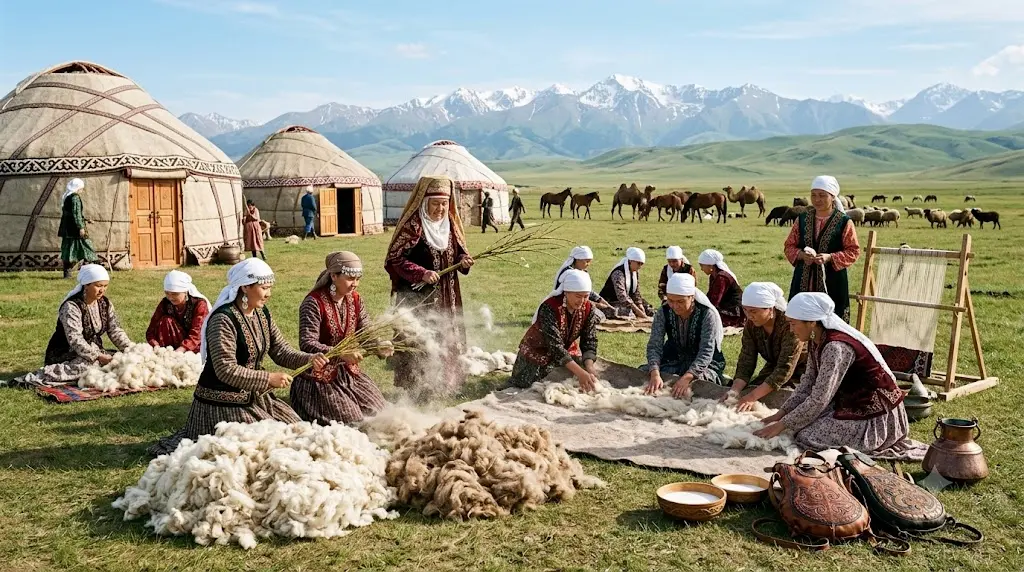
Sheep's wool is classified into five distinct categories:
- Zhabagy (coarse autumn fleece)
- Kuzem (shorn autumn wool)
- Kozy (lamb fleece)
- Oli zhun (dead or shed wool)
- Shet-pushpak (wool scraps)
Zhabagy is used for heavy outerwear like shidem (padded wool robes) and kupi (warm winter coats), as well as felt underlays and cushions. To prepare it, the fleece is teased and boiled to remove natural fats and ensure the coarse fibers do not protrude through fabric linings. It is also the primary material for spinning, knitting, and creating structural threads.
Kuzem and kozy (lamb wool) are primarily used for wet-felting, producing items such as tekemet (large patterned felt mats), syrmaq (appliqué felt carpets), traditional pointed hats, kebenek (felt rain cloaks), and pima (felt boots). Unlike the coarser autumn fleece, these varieties are unsuitable for spinning or padding quilts.
Oli zhun is the hair gathered after slaughter or shed naturally, including matted tufts found on the animal’s underbelly. Shet-pushpak consists of stray, fragmented fibers collected from bushes or around the corral. Both are typically repurposed for braiding ropes.
Goat Wool and Horsehair
Goat wool is divided into fine tubit (cashmere down) and coarser guard hairs. The down, harvested during the molting season, is prized for its extreme softness and warmth, often considered as precious as silk, and is spun for lightweight scarves, stockings, and mittens. The stiffer outer coat is utilized for heavy rope-making.
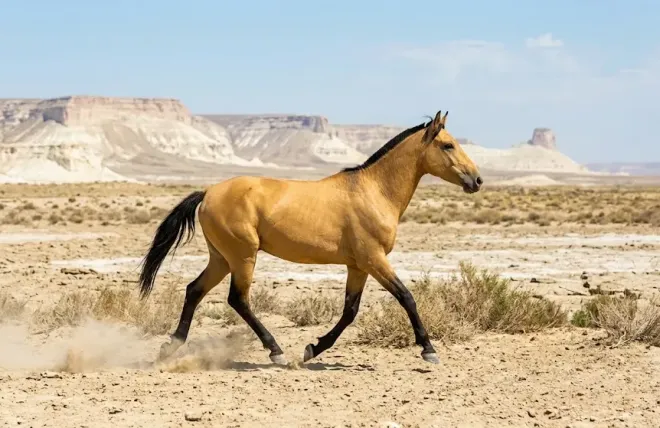
Horsehair (from the mane and tail) is remarkably strong. It serves for weaving heavy ropes, traps, and strainers, or as a decorative and structural component for musical instruments like the kobyz (ancient two-stringed bowed instrument). It is also used to reinforce leather cushions and pillows.
Beyond livestock, Kazakh craftsmen utilized rabbit fur for warm accessories like scarves and socks, while bird down was used to fill pillows and bedding. Feathers carried symbolic weight; a feather attached to a messenger’s letter signaled "extreme urgency," a system known as "feathered post."
The Sacred Eagle Owl
The Eagle Owl (Uki) holds a special, sacred place in Kazakh culture as a symbol of beauty and auspiciousness. Traditionally, feathers from this bird were worn by shamans, poets, and warriors. The custom of pinning feathers to the curtains of a new bridal yurt, or onto the attire of a bride and groom, remains a poignant ritual. So highly was this bird regarded that a single owl was once valued as equal to the cost of a horse.
Feathers are categorized as ulpa (fluffy down from the legs) or kara kaska (darker chest feathers). While men traditionally wore the latter, women favored the soft ulpa for adorning their saukele (high ceremonial bridal headdress) and skullcaps.
Finally, the processes of cleaning wool, felting mats, and embroidery served as vital social events. These communal labor sessions were often accompanied by feasting, singing, and games, turning necessary domestic work into vibrant celebrations that strengthened the bonds of the youth and the community.
The Crafting of the Syrmaq
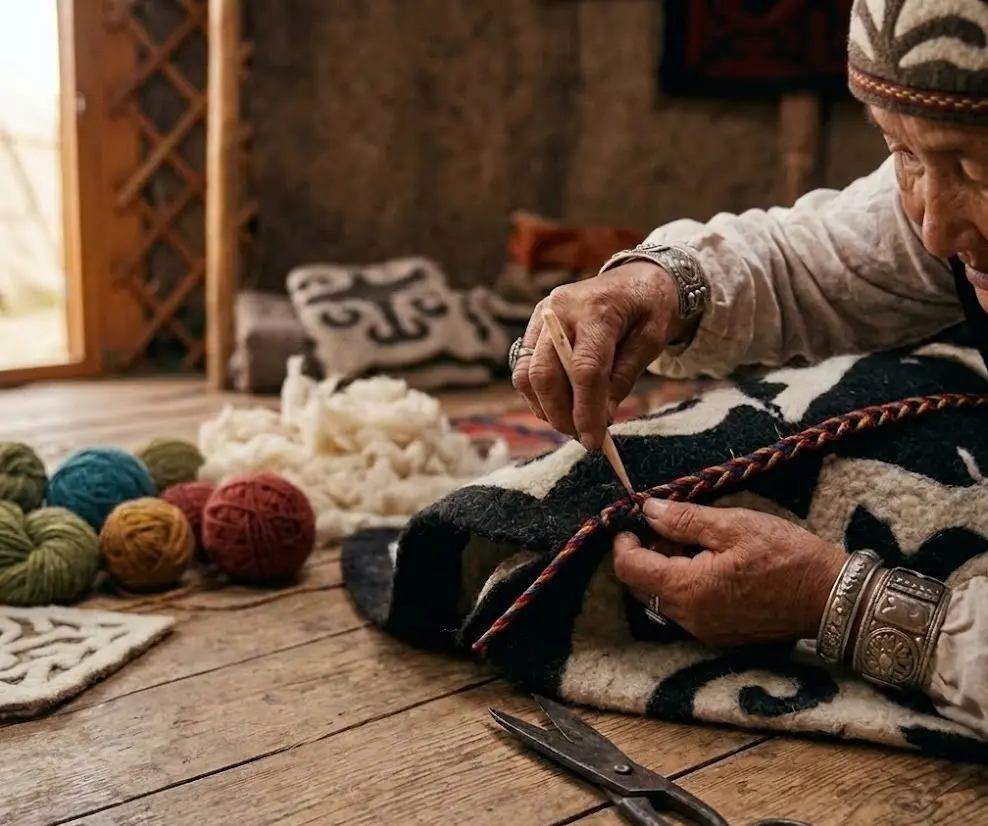
For a syrmaq (a traditional felt floor mat adorned with intricate patterns) to be of high quality, the felt must be uniform, either pure white or solid black. The raw material must be free of impurities, thorns, or holes, as such flaws hinder the precision required for pattern-cutting, quilting, and edge-binding. Consequently, master artisans select the finest wool—often from lambs—well in advance, ensuring it is meticulously beaten until it reaches an airy, fluffy texture.
The surface of the syrmaq is created by felting this selected wool; for economy and refinement, the top layer is kept relatively thin and tailored to the intended dimensions and design. Once the felt is prepared, the mat is backed with either additional felt or heavy canvas before being quilted to provide structure and durability.
Classifications by Size
Kazakh syrmaqs are generally categorized into four primary sizes:
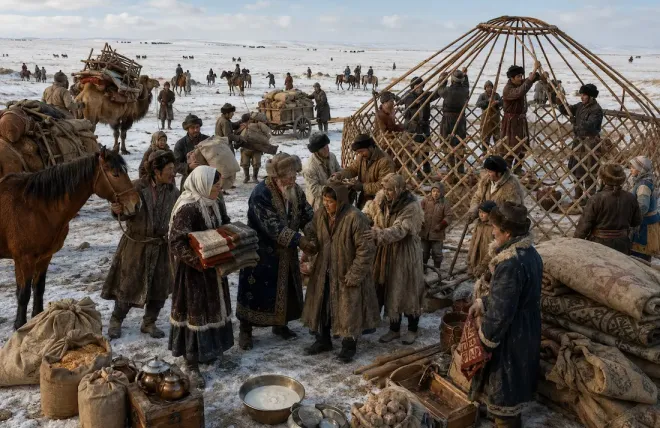
- Kosh Syrmaq (Nomadic Migration Mat): The largest variety, spanning three to five meters. It is specifically designed to cover the cargo loaded onto camels during seasonal migrations.
- Tosenish Syrmaq (Floor Mat): Measuring between three and three-and-a-half meters, these are often shaped to fit the architecture of a yurt—rounded at the fire side to narrow towards the entrance, and flared at the back to fit the honorary tor (place of honor in a yurt) area. They are commonly laid in permanent dwellings, smaller huts, or the back section of a nomadic tent.
- Tor Syrmaq (Honorary Mat): Ranging from two to five meters, these are exquisitely bordered and ornamental. They are reserved for esteemed guests, placed over the main floor felt and beneath the guest bedding to signify deep respect.
- Tosek Syrmaq (Bedside Mat): Roughly two to two-and-a-half meters long, these are placed either directly under or immediately in front of a sleeping area. Smaller versions, known as "single-person mats," measuring just one to one-and-a-half meters, are also common.
Stylistic Variations
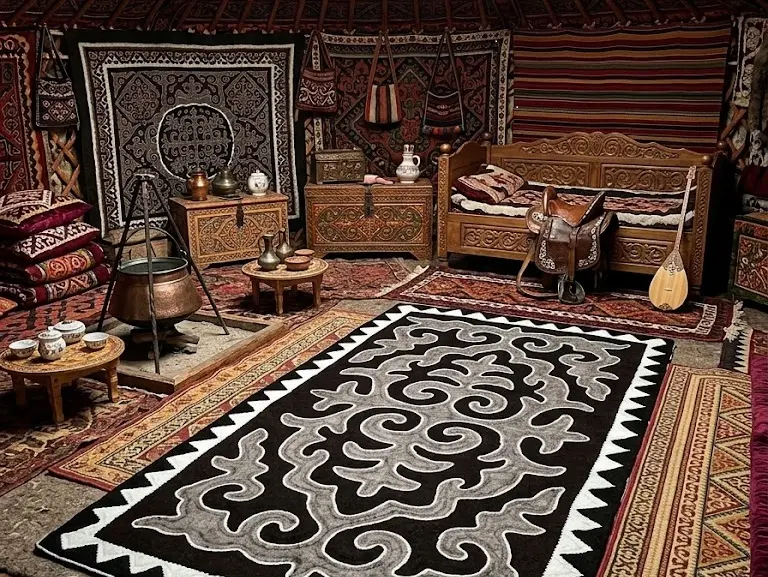
There are four distinct styles of syrmaq, defined by their decorative approach:
- Ak Syrmaq (White Mat): This style is devoid of colorful appliqué or fabric inserts. Its aesthetic beauty relies entirely on delicate border-trimming, featuring either finely braided wool cords or complex, zigzag-patterned monochrome binding.
- Karala Syrmaq (Contrasting Pattern Mat): Crafted by interlocking cutouts of black and white felt, this version is meticulously backed and quilted. The seams where the patterns meet are hidden beneath vibrant, decorative piping. Historically, this was a luxury item used for receiving honorable visitors or protecting travel luggage.
- Zhiekti Syrmaq (Bordered Mat): Made from a solid white or black base, this style features multiple layers of colorful piping and borders to create patterns. These were practical, heavy-duty mats used for securing loads during transport and for general domestic functions.
- Debiske Syrmaq (Appliqué Mat): This style involves sewing diverse fabric cutouts directly onto a whole felt base, with fine piping framing the edges of each motif. Occasionally, the entire mat is encased in intricately embroidered fabric, creating a rich, textured surface.
Cultural Significance and Usage
In traditional Kazakh culture, domestic furnishings—much like the distribution of ritual meat portions (sybaga) —were assigned based on social status and life stages. For instance, the ak syrmaq was traditionally reserved for the maiden's quarters for a bride who had not yet been visited by a groom, or, conversely, as a seat for a grieving widow. In contrast, the debiske syrmaq was designated for newlyweds, adorning their sleeping area or serving as a decorative wall hanging in place of a standard tuskiiz (embroidered wall hanging).
The Art of Ornamenting the Syrmaq
To create a syrmaq, a master artisan first selects a design from their repertoire, carefully planning its placement to complement the dimensions of the felt while minimizing waste. The process begins by spreading the primary felt base flat on the floor. Paper or leather stencils of the chosen motifs are positioned atop the felt, and the artisan uses a razor-sharp blade or shears to cut the patterns with absolute precision.
If the main field is black, the cutout white motif is perfectly inlaid into its center, and vice versa. The pieces are then joined together using a whipstitch to form a seamless, two-toned surface. Once the decorative panel is assembled, the seams are covered with vibrant, dyed piping—a critical finishing step known as zhiekteu (decorative edging).
Quilting and Stitching
After the piping is applied, the decorative top is layered over a backing of felt or canvas and quilted. This stabilization uses two primary techniques: a simple running stitch or a double-threaded method. In the latter, the artisan feeds a second, loose thread beneath the primary needlework, creating a robust seam that mimics the appearance of a sewing machine.
The quilting follows the contours of the motifs to enhance their relief. Once secured, the edges of the mat are squared off and bound with a final, sturdy trim.
Crafting the Binding Cord
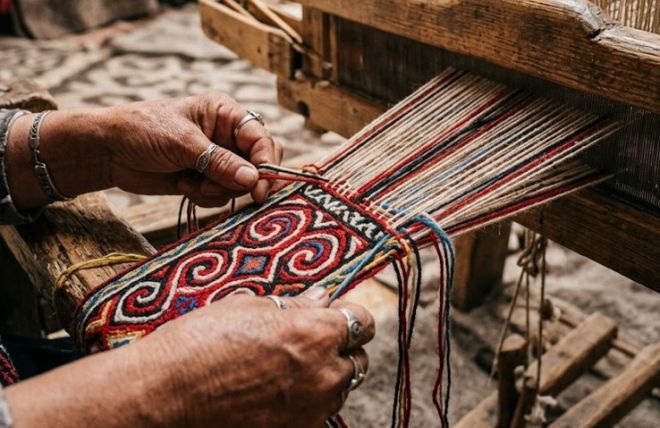
The binding yarn is spun from high-quality, fine white wool, which accepts dyes exceptionally well. Spinners estimate the required length based on the project scale using traditional units of measurement: alkym (a skein-like measure) and domalaq (a ball of yarn).
They spin two separate batches of yarn—one clockwise (right-handed) and one counter-clockwise (left-handed). These are then doubled and twisted again to create two distinct strands, known as tin (warp or structural strand).
Before dyeing, the yarn is coiled into kelepteu (hanks of yarn) to ensure even color saturation. During the boiling process, artisans add alum, ammonium chloride, salt, and a small amount of oil to set the dye and shrink the fibers, resulting in a tighter, more durable cord. The hanks are dried on a rack and rotated hourly to guarantee a uniform shade.
Once completely dry, the clockwise and counter-clockwise strands are rubbed together to refine their texture. They are then joined—without further twisting—to form a bas (master cord bundle). When this dual-strand cord is stitched onto the syrmaq, the opposing twists interlock to create a beautiful, rhythmic "palate" (tangdai) pattern.
Broader Applications of Felt Art
Beyond floor mats, Kazakh craftsmen utilize these techniques to adorn a vast array of functional items, including:
- Ayak-kap (felt covers for household vessels)
- Storage bags and chest casings
- Asmaldyq (decorative camel caparisons)
- Saddle pads and cloaks
- Headgear like taqiya (skullcaps) and felt hats
Unlike the large syrmaq, which is inlaid, these smaller objects are often decorated by appliquéing pre-cut patterns directly onto the surface of a whole piece of felt.
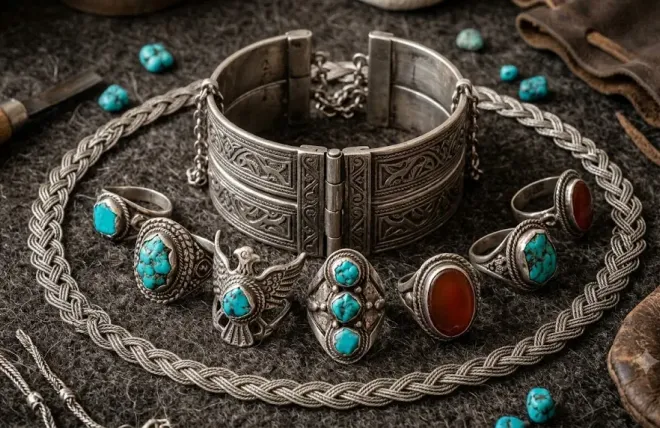
Artisans further embellish these pieces by layering contrasting fabrics or adding intricate embroidery with colorful threads. Edges are often finished with silk fringe, and decorative braided cords are attached for both utility and aesthetics. For items like traditional hats or quivers, the decoration reaches its peak; they are frequently adorned with gold or silver filigree, silk embroidery, and shimmering pendants, transforming simple felt into a sophisticated work of nomadic art.