Kazakh Sheep and Pastoral Vocabulary


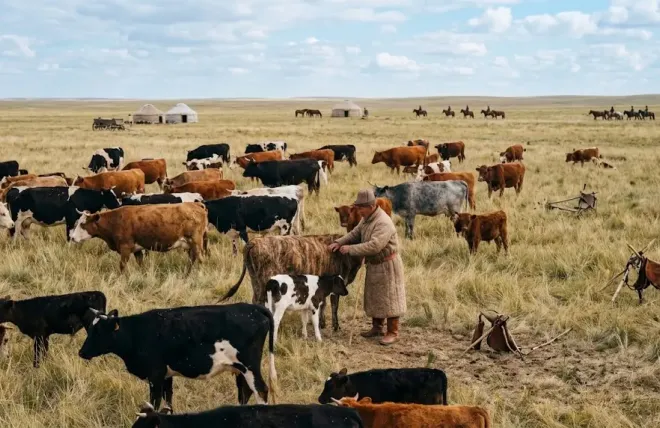
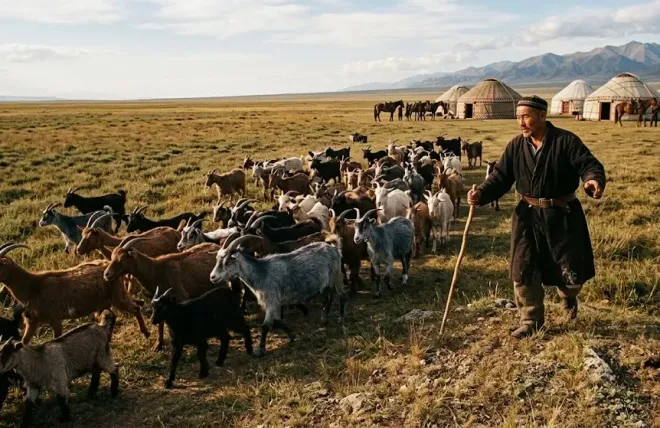
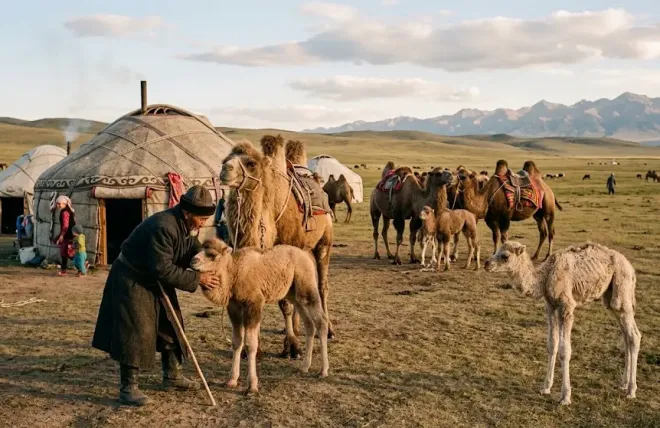
Sheep have played a central role in the pastoral life of the Kazakh steppe for centuries. They provided meat, fat, milk, wool, hides, and other essential resources, while their breeding and management required an exceptionally detailed understanding of animal behavior, health, reproduction, age, and physical condition.
Kazakh pastoralists developed a remarkably precise vocabulary for describing sheep. A single animal could be identified not simply as a sheep, ram, ewe, or lamb, but according to its age, sex, fertility, breeding history, body condition, wool, tail, ears, temperament, behavior, and even the way it responded during milking.
This vocabulary reflects more than language. It records practical knowledge accumulated through generations of pastoral life.
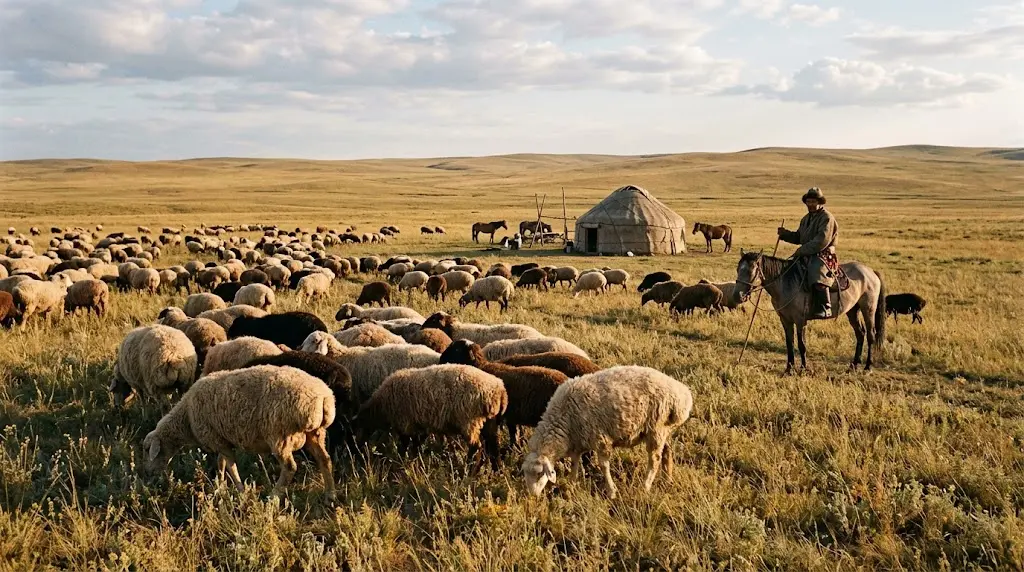
Sheep and Their Wild Ancestors
The ancestry of domestic sheep is complex and involves several wild sheep lineages. Among the wild forms traditionally associated with the history of sheep in Central Asia are the Muflon (mouflon), Arkhar (argali), and wild steppe sheep.
Over many generations of human management, sheep were domesticated, adapted to different environments, and selectively bred into numerous local breeds and types.
Wild sheep are generally hardy animals. They have scent glands near the eyes and between the hooves, strong bodies, broad foreheads, and, in males of horned forms, large curved horns. Depending on their habitat, wild sheep can survive on tough vegetation, including dry grasses, twigs, and other coarse plant material.
Sheep became particularly important to pastoral societies because they were relatively easy to manage and could provide several useful products at once.
Over time, sheep breeding in Kazakhstan produced a wide range of local breeds and types. One important traditional group is Kazakh sheep, including the fat-tailed sheep that became especially well adapted to the dry steppe and other demanding environments. Modern Kazakhstan officially recognizes numerous sheep breeds, including Edilbay, Kazakh fat-tailed coarse-wooled sheep, Kazakh Arkhar-Merino, Degeres, Saryarka, Ordabasy, and others.
Traditional Classification
Kazakh pastoralists traditionally classified sheep according to many characteristics, including:
- region of origin;
- lineage and breeding quality;
- fertility;
- coat and wool characteristics;
- age and sex;
- body condition;
- shape of the head, ears, udder, and tail;
- reproductive history;
- temperament and behavior;
- seasonal management;
- and suitability for breeding, milking, or meat production.
This classification system allowed herders to distinguish animals with remarkable precision.
Classification by Age
Saka Koshkar: A fully mature breeding ram.
Azban: A castrated ram, or wether.
Isek: A castrated ram typically raised for meat.
Donen Qoi: A sheep in its third year of life.
Qunan Qoi: A sheep in its second year of life.
Saulyq: A mature breeding ewe.
Tusaq: A young female sheep that has not yet given birth.
Toqty: A lamb older than six months, generally a weaned lamb.
Marqa Qozy: A young lamb born in spring or outside the main spring lambing period, depending on regional usage.
Classification by Sex
Pastoralists could further distinguish animals within an age category by sex using Erkek (male) and Urghashy (female).
For example:
- Erkek Toqty / Urghashy Toqty: male / female lamb at the toqty stage;
- Erkek Marqa / Urghashy Marqa: male / female marqa lamb;
- Erkek Qozy / Urghashy Qozy: male / female newborn lamb.
This detailed vocabulary made it possible to describe virtually every stage of a sheep's life.
Classification by Physical Condition
Tu Tusaq Qoi
A young ewe, generally around two to three years old, that has remained barren after mating because she failed to conceive or failed to produce a lamb.
Baghyllan Qoi
A sheep in prime physical condition, particularly one noted for exceptional fatness and vitality.
Shuyreli Qoi
A sheep that has become extremely fat by autumn, developing a visible roll of fat around the nape of the neck.
Komgen (Olzha) Qoi
A term applied to a sheep that survived a severe rainstorm by instinctively digging into dry soil for protection. The term can also describe a sheep that appears thin after being shorn early in summer and before its protective fleece has fully grown back.
Sary Tis Qoi
A highly valued, hardy ewe that continues to maintain good health and milk production after lambing four or five times and rarely remains barren.
Tort Tisti Saulyq
Literally, a "four-toothed ewe." The expression refers to an older ewe associated with four lambings and declining productivity. After repeated lambing, some ewes may lose condition and produce less milk, making their breeding value lower than that of younger, more productive animals.
Classification by Reproductive Timing
Kuyek Qashkan Qoi
A ewe that successfully mates after the kuyek, a felt marking cloth attached to a ram and traditionally used to identify successful mating. The cloth was generally removed around the beginning of the breeding season.
Aramza Qoi
A sheep that conceives prematurely, resulting in an unusually early winter lambing. Such timing could be dangerous because winter conditions reduced the chances of survival for both the ewe and newborn lamb.
Additional Gender-Based Terms
Saulyq Qoi
A mature breeding ewe, generally more than three years old.
Sauuly Qoi
A "milking ewe"—a ewe that is being milked after her lamb has died, been lost, or otherwise been separated from her.
Qortyk (Shartyk) Koshkar
A ram considered inferior in lineage or physical development and therefore unsuitable for breeding.
Toqty Koshkar
A young ram that has reached the toqty stage.
Additional Age-Based Terms
Kuyek Qozy
Literally, a "breeding-season lamb." The term refers to a lamb born after successful mating during the proper seasonal breeding cycle and, in some usages, to a lamb under six months old.
Sary Ayaq Marqa
A late-season lamb, typically born in August or September. Although born later than the main spring lamb crop, such lambs could become particularly well developed because they reached an important stage of growth when pasture conditions were favorable.
Laq Qozy
A foster lamb—usually a young lamb that has been placed with a ewe that has lost her own lamb.
Baghlan Qozy
An early-born lamb that has developed exceptionally well and become notably fat.
Milking Practices
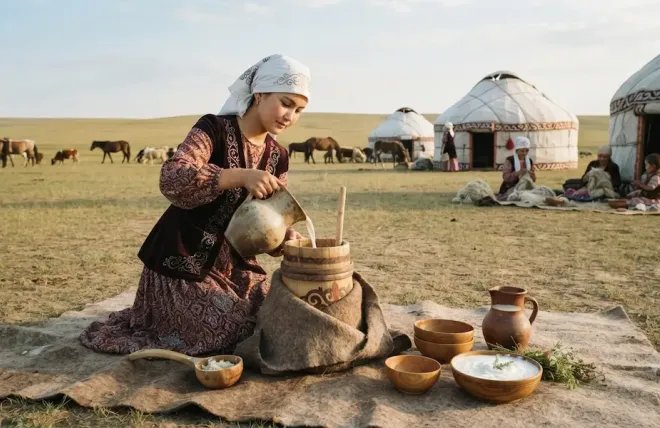
Kazakh pastoralists also distinguished several methods of milking ewes.
Uripteu (Uripei Sauu)
Milking a ewe without allowing the lamb to suckle first.
Zhebu (Zhebei Sauu)
A two-stage milking process in which the ewe is milked once without the lamb and then milked again shortly afterward.
Astynan Idiru (Idirip Sauu)
A standard milking technique in which the lamb first stimulates the ewe's milk-letdown reflex, after which the shepherd milks the ewe.
Zhanai Idirip Sauu
A controlled technique in which the lamb is brought close enough to the ewe to stimulate milk let-down without being allowed to suckle freely. The shepherd then begins milking.
Classification by Udder and Teat Structure
Sapty Ayaq Zhelin
An udder shaped like a sapty ayaq, a traditional deep, cylindrical bowl with a handle.
Kese Zhelin
An udder resembling an inverted kese, a traditional tea bowl.
Taltaq Emshek Qoi
A ewe whose teats point outward and appear widely splayed.
Tuimeli (Qos) Emshek Qoi
A ewe with small accessory teats at the base of the main teats.
Classification by Physical Features
Uki Bas Qoi
A sheep with two small tufts of wool growing vertically above the temples, resembling the tufts on an owl's head.
Tulymdi Qoi
A sheep with long, ragged locks of wool growing from the temples and falling over the eyes. The appearance is compared with a traditional hair ornament or fringe known as tulym.
Tuimeli Qoi
A sheep with two rows of small, bead-like fleshy glands on the underside of the neck.
Shunaq Qoi
A sheep with unusually small, shriveled, or vestigial ears.
Salpaq Qulaq Qoi
A sheep with long, pendulous ears.
Ush Muiizdi Qoi
A rare three-horned sheep.
Topal Qoi
A sheep naturally born without horns.
Arkhar Muiizdi Qoi
A sheep or ram whose horns curve in a manner reminiscent of the majestic horns of the wild Arkhar (argali).
Tail Structure
Tail shape was another important feature in traditional sheep classification.
Tegene Quyryq
A broad, massive tail that does not reach the hocks and blends into the animal's back. Its rounded form is compared with a large tegene, a traditional round basin.
Qalaq Quyryq
A flat, thin, shovel-shaped tail that sits high on the rump and does not hang to the hocks.
Tanqysh (Tanqy) Quyryq
A tail with a pronounced curved or overhanging form that lies close against the body.
Salpy Quyryq Qoi
A tail that is relatively narrow at the base, hangs below the rump, and widens toward the sides, sometimes reaching the hocks or thighs as the sheep walks.
Breeding and Mating Cycle
Toqty Qashqan
A young ewe at the toqty stage that mates at around six months and may produce her first lamb at approximately one year of age.
Aramza Qashqan
A ewe that mates prematurely or outside the usual seasonal cycle, resulting in an unusually early lambing.
Wool and Fleece
Wool was one of the most important resources obtained from sheep. It was used for felt, clothing, household items, insulation, and many other purposes.
Tiri Zhun
Literally, "living wool." This refers to fresh new growth developing beneath the dense winter coat or emerging after the old fleece has been shorn.
Bozdaq
A term used for tiri zhun, referring to wool that is actively growing.
Oli Zhun
Literally, "dead wool." This is old, matted wool that remains in the winter coat until shearing. It is brittle and generally less suitable for textile production.
Zhabaghy Zhun
A heavy, matted fleece mixed with the animal's natural oils and accumulated impurities, forming a dense layer close to the skin.
Biiazy Zhun
Fine, high-quality wool that is soft, elastic, and strong.
Qozy Zhun
The wool of a lamb younger than one year, particularly from a fine-wool type. Compared with adult wool, it is often longer, thicker, and more loosely curled.
Zhabyn Zhun
Shorter, coarser hair found on the lower legs, jaw, tail, and belly.
Kuzem Zhun
Wool obtained during the autumn shearing of sheep and lambs, traditionally around September.
Qaryn Zhun (Kishi Kuzem)
The first shearing of a lamb, traditionally carried out around June.
Seasonal Calendar
Kuzem Aiy (Ulken Kuzem)
September, traditionally associated with the main autumn shearing of adult sheep and lambs.
Kuyek Aiy
November, traditionally associated with removing the kuyek, the marked felt cloth used on breeding rams. In modern practice, breeding schedules may vary.
Tol Aiy
April and May, traditionally regarded as the main lambing months.
Herd Categories
Sheep were broadly divided into three main groups according to sex and reproductive status.
1. Female Sheep — Urghashy Qoi
Qozyly Qoilary: Ewes currently nursing lambs.
Urghashy Boidaq Qoilary: Barren females or young females that have not yet conceived.
2. Male Sheep — Erkek Qoi
Qoshqarlar: Breeding rams.
Erkek Toqtylar / Isekter: Young male sheep and castrated males raised for meat.
3. Offspring — Qozy
Qozy: The general term for young lambs before maturity.
Female Sheep
Breeding Ewes — Saulyq Qoilary
Saulyq: The general term for a mature ewe capable of breeding.
Buaz Qoi: A pregnant ewe that successfully mated during the autumn breeding season. Sheep generally have a gestation period of approximately five months.
Sauly Qoi: An ewe that is nursing a lamb or being milked after her lamb has been lost or removed.
Qozyly Tusaq: A two-year-old ewe that has produced her first lamb.
Qozyly Toqty: A young female at the toqty stage that mated early and produced her first lamb at approximately one year of age.
Toqtyly Qoi: A ewe that lambed in spring and is still nursing a lamb that has reached approximately six months of age.
Shar Saulyq: A middle-aged ewe that has lost her lamb and, without being given a foster lamb, has regained condition and become notably fat.
Kenzhe Toqty: A young ewe that mated late in the season and lambed in late spring or summer. The term may also be applied to a late-born young sheep after it has passed the six-month stage.
Alty Tisti Saulyq: Literally, a "six-toothed ewe." The term describes a mature, highly fertile ewe that has successfully lambed several times.
Sary Qaryn (Saulyq) Qoi: An older ewe that has lambed seven or eight times.
Shar Qoi: Another term associated with Shar Saulyq, referring to a barren but well-conditioned ewe.
Tol Qoi: A ewe whose own lamb has died and which has subsequently been given a foster lamb.
Toqtaghan Qoi: A ewe that has successfully mated. The term may also refer to an older ewe that has reached the end of her reproductive life.
Non-Breeding and Young Females
Urghashy Boidaq Qoi
Boidaq Qoi: A collective term for barren females, young females, or lambs that have not conceived.
Qysyr Qoi: A female sheep that has not mated or has failed to become pregnant.
Qysyr Saulyq: A mature ewe that failed to conceive during the breeding season.
Qysyr Tusaq: A young ewe that failed to conceive.
Tusaq: A young female sheep in the yearling or early breeding stage; usage can vary according to local classification.
Shailaghan Qoi: A sheep that has become so excessively fat through winter grazing or deliberate fattening that it has difficulty walking and spends much of the summer lying down.
Tumsa Tusaq: A young female that was exposed to a ram but failed to produce a lamb.
Zhantyq (Zhantaq) Qoi: A low-slung, sturdy ewe with a broad, flat back and good semi-coarse wool, sometimes with wool hanging over the eyes.
Buraung Qoi: A sheep with a deformed or twisted back, which may result from injury, including trauma caused by predators, or from congenital factors. The animal may have a distinctive uneven gait.
Male Sheep
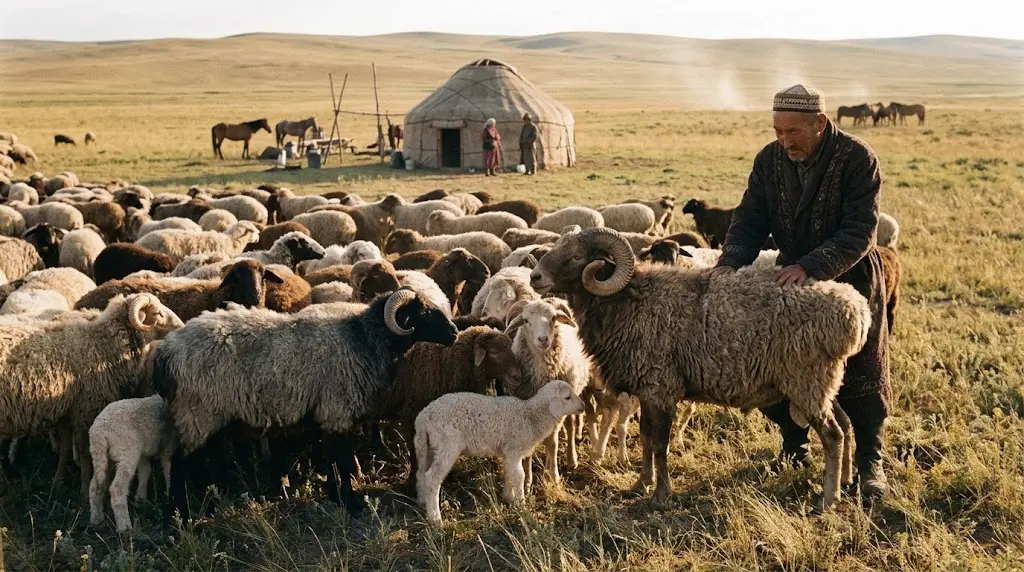
Breeding Rams — Qoshqarlar
Isek Qoshqar: A mature, approximately three-year-old uncastrated male.
Qoi-dyn Keni: The prize ram of a flock—the highest-quality male whose offspring are considered particularly strong, fast-growing, and well developed.
Qoshqar: A fully mature breeding ram. Male lambs can reach sexual maturity surprisingly early and are therefore separated from ewes before uncontrolled breeding occurs. Rams selected for breeding are given special care and introduced into the flock at an appropriate age. Traditionally, a single ram could be used with a large group of ewes, depending on the ram's age and quality.
Castrated and Young Males
Azban: A mature ram that has been castrated, often because of age, excessive weight, or insufficient breeding value.
Isek: A castrated male raised primarily for meat.
Lambs
Qozy Ataulary
Qozy: The general term for a newborn or young lamb.
Mayekti Qozy: A lamb that has developed rapidly by receiving sufficient colostrum and milk from its mother.
Kobe (Kepe) Qozy: A winter-born lamb that survives the difficult season and develops well.
Qauqa Qozy: A frail, poorly developed winter-born lamb associated with inadequate care or unfavorable conditions. It may have a matted coat and a generally unhealthy appearance.
Kun Times Qozy: A late-born lamb kept indoors or in a sheltered enclosure rather than immediately being taken to pasture.
Korpeldesh Qozy: A late-season lamb born in late May, June, or early July.
Kopei Qozy: A term used as a synonym for Korpeldesh Qozy.
Bodene Qozy: A small, poorly developed late-born lamb, regardless of sex.
Qodygha (Qudire): A prematurely born winter lamb that grows considerably by autumn but remains smaller than an older wether.
Aramza Qozy: A lamb born to a ewe that mated unusually early in the breeding cycle.
Marqa Qozy: A lamb born outside the main spring lambing period. It may be larger than a very young spring lamb but smaller than a toqty.
Kuyek Qozy: A lamb born during the normal spring lambing period.
Baghlan Qozy: A lamb allowed to nurse from both its own mother and a foster mother, resulting in especially good growth and a well-fleshed carcass.
Buzau Qozy: A lamb fostered by a cow that has lost her own calf.
Erkek Qozy / Urghashy Qozy: Male lamb / female lamb.
Qoshagan: An affectionate term for a young, beloved lamb.
Orphaned Lambs
Zhetim Qozy
Zhetim Qozy: A lamb whose mother has died.
Tiri Zhetim: Literally, a "living orphan." This describes a lamb whose mother is unable to produce milk or has rejected it, requiring the lamb to be fostered by another ewe.
Zhalqy Zhetim: A single-born lamb orphaned at birth.
Synghar Zhetim: One of a pair of twins that survives after the mother and the other twin have died.
Qos Zhetim: A pair of orphaned twins whose mother has died.
Temperament and Behavior
Kazakh shepherds also developed precise terms for animal temperament.
Taghy (Zhaby) Qoi: A wild or shy sheep that avoids human contact.
Zhanbaqy Qoi: A stubborn, restless sheep that resists milking or handling.
Zheruik Qoi: A temperamental ewe that refuses to nurse her own lamb and may require forced fostering.
Qatybas Qoi: A ewe that completely abandons or rejects her lamb.
Bedireuik Qoi: A ewe that does not readily release milk for the milker and allows only her lamb to suckle.
Zhanasqy Qoi: A ewe that continually stays near the nursing area to remain close to her lamb.
Qanypez Qoi: An aggressive ewe that kicks, jumps, or attempts to overturn the milking bucket while being milked.
Balazhan Qoi: A highly maternal ewe that readily nurses other lambs as well as her own and may accept an orphan.
Zarzhaq Qoi: A restless ewe that continually bleats while searching for her lamb or flock.
Zhuas Qoi: A gentle, docile sheep that is easy to tether and milk.
Tarpan Qoi: A skittish sheep that snorts, stamps its front hooves, and watches people suspiciously when approached.
Shadyr Qoi: An aggressive sheep that uses its horns to drive other animals away.
Aq Kongil (Kongilshek) Qoi: A good-natured ewe that willingly releases her milk during milking.
Behavioral Terms for Lambs
Qomaghai (Ashqaraq) Qozy: A greedy or ravenous lamb that repeatedly butts its mother's udder to stimulate milk flow.
Tilenshek Qozy: A "begging lamb"—an orphan that persistently follows ewes in search of milk.
Sughanat (Turtinshek) Qozy: A restless lamb that attempts to suckle from whichever ewe it encounters.
Iirilu: A behavior in which lambs cluster together and lower their heads during the hottest part of the day, helping protect themselves from flies and heat.
Kuyeydeu: The act of gathering or huddling in one another's shade to escape intense sunlight and flies.
Milking and Fostering Practices
Idiru
A milking technique in which the ewe is milked once without the lamb, after which the lamb is allowed to suckle briefly to stimulate milk let-down before milking is completed.
Zhamyrau
The excited scramble of lambs rushing toward their mothers when they see them before the scheduled milking time.
Zhamyratu
The act of driving lambs to the milking area so that they can be reunited with their mothers.
Tabysu
The reunion of mothers and lambs after milking.
Qosaqtau
The practice of arranging ewes in pairs or rows and securing them with ropes for milking.
Zhaghystyru
The process of fostering a lamb onto another ewe, particularly an orphan or a lamb whose own mother produces insufficient milk.
Auyzyndyru
The practice of physically restraining an uncooperative or rejecting ewe so that her lamb can be guided to the teat and encouraged to nurse.
Tunetu
A gradual weaning technique in which lambs are periodically separated from their mothers, for example every two or three days, so that the ewe's milk production gradually decreases.
Castration and Seasonal Breeding Management
Tarttyru
A traditional method of castrating male lambs or low-quality older rams by damaging or severing the spermatic cord.
Soqtyru / Kestiru
Terms associated with tarttyru, referring to castration.
Kuyek Audaru
A seasonal breeding-management practice involving adjustment or repositioning of the kuyek, the marked felt cloth attached to a ram.
Vocalizations and Behavioral Sounds
Mekirenu
A gentle, low sound produced by a ewe through her nostrils while nursing, licking, or interacting affectionately with her lamb.
Manyrau
The familiar loud bleating of a sheep, particularly when searching for its lamb or flock or when separated from the herd.
Ear-Marking Systems
Ownership was especially important in pastoral societies where animals could mix with other flocks. Shepherds therefore used distinctive ear marks known collectively as En (ear marks).
En
The general term for an ear mark used to identify ownership.
Qumyrsqa En
An "ant mark," consisting of notches cut into the tips or edges of both ears.
Oiyq En
A concave notch cut into the front or rear edge of the ear.
Tesiken
A circular hole punched through the center of both ears.
Oiyq Tesik
A combination of a circular hole in one ear and a notch in the other.
Kesik En
The tips of both ears cut off straight.
Synghar Kesiken
Only the tip of one ear cut off.
Tilik En
A small slit cut near the tip of the ear.
Kezen
A small horizontal slit made toward the back of the ear.
Sara Tilik
A single large slit cut into the right or left ear.
Syrgha En
An ear mark in which a strip of the ear is cut from the rear edge and left hanging like an earring, or syrgha.
Solaq En
A rectangular or triangular piece cut from the edge of the ear.
Qiiq
A slanted or diagonal cut made near the tip of the ear.
Tesik Tilik
A combination of a slit and a circular hole.
Oiyq Tilik
A combination of a slit and a notch.
Qos Synghar Tilikti En
A mark consisting of one slit on the tip of one ear and two slits on the other.
Setik En
A long-standing ear slit made while the animal is still a lamb.
Traditional Commands
Shepherds used distinctive calls and commands to control their flocks.
Shai bylai: Used to turn or gather sheep that are wandering away.
Shai-shai: Used to calm a flock startled by wolves or dogs and to soothe noisy lambs.
Shai-shai, ai (oi): A loud call used to stop sudden panic or a stampede.
Pytshai-pytshai / Pishat-pishat: Calls used to summon a lamb to its mother.
Tipshe-tipshe: Used to call sheep accustomed to being fed grain.
Qodshy-qodshy: A command used to make a skittish or wandering sheep stop.
Qurai-qurai / Quai-quai: Calls used while leading a flock toward water.
Uu-aq-uu-aq: Used to gather sheep that have scattered widely while grazing.
Qyrhai-qyrhai: Used when driving sheep into the pen for the night.
Ureit soq-soq: A command associated with provoking rams to fight, whether for display or training.
Qod-qod: Used to encourage a ram to approach a ewe in heat.
Qurai-qurai / Qurai-qurait: Used to turn the flock while grazing.
Ir-hait / Yr-hait (Rait): Used when driving sheep through water or across a river.
Traditional Curses
Traditional expressions could also be directed at troublesome animals. Expressions such as Topalang (Qara Tuinek, Qyl Qurt) Kelgir were used in moments of extreme frustration, invoking serious disease or misfortune upon a particularly unruly animal.
Such expressions belong to the traditional language of pastoral life rather than representing literal veterinary practices.
Common Sheep Diseases and Conditions
Traditional shepherds also maintained a practical vocabulary for common animal diseases and physical disorders.
Topalang: Anthrax, a severe and potentially fatal infectious disease.
Kul: A disease associated with fever and blister-like lesions on the skin and mucous membranes.
Saryp: Inflammation and swelling around the hooves, associated with foot disease or foot rot.
Sekirtpe: A serious infectious condition affecting the digestive tract, particularly the abomasum and small intestine.
Sary Buun: Joint inflammation accompanied by yellowish fluid accumulation.
Bogezek (Zhauyryntaq): A painful hoof condition that can prevent the animal from walking normally.
Shoiyrylma: A condition associated with a weakened or deformed back.
Baspaq: A respiratory condition associated with blockage of the nasal passages.
Qyzyl Shu (Ish Tastau): Spontaneous abortion or miscarriage.
Qara Tuinek: Intestinal torsion, commonly described as a "twisted gut."
Alang: A localized form or manifestation of anthrax.
Zharghysh: A condition associated with internal rupture and sudden death.
Kontaq: Mange, a skin disease causing hair loss and thick, scaly skin.
Qara Suiel: Warts or wart-like growths occurring in the mouth or around the hooves.
A Vocabulary Shaped by Pastoral Life
The traditional terminology surrounding sheep reveals how closely Kazakh pastoralists observed their animals.
A shepherd needed to know not only how many sheep were in the flock, but also which ewe was pregnant, which had recently lambed, which animal was suitable for breeding, which lamb was an orphan, which sheep produced milk readily, which animals were too fat or too thin, and which ram was likely to produce strong offspring.
Even seemingly small details—such as the shape of a tail, the position of the teats, the form of the ears, the texture of the fleece, or the sound made by an animal—could have practical significance.
This vocabulary therefore represents more than a collection of old animal names. It preserves a detailed record of traditional livestock knowledge developed in response to the demands of life on the Kazakh steppe.
For nomadic and semi-nomadic communities, sheep were not simply livestock. They were a dependable source of food, clothing materials, household resources, and economic wealth. Understanding the animal in such detail was part of the knowledge required to survive and prosper in a pastoral environment.