Kazakh Clan and Ancestral Symbols


Kara Shanyrak: The Ancestral Hearth
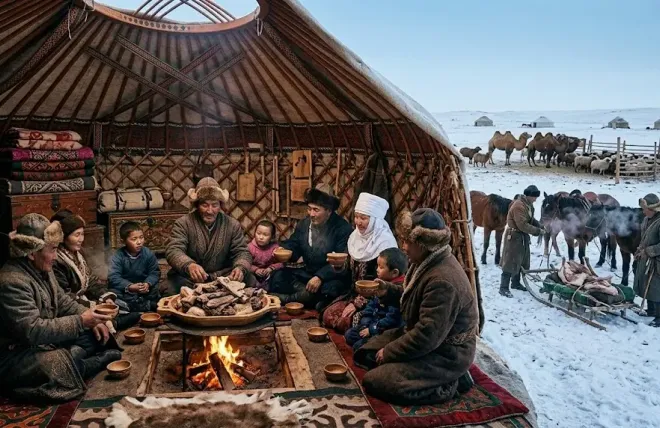
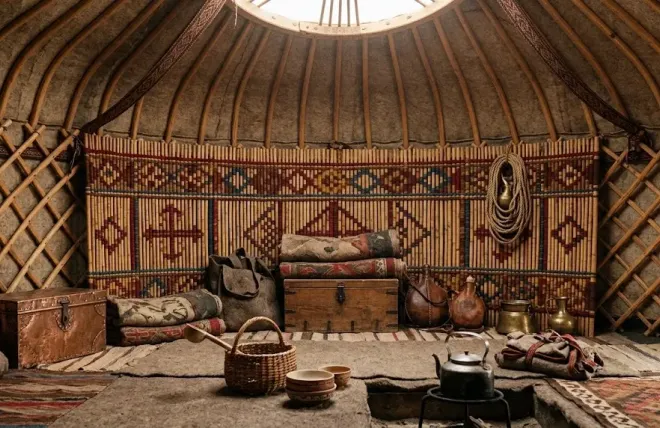
The Kara Shanyrak (the ancestral or paternal home) was the main family home and a highly respected inheritance passed down through the male line. When older sons married and established separate households, they received their share of the family property and livestock. The Kenzhe (youngest son), however, traditionally remained with his parents and inherited the Kara Shanyrak.
As the keeper of the ancestral home, the youngest son was expected to care for his aging parents and preserve the family's traditions and honor. This arrangement was well suited to life on the steppe: while older sons established their own households and herds, the youngest remained at the parental home and took responsibility for the older generation. The home he inherited was not simply a place to live but the family hearth that connected different generations.
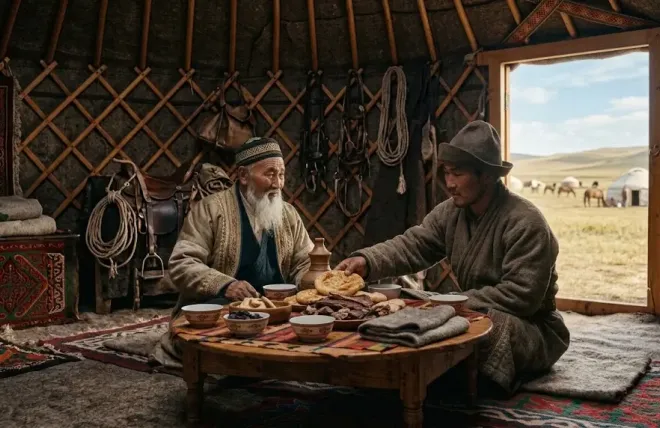
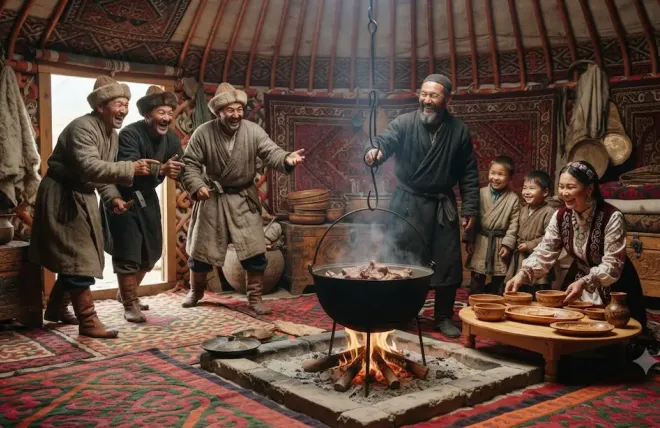
The Kara Shanyrak was regarded with particular respect when it had belonged to a famous or highly respected person, such as a Bi (traditional judge), Batyr (warrior), or Aulie (holy or revered person). According to traditional accounts, people might visit such a home to pay their respects, receive a blessing, or share food before setting out on an important or distant journey. The ancestral home could therefore become a lasting symbol of the family's reputation and history, remembered by descendants long after its original owner had died.
Tamga: Clan Identity Marks
A Tamga (clan or lineage sign) was a distinctive geometric symbol associated with a particular clan (Ru) or larger tribal union. Tamgas served several practical and social purposes. They could be used to mark livestock and other property, identify lineage, and distinguish one clan from another. They were also found on funerary monuments and other objects, where they could indicate a person's affiliation with a particular lineage.
The symbols were usually simple geometric forms such as circles, lines, hooks, crosses, or angles. Their meaning was not limited to decoration: a Tamga could function as a sign of ownership, identity, and social affiliation. In some historical contexts, tamgas also served as legal marks or signatures.
The traditional Tamga system was closely connected with the organization of Kazakh society into three major Zhuzes (tribal unions): the Senior Zhuz (Uly Zhuz), Middle Zhuz (Orta Zhuz), and Junior Zhuz (Kishi Zhuz). Each included numerous clans with their own distinctive signs.
During the period of Khan Tauke, the system of customary laws known as the Zheti Zhargy (Seven Charters) also recognized the importance of clan and tribal signs. Historical sources associate the code with rules concerning clan identity and the use of Tamgas. However, describing the system as a modern state registry of coats of arms would be misleading: Tamgas were traditional identity and property signs rather than European-style heraldic coats of arms.
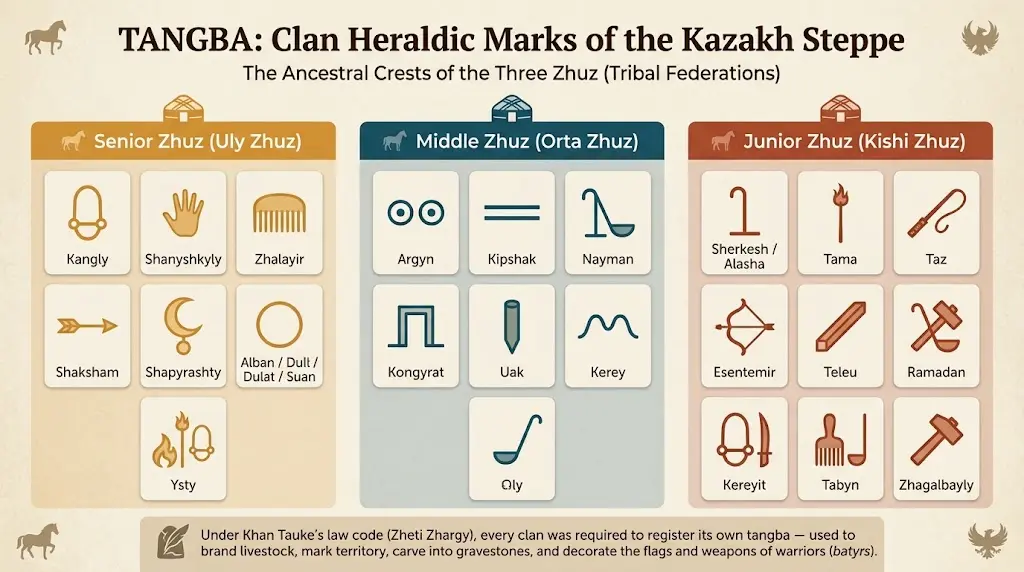
Clan Tamgas of the Senior Zhuz (Uly Zhuz)
- Kangly — a bridle or fire poker (Koseu)
- Shanyshkyly — a stamped handprint
- Zhalayir — a comb (Tarak)
- Shaksham — a pointed arrow
- Shapyrashty — a crescent moon and amulet (Ai, Tumar)
- Alban, Dulat, Suan — a circle
- Ysty — a fire poker and bridle
Clan Tamgas of the Middle Zhuz (Orta Zhuz)
- Argyn — two circles, representing eyes (Koz)
- Kipshak — two parallel vertical lines
- Nayman — a hitching post or ladle (Ozhau)
- Kongyrat — a door threshold (Tabaldyryk)
- Uak — a wooden stake or support pole
- Kerey — double camel humps
Clan Tamgas of the Junior Zhuz (Kishi Zhuz)
- Sherkesh, Alasha — a hitching post
- Tama — a fire poker, or the first letter of the script
- Taz — a riding whip (Kamshy)
- Aday — a combat bow
- Esentemir — a vertical support beam
- Teleu — a hammer and bridle
- Ramadan — a traditional ladle
- Kereyit — a bridle and saber
- Tabyn — a comb, poker, and ladle
- Zhagalbayly — a blacksmith's hammer
These associations describe the traditional forms attributed to particular clans. Because Tamga traditions developed over time and could include variations within clans and subclans, individual interpretations of their shapes and meanings are not always identical across sources.
Zheti Ata: The Seven Ancestors
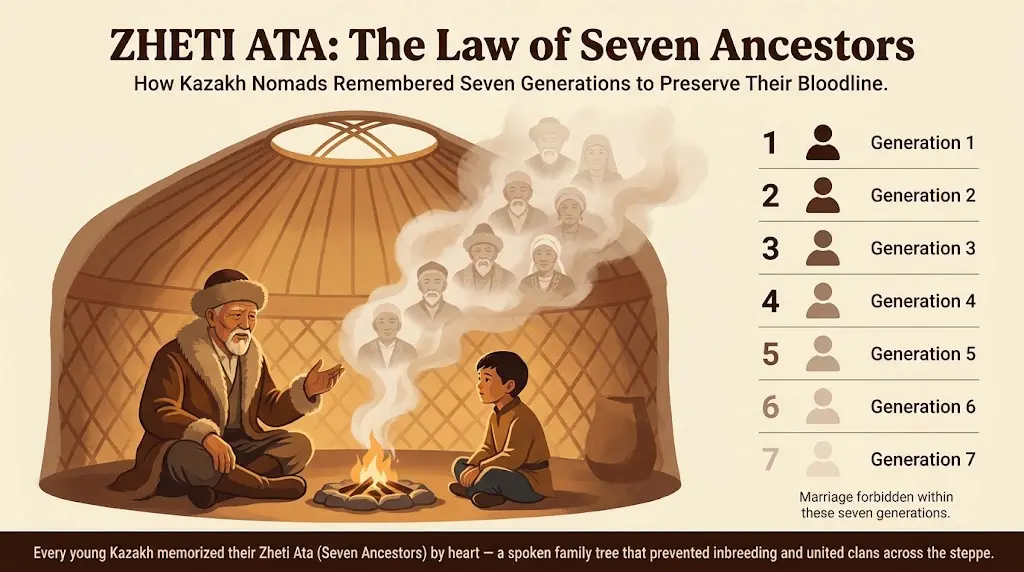
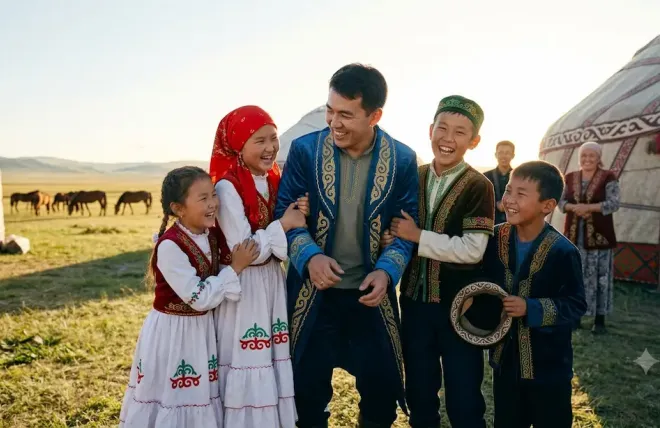
The Zheti Ata (Seven Ancestors) is a traditional Kazakh system of remembering one's direct ancestors through seven generations. Children were taught to memorize the names of their ancestors, often learning them orally from parents and grandparents. Knowing one's ancestry was considered an important part of understanding one's family, lineage, and place within the wider community.
The tradition also had an important social purpose. Under the Zheti Ata principle, people who shared a recent male ancestor were regarded as close blood relatives, and marriage within seven generations was traditionally prohibited. This rule helped maintain clear boundaries between close relatives and encouraged marriage between different family and clan groups.
The prohibition was therefore more than a simple marriage taboo. It formed part of a broader system of kinship and social organization. By requiring people to know their ancestry, the tradition helped preserve genealogical memory, strengthen relationships between relatives, and reduce the possibility of marriage between close blood relatives.
In this way, Zheti Ata connected personal family history with the wider social structure of Kazakh society. A person's ancestry was not merely a list of names from the past: it helped determine whom they could marry, how they understood their kinship ties, and how they related to the larger community.