Traditional Kazakh Meat Dishes


The Traditional Preparation of Kazakh Besbarmak
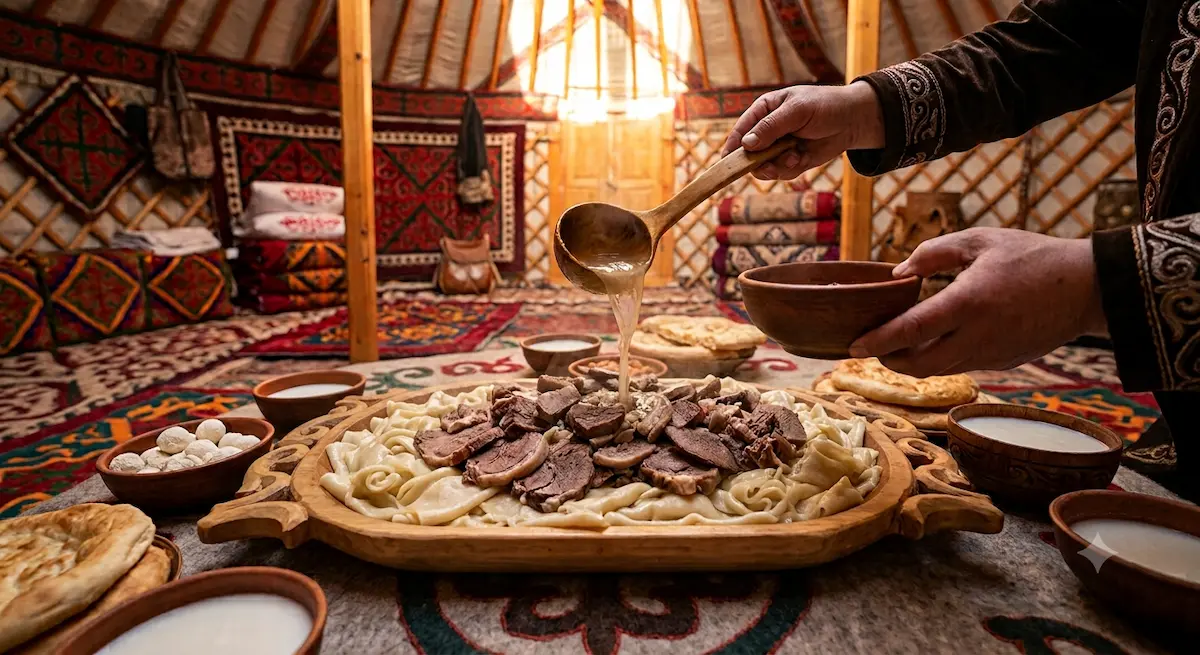
When preparing meat for a traditional Kazakh feast—commonly known as Besbarmak (literally meaning "five fingers," as it is traditionally eaten by hand)—the process begins by portioning the butchered meat according to the number of guests. For celebratory events or when hosting honored visitors, a sheep is typically slaughtered.
Once cleaned, the carcass is traditionally divided into 13 mushe (primary anatomical parts):
- Zhambas (two hip bones)
- Ortan zilik (two thigh bones)
- Asykty zilik (two shin bones)
- Belomyrtka (the lumbar vertebrae)
- Sube (two loin cuts, which include the five upper ribs)
- Rib cages (two pieces)
- Tos (the brisket)
- Omyrtqa (the spine)
- Zhauyryn (two shoulder blades)
- Tokpan zilik (two upper arm bones)
- Kari zilik (two forearm bones)
- Bugana (the collarbone)
- The neck
The Cooking Process
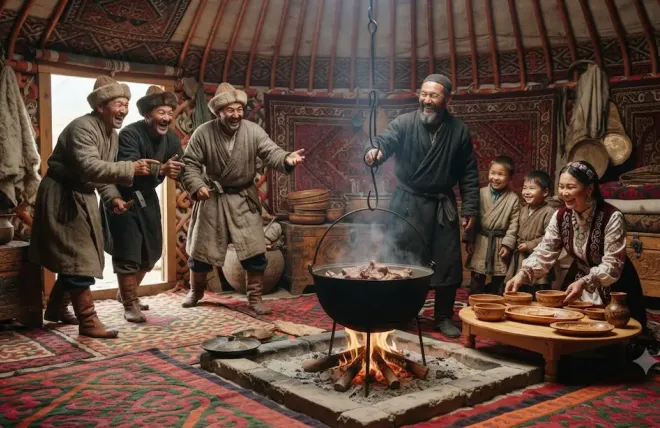
After the cuts are thoroughly washed, they are placed into a large kazan (a traditional cast-iron cauldron) and covered with cold water until fully submerged. The cauldron is set over a high flame to reach a vigorous boil. As the water begins to bubble, it is essential to skim off the foam and blood residue rising to the surface to ensure a clear, flavorful broth. Once skimmed, add a moderate amount of salt and a whole onion, then reduce the heat to a simmer. The meat should cook steadily for 60 to 90 minutes until it becomes tender and begins to separate easily from the bone.
The Finishing Touches
When the meat is fully cooked, it is carefully removed from the broth. While the meat rests, the host prepares a signature sauce known as tuzdyk (an onion and pepper broth sauce). This is crafted by taking some of the hot broth and mixing it with black pepper and thinly sliced onions in a separate bowl, which is then covered and allowed to steep.
Before serving, the meat is carved and arranged on large communal platters. The tuzdyk is poured generously over the meat to enhance its flavor. For guests of honor, the platter is elegantly garnished with specific prized cuts, including the sheep’s head, as well as horse meat delicacies like qazy, qarta, zhal, and zhaya. To round out the meal, boiled dough sheets (zhayma) and whole boiled potatoes are added to the platter, creating the complete and iconic Kazakh culinary experience.
Traditional Kazakh Meat Delicacies
Qazy (Horse Meat Sausage)
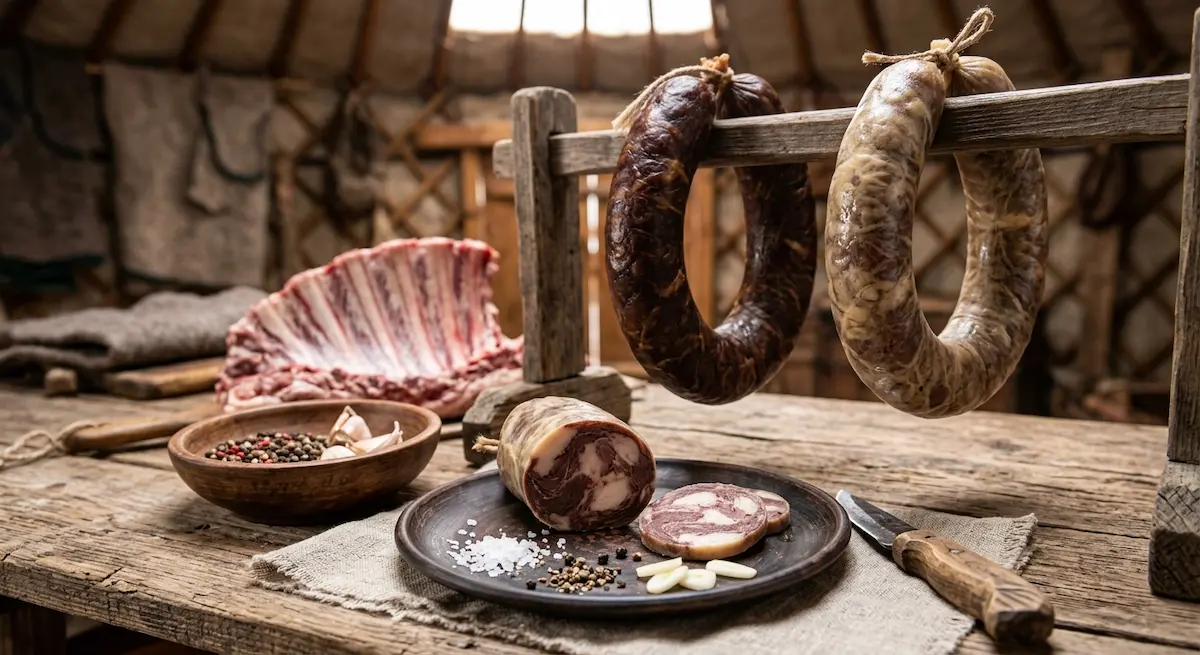
Qazy is considered one of the most prestigious parts of the horse. It consists of the rich, marbled meat and fat harvested from the animal's rib cage and loin area. To prepare it, the butcher removes the ribs (excluding the first and last two) and carefully separates the meat and fat from the bone, ensuring they remain attached as a single layer. These strips are then stuffed into cleaned, prepared intestines.
Before stuffing, the meat is generously salted and left to cure for two to three days. After being rinsed in cold water, the meat-filled casings are tied at both ends to form a semi-circle and hung on a rack for eight to ten hours to air-dry. If the goal is to smoke the qazy, it is exposed to smoke for 13 to 27 hours. For serving, it is simmered slowly for about two to two-and-a-half hours. It can be enjoyed either hot, freshly boiled, or chilled, usually seasoned with garlic, black pepper, and salt.
Qarta (Boiled and Smoked Intestine)
Qarta is another highly valued delicacy made from the horse's rectum. Immediately after a horse is butchered, the tissue is emptied, turned inside out, and washed thoroughly in cold water. To enhance the flavor, it is seasoned with salt, pepper, and finely chopped onions.
To prepare it for smoking, the meat is salted and allowed to rest in a cool environment ( ) for one to two days. It is then cold-smoked for 12 to 18 hours, followed by a drying period of two to three days at a temperature of . When ready to cook, the qarta is washed again and simmered over low heat for 90 to 120 minutes until tender.
Zhal (Smoked Horse Neck Fat)
Zhal is an exquisite cut located between the horse's withers and the cervical vertebrae, serving as the muscular support for the neck. When the horse is skinned, this distinct, fatty layer is carefully carved away. In a well-fed horse, this piece is remarkably thick—often as wide as a person's hand.
There is a popular saying in Kazakh culture that a truly fat horse has a zhal that "rises above its ears." To prepare it, the meat is scored with incisions and rubbed with salt. Traditionally, it is smoked over juniper wood for one to two hours, which acts as a natural preservative and imparts a unique aroma. It is often served chilled as an elegant cold appetizer.
Zhaya (Cured Horse Rump)
Zhaya is a prized cut of meat taken from the hip and rump area of the horse. Once the animal is skinned, the meat is sliced into thick, rounded slabs measuring approximately 10 centimeters in thickness. These pieces are salted and left to cure for one to two hours before being smoked for 14 to 18 hours. Zhaya is a signature item for VIP guest platters, typically served cold and thinly sliced, where the rich marbling of fat and lean meat is complemented by fresh onions and black pepper.
Traditional Soups and Preservation Methods
Sorpa (Meat Broth)
Sorpa is served in bowls after the main meat dish has been enjoyed. In Kazakh culture, it is considered the concentrated essence of the meal—a nutrient-rich, flavorful elixir.
To achieve a rich and hearty sorpa, the meat should be boiled generously and skimmed frequently during the initial boil. When using freshly slaughtered meat, the broth is often stirred vigorously with a ladle—a process known as sapyrudy—to aerate it and improve the texture. Once the initial foam is removed, the pot is kept covered over low heat. To further elevate the flavor, guests often add traditional fermented dairy products like kurt (dry cheese balls), katyk (sour milk yogurt), or suzbe (strained, savory yogurt) directly into their bowls.
Bas (The Ceremonial Animal Head)
The head (bas) of a sheep, goat, or cow is a significant ceremonial offering. It is prepared by first singeing the hair off, then scraping and washing it thoroughly in warm water several times until spotless.
Small animal heads (sheep or goat) are typically boiled whole and presented to the most honored guest at the table. However, the heads of larger animals like horses or camels are separated into pieces before cooking. Notably, horse cheek is not considered a ceremonial cut and is therefore never offered to honored guests. The bas is always served alongside the main platter of boiled meat.
Sur (Smoked and Cured Meat)
Sur refers to any meat that has been preserved through a traditional, long-term smoking process, which is essential for preparing sogym (the winter meat harvest).
After the carcass is butchered, the prized pieces—such as qazy, qarta, and shuzhyk (traditional horse meat sausage)—are hung on a wooden rack called an arsa. A fire is built underneath using non-flammable wood, ideally tobylgy (spiraea shrubs), to generate thick, fragrant smoke. The smoking is done in stages so the high-quality fat doesn't melt away prematurely. Meat treated this way takes on a rich, golden-brown hue and can be stored for extended periods. Because the smoke flavor can be quite intense, it is best to mix sur with fresh meat when boiling to achieve a balanced sorpa.
Nomadic Quick-Cook and Specialty Dishes
Zhaubuyrek (Hunter's Kebab)
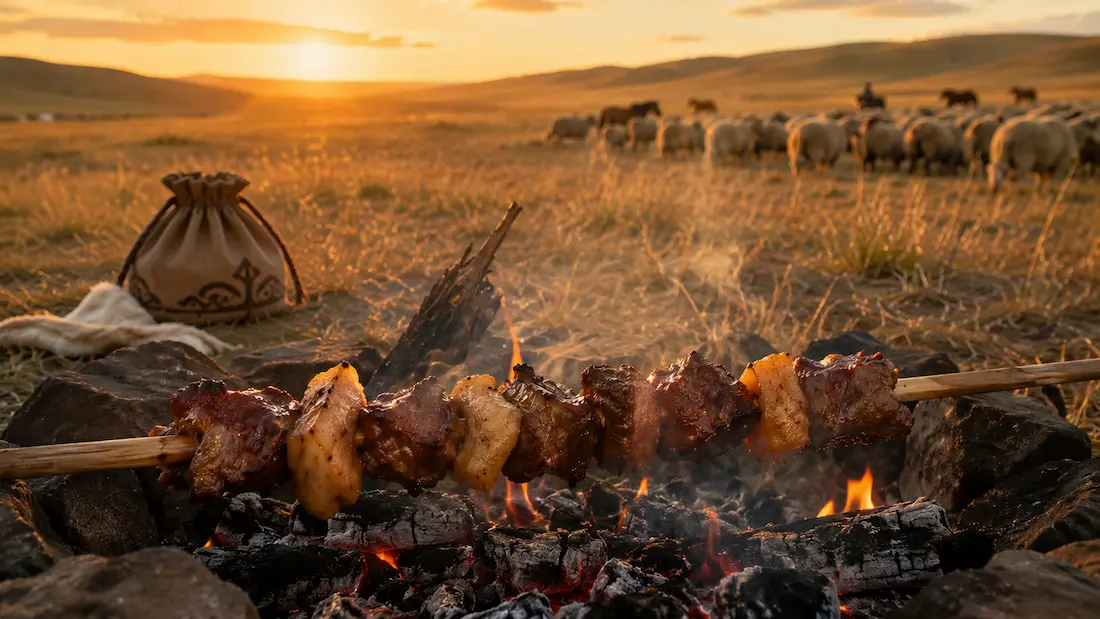
Zhaubuyrek is a classic nomadic dish, traditionally prepared by shepherds and travelers over an open fire. To make it, the butcher takes the sheep’s tail fat, liver, and lungs, slicing them into thin, leaf-like strips. These pieces are then threaded onto a skewer, alternating between the liver and the rich fat to ensure the meat remains juicy. Seasoned with salt and black pepper, it is roasted over hot coals. It can be considered a traditional Kazakh version of shashlik (kebab).
Borsha (Grilled Steak Strips)
Often prepared using beef, Borsha is another popular variation of roasted meat. Lean cuts from the hip, arm, or shoulder are sliced into long strips, gently tenderized with a knife, seasoned, and placed on a wire grill over hot coals. It is turned frequently until it reaches a deep, dark red color. It is traditionally enjoyed while drinking kymyz (fermented mare’s milk) or shubat (fermented camel’s milk).
Qaryn Burtpe (Stuffed Tripe)
Qaryn Burtpe is a rare and flavorful delicacy. It is made by stuffing a cleaned sheep’s stomach (qaryn) with a finely minced mixture of fresh meat, fat, liver, wheat flour, garlic, and spices. When boiled, the burtpe must be turned occasionally and pierced with a needle to allow steam to escape, simmering for 90 to 120 minutes.
Asip (Traditional Haggis-style Sausage)
Asip is a traditional sausage prepared by turning the sheep’s large intestine inside out and scrubbing it thoroughly. The filling consists of finely chopped meat, heart, and liver, mixed with onions, rice, and spices. Once the mixture is packed into the casing, it is submerged in boiling water for 50 to 60 minutes and pricked with a skewer to prevent it from bursting.
Zhorgem (Braided Intestines)
Zhorgem is a unique dish made by braiding the small and large intestines of an animal. To ensure they cook evenly and maintain their shape, the butcher weaves them into tight, intricate bundles. Zhorgem can be served boiled as part of a main meat platter or sliced and sautéed in fat until crispy.
Qimay (Beef Rib Sausage)
Qimay is a prestigious dish prepared from beef during the winter slaughter season. The large intestine is stuffed with cubes of brisket, choice cuts of beef, onions, and spices. Often referred to as "beef qazy," qimay maintains a perfect balance between fat and lean meat. It is traditionally cold-smoked, dried, and served chilled as an accompaniment to boiled meat.
Varieties of Quyrdaq and Other Delicacies
Sirne (Slow-Braised Lamb)
Sirne is an exquisite dish usually reserved for esteemed guests, featuring lamb or young mutton cooked entirely in its own juices. The meat cuts and natural fat are placed into a heavy pot, covered with a tightly sealed metal lid to trap all steam, and slow-cooked over a very low heat without extra water, allowing the meat to braise in its own essence.
Mi Palau (Brain Stew)
This is a highly prized, delicate dish served to elders. It is prepared by chopping the cooked brains, neck meat, eyes, and skin of a sheep’s head into small pieces. These are combined with a splash of hot broth, chopped onions, and spices, creating a rich, savory stew.
Quyryq-Bauyr (Tail Fat and Liver Appetizer)
To prepare this ceremonial appetizer, sheep’s tail fat (quyryq) is boiled over low heat, followed by the addition of fresh liver (bauyr). Once cooked and cooled, both are sliced into thin, matching pieces and served together with a flavorful tuzdyk sauce. It is always served as a separate course before the main meat platter.
Quyrdaq (Traditional Meat and Organ Roast)
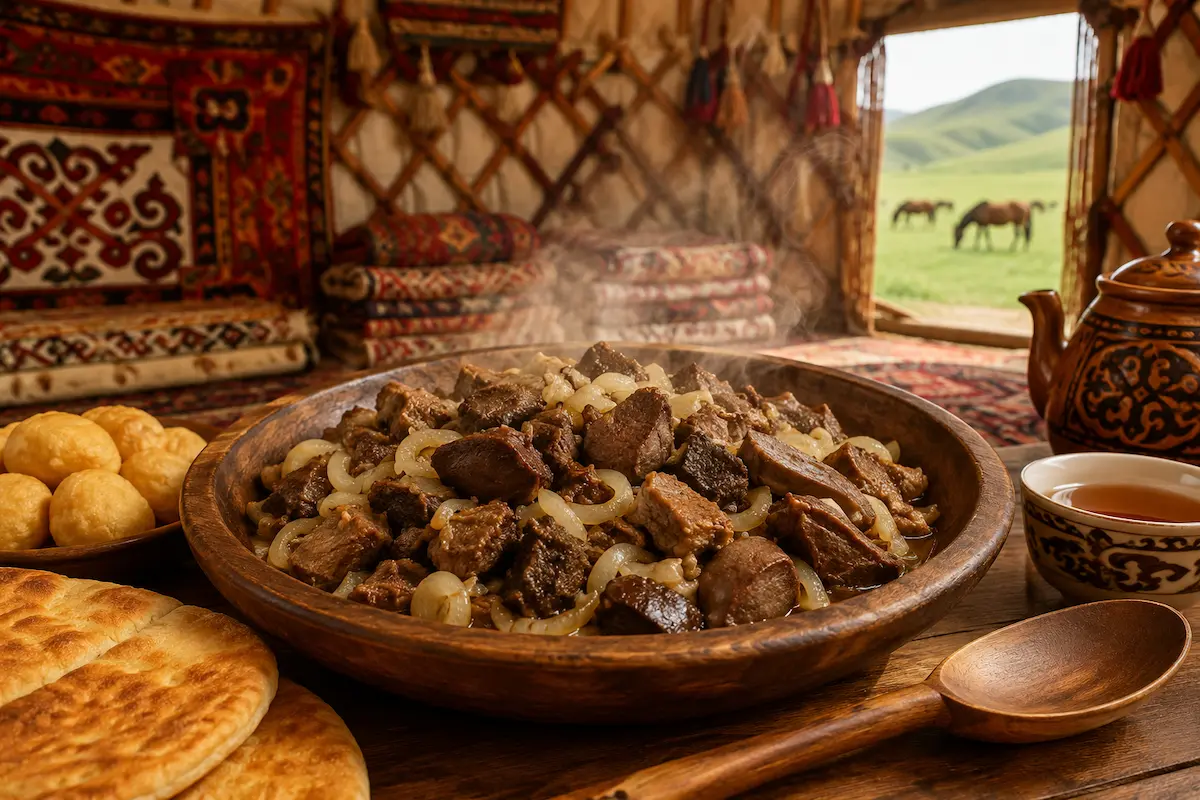
Quyrdaq is a hearty, classic dish made from fresh lung, liver, heart, kidneys, and assorted meat cuts, fried over high heat in rendered tail fat with onions and spices.
There are several traditional variations of this dish:
- Bal Quyrdaq: A refined version made from the tender meat of a young animal, sautéed exclusively in kaimak (fresh clotted cream) rather than fat.
- Zhonqa Quyrdaq: Made from frozen sogym (winter meat) shaved into paper-thin strips resembling wood shavings (zhonqa), allowing it to fry almost instantly.
- Potato Quyrdaq: A later variation where diced beef is fried with onions, and potatoes are added to braise in the rich meat juices.
- Qara Quyrdaq ("Black Roast"): Composed primarily of lungs, liver, and heart; the iron-rich elements darken the sauce as it caramelizes, giving it its name.
- Sogym Quyrdaq: Prepared specifically to feed those who helped with the winter slaughter, made from fresh trimmings and neck meat.
- Ukpe Quyrdaq: A rapid-cooking version characterized by incredibly finely minced lungs (ukpe) and meat.