Kazakh Bone and Horn Craft


The Craft of Bone Processing
Since the earliest periods of nomadic life, hunting and animal husbandry have been central to the livelihoods of the Kazakh people. Beyond using meat, fat, milk, and hides, their ancestors learned to transform bones and horns into practical tools, weapons, household objects, and decorative items.
Early bone-working techniques were simple but resourceful. Rib bones could be shaped into crude knives, leg bones into clubs, skulls into containers, and shoulder blades into shovel-like tools. Over generations, techniques such as carving, grinding, drilling, and heat treatment became increasingly sophisticated, eventually turning bone and horn into important materials for the decorative arts.
Archaeological evidence confirms that bone and horn working has deep roots in the region. Bone and horn objects have been found among early nomadic cultures of Kazakhstan, while later Kazakh craftsmen developed highly specialized techniques for combining these materials with wood, metal, and other natural materials.
The Evolution of Bone Craft
The development of metallurgy, particularly bronze and ironworking, expanded the possibilities of traditional bone craftsmanship. Bone and horn were no longer used only for simple utilitarian objects. They became sophisticated decorative materials, sometimes combined with silver, brass, and other metals or incorporated into elaborate carved designs.
Kazakh craftsmen developed an intimate knowledge of livestock and learned to use almost every part of an animal. This practical approach reflected the realities of nomadic life, where materials were valuable and waste was minimized.
The bones of horses and camels were particularly valued for certain decorative applications because their dense structure made them suitable for carving and polishing. Cattle bones were also widely used, especially for larger objects and components such as ladles, bowls, handles, and other household implements.
Preparing bone for decorative work required considerable patience. Depending on the desired finish, craftsmen could clean, degrease, boil, bleach, dry, and polish the material. Bone could also be treated to achieve different shades and surface qualities. The process involved steady cutting, scraping, grinding, and repeated cleaning.
Craftsmen used specialized tools, including fine saws, rasps, chisels, drills, and scrapers, which had to be kept extremely sharp. When shaping thin pieces, careful handling was essential because bone can crack or split under excessive pressure.
For more complex pieces, craftsmen sketched geometric or floral patterns onto polished bone and then carved them with small gouges or fine pointed tools. Colored pigments could be applied to the carved grooves to emphasize the design.
Some compositions were assembled from numerous small bone fragments. These pieces were carefully fitted together and attached to a wooden base with small nails or other fasteners. When holes had to be drilled near the edge of a bone piece, craftsmen worked cautiously to reduce the risk of cracking or shattering.
Construction and Detail
Particular sections of animal bones were especially suitable for producing objects with geometric, circular, straight, or branched forms. Thin sections of long bones could be shaped into awls, hooks, handles, and components for small boxes and other objects.
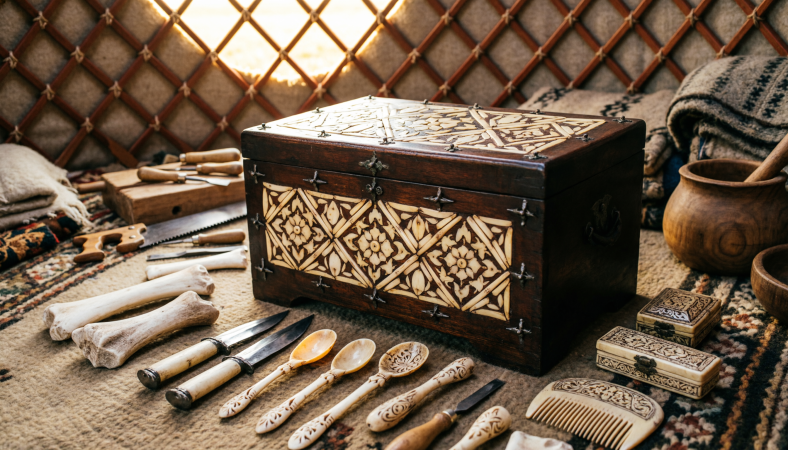
One notable example is the use of bone inlay on wooden chests known as kebeje (traditional wooden storage chests). The bone pieces could be fitted into shallow grooves cut into the wooden surface using a technique known as sugyndy iru (a method of setting tapered bone pieces into prepared grooves). The lower part of the bone insert is wider and gradually narrows toward the top, allowing it to fit securely into the wood. Small decorative nails could then reinforce the pieces while becoming part of the overall ornamental composition.
Bone was also used to decorate other wooden household objects, including chests, beds, doors, saddles, and musical instruments. Geometric bone plates could be arranged into elaborate patterns, combining practical construction with visual ornamentation.
Modern Kazakh masters continue to develop this tradition. Contemporary craftsmen work not only with livestock bones but also with bird and fish bones, using them to create floral motifs, decorative panels, brooches, figurines, and other artistic objects.
Bone can also be incorporated into larger pieces of furniture and household equipment through complex joining and fastening techniques. From elegant cane and whip handles such as kamshy sap (whip handles) to togyz kumalak game boards, bone remains part of the living material culture of Kazakhstan.
Common Items Crafted from or Decorated with Bone
- Alka — necklaces
- Astau — large wooden serving platters, sometimes decorated with bone
- Baki sap — folding-knife handles
- Beldik — belts
- Besik — cradles
- Bilezik — bracelets
- Dombra — traditional long-necked musical instruments
- Er — saddles
- Eshik — doors, including decorated wooden doors
- Ine — needles
- Keste sap — handles for embroidery tools
- Kerege — lattice sections of a yurt, sometimes featuring ornamental detailing
- Kasyk — spoons
- Kylysh sap — sword hilts
- May salgys — butter containers
- Ozhau — ladles
- Oyynshyktar — toys
- Tayanyk — headrests
- Taba k — serving plates
- Tegene — large basins
- Sham koygysh — lamp stands
- Various dishes, containers, handles, decorative fittings, and household objects
The Art of Horn Processing
Alongside hides, wool, and bone, animal horns and hooves provided important raw materials for Kazakh craftsmanship. The specialized working of horn, known as muyiz uk satu (horn processing and craft), became an important branch of traditional decorative and applied art. Historical sources describe the use of horns from animals such as argali, saiga, and cattle for bowls, ladles, knives, handles, and other objects. Horn was also used to decorate wooden household furnishings such as kebeje.
Horn objects were valued not simply because they were functional, but because they could display the skill of the craftsman. Carved and engraved patterns transformed an ordinary natural material into an object with aesthetic and cultural significance.
One traditional example is the ozhau, a ladle used for serving fermented mare's milk, kymyz. Horn could be shaped into curved ladles, including forms inspired by the neck of a swan. Such objects combined practical design with decorative craftsmanship.
Horn was also used for handles, vessels, snuffboxes, knife and dagger fittings, and other objects. Particularly elaborate examples could be combined with silver, brass, or other decorative metals.
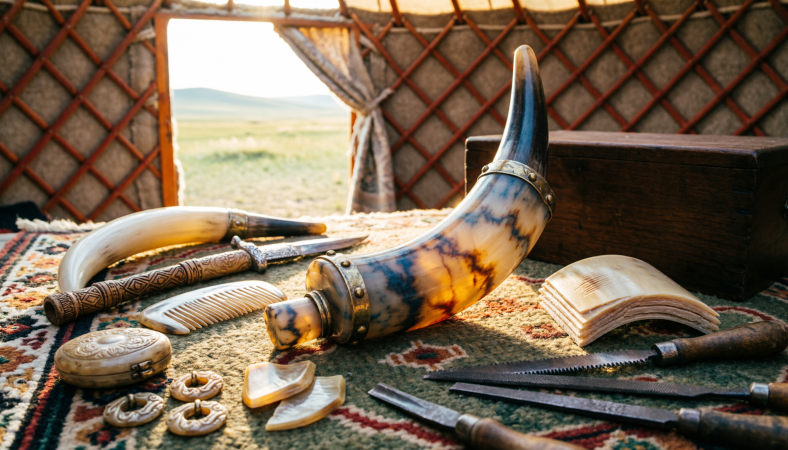
Among the most distinctive objects were horn powder flasks and snuffboxes known as shaksha. Horn was also used for handles of weapons and tools, while horn plates could be incorporated into decorative furniture and household objects. Historical and ethnographic sources document the broad use of horn in Kazakh applied arts.
Techniques and Workability
Horn differs from bone in one important respect: when heated, it becomes much more pliable. This makes it particularly suitable for bending, pressing, cutting, drilling, and shaping.
Because horn can be softened with heat, craftsmen could create a wide variety of objects, including spoons, vessels, buttons, combs, brooches, jewelry boxes, sword and knife handles, writing implements, and small mechanical components.
The basic technique involved heating or boiling the raw horn until it became sufficiently soft and flexible to reshape. The softened material could then be bent around a form, flattened, cut into plates, or carved.
To make a comb, for example, a craftsman could select horn from large cattle and cut it into sections with a fine-toothed saw. The pieces were flattened under pressure, thinned with a chisel and knife, and placed between wooden guides to protect them while the teeth were cut with a fine saw. Once the basic shape was complete, the comb was filed, polished, and, when desired, colored or dyed to produce a smooth, lustrous surface.
The properties of horn made it especially useful for objects that needed to be both durable and relatively light. The material could also display natural variations in color and pattern, giving finished objects an individual appearance.
Inlay and Artistic Assembly
Horn was frequently combined with wood and bone. Craftsmen could further embellish finished objects with silver rivets, brass fittings, decorative nails, or metal bands.
The most useful raw materials included the horns of cattle, mountain goats, rams, and wild argali, as well as horse hooves and the dense horn material of camel hooves. Different types of horn offered different colors, textures, thicknesses, and degrees of workability.
Skilled craftsmen could shave horn into thin sheets and layer or assemble them to create floral, leaf, geometric, or feather-like patterns.
One particularly distinctive object was the powder flask or snuffbox known as shaksha, which could be made from camel hoof horn. After drying, the material could develop a richly variegated appearance, sometimes resembling veined stone.
The horn was boiled and shaped into a suitable form. Some vessels were made in shapes reminiscent of traditional leather containers called torsyk (traditional leather vessels used for liquids such as fermented dairy drinks) or forms inspired by ram's horns.
The shaped material could then be trimmed, reinforced with small nails, or stitched using strong sinew. To preserve the desired shape while it dried, the vessel could be packed with sand and hardened in the sun.
Finally, the opening could be fitted with a brass or silver cap, while a decorative plug made from horn completed the vessel. Such flasks were practical personal accessories and could be suspended from traditional leather belts.
The related torsyk, although traditionally made from leather rather than horn, was an important vessel in its own right. It was used for storing and serving traditional fermented drinks, including kymyz and shubat.
The Versatility of Finished Goods
The ability to soften, straighten, cut, and mold horn allowed craftsmen to turn this natural material into a remarkable range of everyday objects and decorative pieces.
Buttons, for example, could be shaped in molds and then finished by drilling or piercing the holes needed for attachment. Thin horn plates could become combs, hairpins, decorative fittings, and inlay elements, while thicker sections were suitable for handles and vessels.
The resulting objects were not merely practical. Their polished surfaces, natural patterns, carved designs, and metal fittings allowed craftsmen to combine utility with beauty.
Common Items Crafted from or Decorated with Horn
- Tea sets and ladles
- Shaksha — snuffboxes and powder flasks
- Serving platters
- Combs and hairpins
- Knife and axe handles
- Sword and dagger handles
- Decorative inlay for wooden chests such as kebeje
- Ornamentation for wooden doors and furniture
- Buttons and small personal accessories
- Various household containers
- Decorative and functional fittings
A Living Craft Tradition
Kazakh bone and horn craftsmanship developed from the practical needs of a nomadic society, where livestock provided food, clothing, tools, transportation, and raw materials. Bones and horns that might otherwise have been discarded could be cleaned, shaped, polished, carved, and transformed into useful objects or works of art.
The craft therefore represents more than a collection of techniques. It reflects a broader principle of traditional nomadic life: making full use of available natural resources while combining practicality with beauty.
From the carved bone inlay of a kebeje to the curved ozhau, from horn handles and combs to the distinctive shaksha, these objects preserve knowledge of materials and craftsmanship passed from one generation to another.
Today, bone and horn working remains part of Kazakhstan's traditional craft heritage. Contemporary masters continue to reinterpret old techniques, demonstrating that materials once essential to nomadic everyday life can still inspire new forms of artistic expression.