Marriage and Wedding Customs


Amengerlik: Levirate Marriage
When a married man passed away, Kazakh society used the ancient practice of Amengerlik to ensure the widow and her children were never abandoned or left without protection. The widow was traditionally given the choice to marry one of her late husband’s younger brothers or a close cousin within the lineage. Crucially, the woman's consent was a core factor. If she chose to leave the clan entirely to marry a stranger from another tribe, she was free to do so, though she could not claim the late husband’s ancestral herds; she departed strictly with the dowry (zhasau) she originally brought from her parents' home—a process known as irgeden shygaru (exiting the foundation). If she chose Amengerlik, her new husband assumed full financial and emotional responsibility for her children, keeping the family lineage whole.
Aq Zhol: The Path of Fidelity
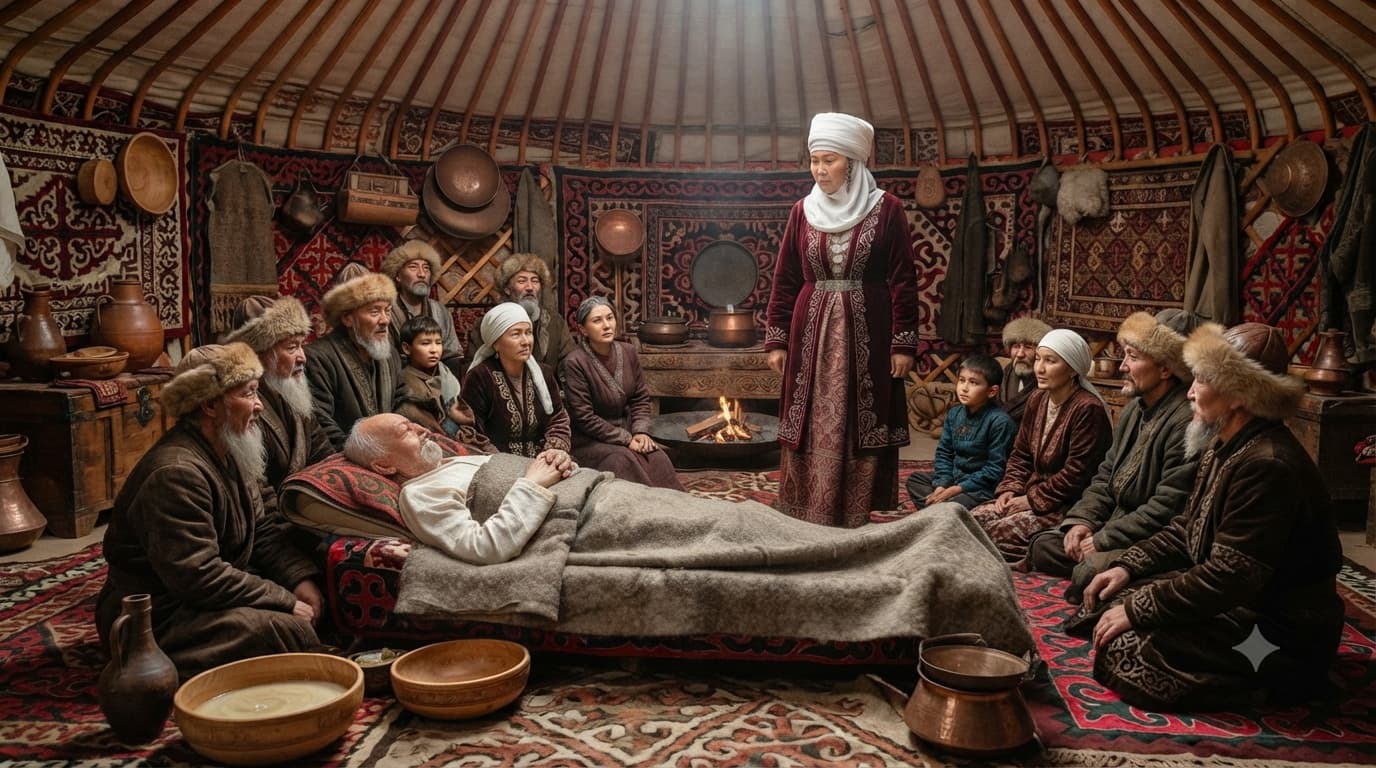
Aq Zhol (The White Path) was a traditional ritual used to test or honor a woman’s marital fidelity. Steppe mysticism held that if a woman was completely devoted and honest to her husband, her spirit possessed healing powers. If she stepped over a severely bedridden person three times, the patient would miraculously recover. A woman whose presence successfully broke a fever was revered as a spiritually gifted protector. This vivid tradition is famously detailed in Ilyas Esenberlin’s historical epic novel Kahari (Thunder).
At Tergeu: The Etiquette of Respectful Names
To instill modesty and respect for elders, young brides entering their husband's village practiced At Tergeu (avoiding direct names). It was considered highly disrespectful and improper for a daughter-in-law to call her husband’s relatives by their birth names. Instead, she invented affectionate, honorable titles for everyone:
- Father-in-law
- Traditional Birth Name Replaced By: Ata or Biy
- Meaning / Tone: Grandfather / Judge Father
- Mother-in-law
- Traditional Birth Name Replaced By: Apa
- Meaning / Tone: Mother
- Older Brother-in-law
- Traditional Birth Name Replaced By: Aga or Myrza Kaynaga
- Meaning / Tone: Respected Brother / Generous Lord
- Husband's Sister
- Traditional Birth Name Replaced By: Kayninsilim
- Meaning / Tone: My Cherished Little Sister
- Elder Brother's Wife
- Traditional Birth Name Replaced By: Zhengeshe
- Meaning / Tone: Respected Sister-in-Law
This linguistic politeness preserved harmonious boundaries within large extended households. While fading in urban centers, it remains a beautiful mark of traditional upbringing.
Bes Zhaksy: The Five Ultimate Treasures
The Bes Zhaksy (The Five Best Things) represents the absolute pinnacle of luxury gifting in steppe diplomacy. It was used to seal eternal friendships between wealthy lords, heroes, and tribal judges (biys), and routinely functioned as the premium bride-price (kalyn mal) between aristocratic families. The traditional composition of the Bes Zhaksy included:
- Kara Nar: A magnificent, pure-black pedigree camel.
- Zhuyrik At: A legendary, lightning-fast racing stallion.
- Persian Carpet: An exceptionally rare, intricately woven imported rug.
- Almas Kylysh: A flawless, razor-sharp Damascus or diamond-steel sword.
- Bulghyn Ishik: A luxurious winter coat crafted from premium sable fur.
Occasionally, one of these items would be swapped for a Saukele—a high-status bridal headdress encrusted with precious gemstones. The collective value of a single Bes Zhaksy package was equivalent to a massive herd of four to five prime horses, serving as a striking display of wealth and absolute diplomatic respect.
Irgeden Shygaru: The Widow's Autonomy Decree
Following the old custom of levirate marriage (Amengerlik), if a husband passed away, his widow was traditionally expected to marry one of his brothers or close male relatives after the one-year mourning period to keep the family intact. However, if no eligible relatives existed or if the widow firmly requested her independence, a council of elders and judges would formally review her case. If granted her freedom, she could leave to marry outside the clan, though she had to leave the late husband's livestock property behind, taking only her personal bridal dowry (Zhasau). This formal process of granting autonomy and separating her household was called Irgeden Shygaru.
Kade: The Fabric of Steppe Etiquette
A Kade is an obligatory token, gift, or fee required at specific milestones during major celebrations, weddings, and games. Arriving at a family function without a Kade is viewed as a severe insult to the hosts and a total breach of etiquette. The traditional catalog of these gifts is immense:
- Wedding & In-Law Rituals: Toibastar (gifts for the person who sings the opening song), Korimdik (a cash gift to see the new bride's face), Shege Shapan (the "nail robe" gifted to cement an alliance), and Sut Aky (the milk-fee paid directly to the bride's mother for raising her).
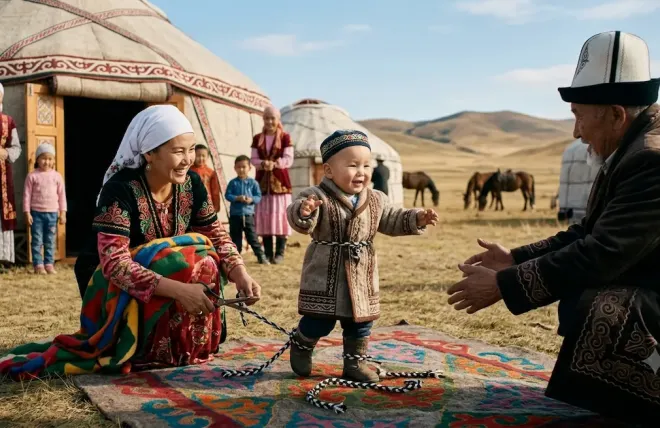
- Childbirth & Milestones: At Koyuu (naming tokens), Kindik Kesu (the umbilical-cord cutting gift), and Tusau Kesu (the toddler's first-steps rope-cutting fee).
- Funerary Rites: Sadaka (charitable distributions) and Aruylau (cleansing tokens).
Korisu: The Three Ritual Welcomes
The emotional act of Korisu (formal greeting or embracing) appears in three distinct cultural scenarios:
- The Bride's Tears: A newlywed bride was traditionally barred from visiting her parental home during her first year of marriage to help her bond with her new in-laws. When her siblings came to visit her new camp, she would embrace them crying (Korisu), pouring out her joy, homesickness, and marital updates.
- Long-Distance Reunions: When a daughter married into a distant tribe separated by hundreds of miles, her eventual reunion with her parents was marked by a highly emotional, weeping embrace.
- Grief and Mourning: When entering a house of mourning, arriving guests would embrace the family while weeping. By custom, men expressed their grief with silent, stoic embraces, while women accompanied the gesture with vocal laments.
Suyek Zhingyrtu: Renewing the Family Bone
To strengthen long-term alliances between clans, Kazakhs frequently practiced Suyek Zhingyrtu (literally, "renewing the bone"). If a family successfully married their eldest son to a daughter of another clan, they would later arrange a second marriage between their younger son and the bride's younger sister. This double-alliance created incredibly tight family connections. Clan leaders carefully monitored these arrangements to ensure that all generational lineages remained perfectly aligned with customary laws, ensuring regional peace and unity.
Salem Beru: The Etiquette of Respectful Greetings
Offering a formal greeting (Salem Beru) is a vital pillar of steppe manners. When a traveler arrives from a long journey, or when locals meet, they must immediately pay their respects to the village elders and honored leaders. This custom manifests in several traditional ways:
- The Travelers: Travelers arriving from distant lands must immediately visit the tents of local elders to offer formal greetings.
- The Bride's Curtsy: A daughter-in-law greets her husband's parents and senior relatives by performing a graceful, deep curtsy (iyilip salem etu) while gently bowing her head, demonstrating deep respect.
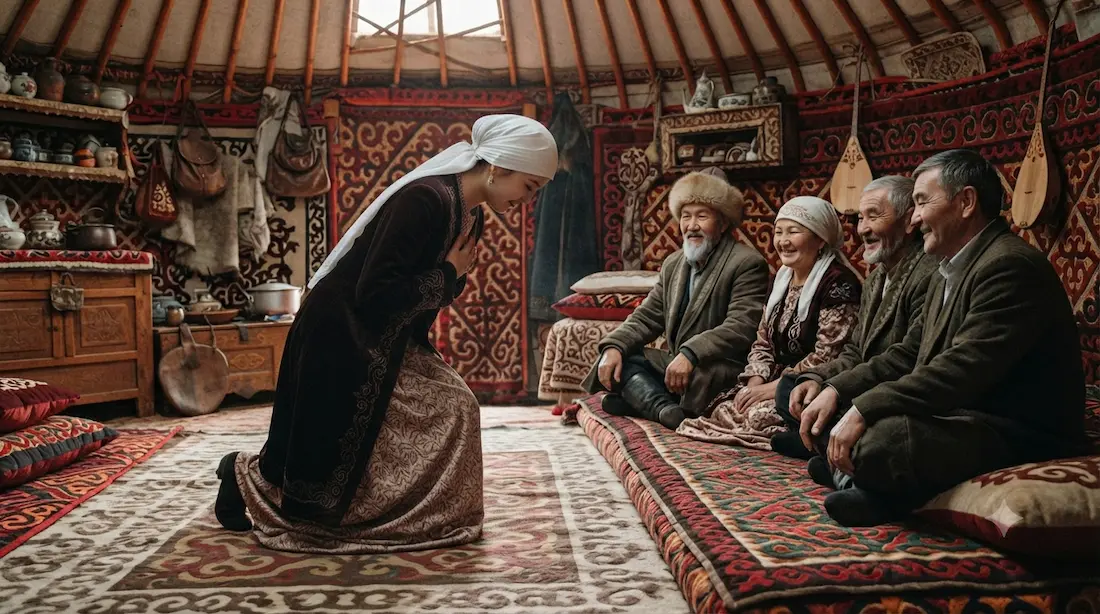
- The Back-Greeting: If a person suffered from a severely stiff or injured neck and could not bend their head forward, they would turn around and bow slightly from the back when greeting a leader. While unusual, this practical accommodation often brought a wave of good-natured laughter to the assembly.
Tabarik: Sharing the Bounty
When a person wins a grand prize at a horse race or receives premium gifts during an in-law negotiation, onlookers have the right to request a Tabarik (a small fragment of the fortune). The winner is expected to divide their rewards and distribute small pieces, coins, or fabrics to the crowd. Refusing to share a Tabarik is viewed as greedy and a violation of custom, often resulting in public mockery and social exclusion.
Uy Synygy: The Marital Safeguard for Brides
If a man experienced the tragic misfortune of losing multiple wives to illness or early death, arranging a new marriage became exceptionally difficult, as families were hesitant to send their daughters into his home. If a prospective family eventually agreed to a match, they would request a special compensatory custom called Uy Synygy (literally, "the repair of the broken home"). In addition to the standard bride-price (Kalyn Mal), the groom had to provide an extra dowry of equal value. Because a man marrying for the third or fourth time was typically much older than a young bride, this mandatory custom served as a fair economic safeguard, securing the bride's financial future and status within the new household.
Zheti Ata: The Law of Seven Ancestors
An ironclad rule of the steppe dictates that all descendants branching from a single forefather up to seven generations are considered direct siblings and close blood relatives. Because of this, every young Kazakh was fiercely trained to memorize their Zheti Ata (Seven Ancestors). Marrying anyone within this seven-generation lineage was strictly forbidden, a genetic and social law that successfully prevented inbreeding and preserved strong alliances across the plains.
Zhurtys: The Fabric Ritual
Zhurtys is a specialized ritual of sharing textile wealth, practiced exclusively among women. During a wedding, a beautifully embroidered double-saddlebag (korzhyn) packed with gifts is presented. When the bag is formally opened, the large sheets of fine fabric tied to its handles are unraveled and ritually torn (zhurtu) into smaller strips so that every woman present receives a piece. This custom is also practiced during Kudayi (remembrance feasts) or the funerals of individuals who lived exceptionally long, prosperous, and honorable lives, allowing attendees to take home a physical fragment of that person’s good fortune.