Kazakh Nomadic Jewelry Art


The tradition of zergerlik (jewelry making) is an ancient craft deeply rooted in the history, identity, and everyday life of the Kazakh people. Throughout Central Asia, the term zerger (jeweler or master metal artisan) has long been used to describe the highly respected craftsmen who dedicated themselves to creating exquisite gold and silver adornments.
While Kazakh artisans possessed a profound mastery of intricate metalworking techniques, they rarely engaged in the primary smelting or refinement of precious metals themselves. In nomadic steppe conditions, setting up large-scale mining and smelting furnaces was impractical. Instead, they acquired gold and silver through trade and exchange with neighboring Russian regions and trade routes. Because raw bullion was difficult to procure, Kazakh jewelers often melted down gold and silver coins, or incorporated foreign and local currency directly into their artistic designs.
Key Fundamentals of Zergerlik Art
To understand the art of Kazakh jewelry, it is helpful to look at its core components and vocabulary:
Sym: A specialized iron drawplate used by jewelers for wire-drawing to reduce silver into hair-thin strands.
Jamby: Refined silver ingots that served as the primary raw material, trade currency, and standard of wealth.
Gold and Silver Casting: The ancient technique of shaping molten precious metals into solid jewelry and decorative objects using handmade molds.
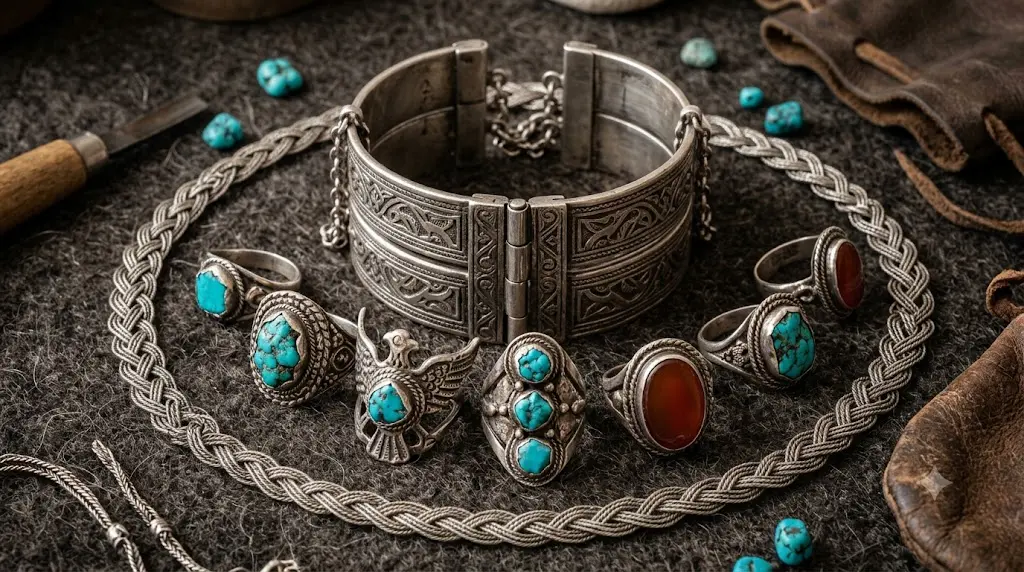
Principal Jewelry Exemplars: The most celebrated traditional adornments, including bilezik (bracelets), sakina (rings), baldak (unadorned bands), sholpy (melodic hair pendants), and shashkap (protective velvet hair sheaths).
Craftsmanship and the Scope of Nomadic Jewelry
Working with simple, traditional tools and portable workshop setups, zerger artisans produced remarkably delicate and complex items. Their creations were an essential part of nomadic life, serving not only as personal adornments, but also as family heirlooms, protective talismans, and clear indicators of social status and economic prosperity. Kazakh jewelry art can be broadly categorized into personal ornaments and functional household items.
Personal Adornments
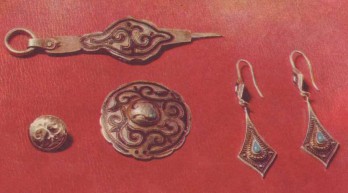
Bilezik: Traditional bracelets worn on the wrists.
Onir jiek: Ornate chest-border decorations sewn onto the front of women's dresses.
Sakina: Traditional rings set with gemstones or patterned motifs.
Syrga: Delicate earrings worn by girls and women.
Tis shukygysh: Elegant personal toothpicks crafted from silver or gold, carried in small protective pockets as a sign of personal hygiene and refinement.
Kemer beldik and Kise: The kemer beldik was a wide, heavy ornamental belt, often worn alongside a kise (a decorative belt pouch for carrying flint, knives, or personal necessities).
Specialized Fasteners and Accessories: Artisans created kiyksha (diagonal-patterned metal plates), koza (bud-shaped ornaments), sholpy (elaborate hair pendants), alka (necklaces), kapsyrma (ornamental belt buckles), saukele tuireuis (decorative pins for the saukele, the traditional tall bridal headpiece), myk (small decorative metal nails and fasteners), ilgek (clasps and hooks), sagat bau (watch chains), uzbe (linked chain ornaments), buttons with stems, burama (coiled wire pieces), and denbet (ornamental plaques).
Everyday and Lifestyle Objects
Beyond personal adornment, zerger artisans transformed everyday objects into artistic masterpieces. They embellished wooden tableware, beds, horse saddles and bridles (er-turman), weaponry, writing tools, tobacco cases, nasybai shaksha (snuffboxes for holding powdered tobacco), opa sauyt (vanity sets and powder compacts), and musical instruments such as the dombyra (two-stringed plucked lute), kobyz (ancient bowed instrument), and syrnai (traditional wind instrument).
Technical Approaches in Kazakh Jewelry Making
The work of a zerger is classified into several distinct techniques based on how metals are processed and decorated:
- Mechanical and Pressure Techniques: Utilizing hand presses, compression molds, and specialized iron dies to stamp thin metal sheets.
- Casting: Pouring molten precious metal into custom-made molds to produce heavy, solid forms.
- Applied Ornamentation: Overlaying one metal onto another, or bonding metals together to form layered decorative patterns.
- Surface Decoration: Engraving, scratching, or etching designs directly onto the surface of metal.
- Finishing Processes: Gilding (applying thin gold leaf), stamping, hollow-casting, rounding, beading, and attaching dangling metal fringes.
The Art of Wire-Drawing and the Significance of Jamby
To ensure that silver is ideal for forging and stretching into fine strands, master jewelers meticulously select only the purest, unalloyed metal. Pure silver remains soft and malleable during forging and can be drawn into fine wire without fracturing. Furthermore, pure silver possesses a natural, bright luster that requires little artificial enhancement and resists tarnishing in the open climate of the Eurasian steppe.
Consequently, Kazakh zerger artisans prioritized jamby—large, refined ingots of pure silver—as their primary raw material. Because these ingots retained their brilliance, they were regarded as the gold standard for high-quality jewelry making. Within Kazakh nomadic culture, jamby also served as major currency and were classified into six distinct types based on their size and shape (ranging from largest to smallest):
Besik jamby: Cradle-shaped ingot (the largest and most valuable type).
At bas jamby: Horse-head shaped ingot.
Koy bas jamby: Sheep-head shaped ingot.
Tai tuyak jamby: Foal-hoof shaped ingot.
Koy tuyak jamby: Sheep-hoof shaped ingot.
Asyk jamby: Knucklebone-shaped ingot (the smallest type).
To transform these solid ingots into fine wire, the jeweler employed a specialized tool called a sym (drawplate). This tool consisted of a rectangular iron bar, typically 20–25 cm long, 3–4 cm wide, and 2 cm thick. Running through the center of the bar was a series of 11 to 18 progressively smaller holes, ranging from the thickness of a nail down to a hole as fine as a single human hair. Between these holes, the tool featured small spherical and semi-spherical depressions used for shaping the rounded heads of decorative nails and pins.
The wire-drawing process followed a precise series of steps:
- Melting and Forging: The silver was melted, purified, and forged into a slender rod approximately 10–15 cm long, matching the thickness of a small nail.
- Sequential Pulling: The rod was threaded through the largest hole of the sym and incrementally pulled through progressively narrower holes. With each pass, the silver thinned and lengthened until it emerged as a fine, hair-like wire.
- Coiling: As the wire was drawn out, it was gathered into neat circular coils, much like embroidery thread.
- Texturing: To enhance its decorative potential, the artisan could place the end of the wire onto the grooved surface of a metal file and strike it evenly with a hammer, causing the soft silver to take on the textured pattern of the file.
- Polishing: Finally, to achieve a brilliant mirror-like shine, the silver was polished using a soft whetstone and fine sandpaper, followed by felt, and finished with a buffing using soft cloth.
Ornamentation Through Casting and Pressing
Objects featuring rounded, spherical, angular, or square forms were typically crafted from solid cast gold or silver. Examples included refined ingots like jamby, at bas altyn (horse-head shaped gold ingots), and dilda (gold coins), as well as heavy cast bracelets, rings, golden bowls, and ak jamby (pure white silver ingots). By melting and casting precious metals, artisans also created luxury everyday items such as golden spoons, silver ladles, and decorative watch cases. In nomadic culture, items made from solid cast metals were cherished treasures passed down as family heirlooms.
Custom Molds and Hand Finishing
To create cast pieces, a master artisan first crafted a custom mold. Molds were traditionally made from tin, lead, brass, finely ground clay, durable hardwood, or animal horn. The artisan carved intricate reverse patterns into the interior surface of the mold. When molten gold or silver was poured into the cavity, it emerged with the pre-formed relief design. Once cooled, the jeweler refined the surface by hand, using a fine awl, sharp chisel, or knife tip to etch additional detail.
To achieve a glowing finish, craftsmen buffed the cast pieces using sandpaper, felt, wool, or soft fabrics. Kazakh jewelers used this casting and polishing approach for items like rings, bracelets, earrings, and sholpy (hair ornaments). Artisans also created complex decorative textures by twisting, braiding, or weaving fine silver wire—drawn through a sym (drawplate)—and by setting colored gemstones into metal bezels, secured with tiny ornamental nails.
Pressing and Stamping Techniques
For delicate, lightweight accessories such as a woman's alka (necklace), tana (ornamental plaque), jarma (chain links), shytyrman (intricate mesh pieces), koza (bud ornaments), and decorative metal buttons, jewelers used a specialized pressing technique:
- A thin, soft sheet of silver was placed over the cavity of an engraved iron mold.
- A piece of sturdy lead was placed directly on top of the silver.
- The artisan compressed the mold using a strong vise or struck the lead with a hammer.
- The pressure forced the soft silver to conform perfectly to the patterned interior of the mold, leaving a crisp impression of the design.
- The lead was then carefully removed using a hook; however, in some cases, the lead backing was left inside the hollow silver ornament to give it extra weight, durability, and structural stability.
Principal Exemplars of the Jeweler’s Art
Bilezik (Bracelets)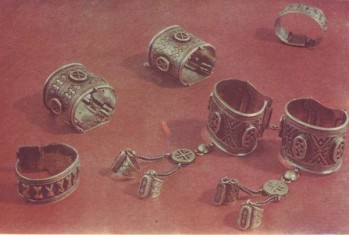
Kazakh jewelers produced an extensive variety of bracelets, each demonstrating specialized craftsmanship and stylistic features. These included:
- Kos bilezik: A double bracelet consisting of a broad, flat metal base topped with two parallel, rounded bands. It was typically decorated with traditional motifs such as synary okshe (sole of the heel motif), yrghak (wave motif), burma (coil pattern), and koz (eye or stone setting).
- Bes bilezik: A five-fold bracelet system connected to rings across the hand.
- Jumyr bilezik: A smooth, rounded solid metal bracelet.
- Orama bilezik: A flat, belt-like bracelet designed to wrap around the wrist. Its edges were often lined with gold, while the center featured complex animal, botanical, or geometric motifs, frequently combining gold and silver.
- Burama bilezik: A coiled or twisted wire bracelet.
- Kavkaz bilezik: A Caucasian-style decorated bracelet.
- Kozdi bilezik: A gemstone-set bracelet featuring raised bezels holding precious stones in white, blue, red, or green. The settings were adorned using stamping, engraving, and filigree edge decorations.
- Orme bilezik: A braided silver wire bracelet.
- Uzbeli bilezik: A linked chain bracelet made of articulated metal segments.
- Topsaly bilezik: A hinged bracelet consisting of movable jointed sections.
- Kolka bilezik: A hollow or chambered bracelet.
The size and weight of these bracelets varied according to personal preference, with surface ornamentation carefully chosen to complement the bracelet's structural style.
Saqina and Baldak (Rings and Finger Bands)
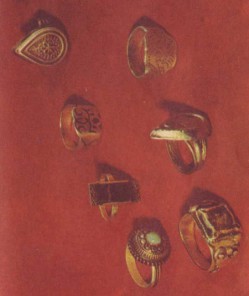
Sakina were named according to their visual style and focal design:
- Tasty sakina: A stone-set ring holding a central gemstone.
- Monsakty sakina: A beaded ring decorated with small metallic or glass spheres.
- Kavkaz sakina: A ring crafted in the Caucasian artistic style.
- Kusmuryn sakina: A bird-beak shaped ring, historically symbolizing good news, freedom, and youth.
- Yrghak sakina: A ring decorated with wave patterns.
- Buramaly sakina: A coiled or twisted ring.
In contrast, baldak were simple bands not categorized by style, but named strictly by their material: altyn baldak (gold band) or kumis baldak (silver band). Sakina were usually forged from solid silver, with the gemstone setting crafted separately, decorated in a mold, and then soldered onto the main ring.
Sholpy (Hair Ornaments)
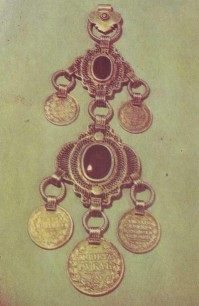
The sholpy is one of the most elaborate and culturally rich elements of Kazakh women's jewelry. These heavy silver pendants served aesthetic, practical, and social functions: their weight was believed to improve posture and promote healthy hair growth, while their monetary value reflected a family's wealth.
Traditionally, sholpy were worn by young girls and unmarried women, as loud hair ornaments were considered inappropriate for older women. The gentle, rhythmic chiming of the silver as a young woman walked served as a subtle sign of her presence in the nomadic encampment.
Common varieties included:
- Konyrauly sholpy: Consisting of a series of diamond-shaped silver capsules linked together, each containing a tiny interior bell. The exterior of the capsules was decorated with fine engraving, while the corners were adorned with dangling pearls, beads, or silver coins. As the wearer moved, the pieces struck one another to create a melodic chiming sound.
- Uzbeli sholpy and Kos uzbeli sholpy: Crafted by linking silver currency coins or decorative metal tokens in vertical sequences. These ornaments were attached to a girl's two braids, either as a single strand for each braid or split into four separate strands. The links were formed by soldering decorative silver hoops or by drilling small holes directly through the coins.
- Other Variations: Kozaly sholpy (bud-shaped hair pendant), Kozdi sholpy (gemstone-set hair pendant), Kop uzbeli sholpy (multi-linked hair pendant), Sagat bauly sholpy (watch-chain style hair ornament), and Marjandy sholpy (pearl-decorated hair pendant).
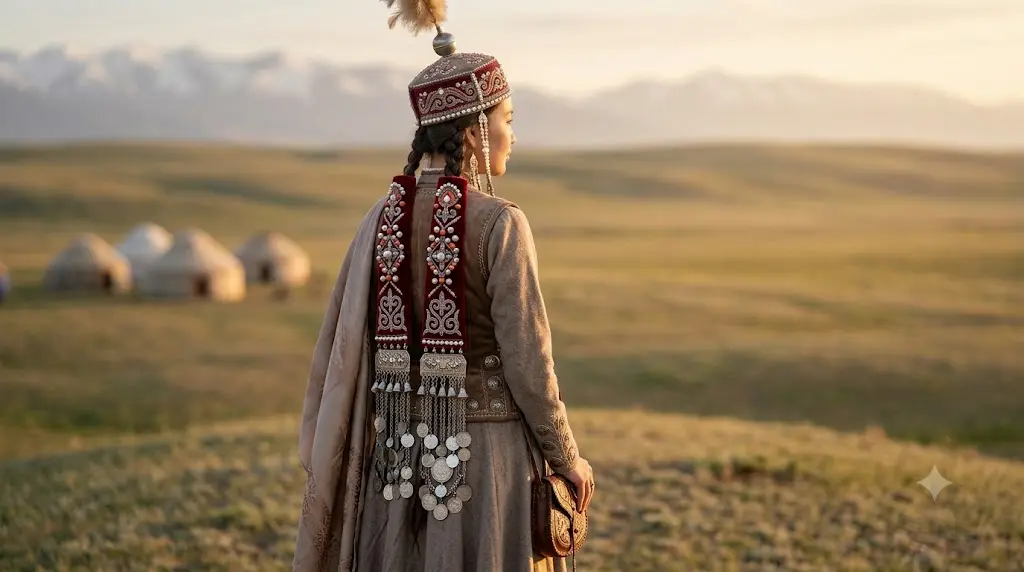
Shashkap (Hair Sheaths)
In traditional Kazakh culture, young women and brides wore a shashkap—a long, tubular fabric sheath designed to completely enclose and protect their braided hair.
These practical covers were worn while performing physically demanding everyday labor in the steppe, such as processing raw wool, making felt, weaving reed mats, loading pack animals during migrations, assembling yurts, or milking livestock. Along with other hair accessories like sholpy, shashbau (decorative hair ribbons and ties), alka (necklaces), and onir (chest ornaments), the shashkap combined aesthetic beauty with practical protection against the drying steppe wind, intense sun, and dust.
Shashkap were typically made from rich blue, green, red, or black velvet. The edges and ends of the velvet sheath were embroidered with gold and silver thread, while the center was adorned with harmonious decorative patterns formed from white pearls.