From Looms to Ropes: The Textile Arts of Kazakh Nomads


The ormek (traditional loom) was one of the essential tools of Kazakh textile craftsmanship. Simple yet remarkably effective, this manual device requires no complex machinery and uses easily accessible materials, allowing weavers to assemble it anywhere across the steppe. Nomads relied on two primary variations of this versatile apparatus:
- The Hanging or Termeli Loom: Designed to produce wider, continuous textiles, including large floor coverings.
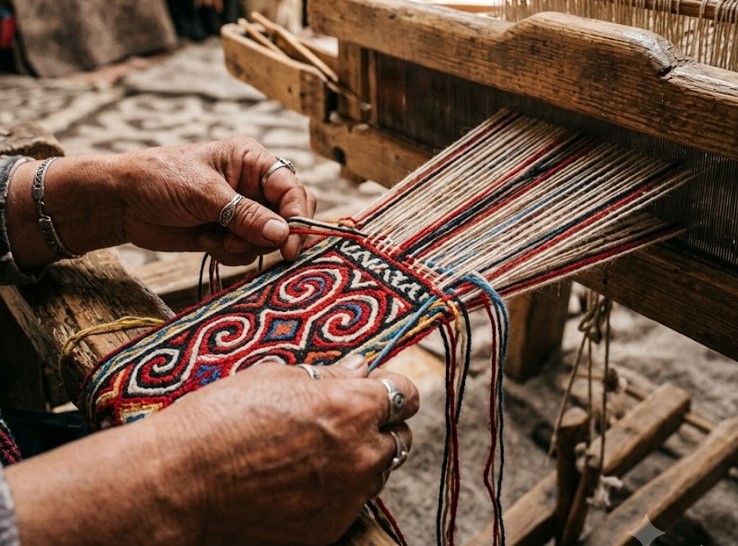
- The Zhai Loom: A compact, portable frame used for weaving narrower items such as shekpen (traditional wool cloaks), alasha (striped rugs), storage sacks, saddlebags, belts, terme (patterned bands), and baskur (structural yurt ribbons).
Preparing the Yarn and Warp
Artisans spin yarn in vibrant colors and wind each hue into separate balls based on the desired design, striping, and ornamentation. Depending on the required thickness and strength, the warp threads—which run longitudinally along the frame—are spun either as single strands or plied into two.
For heavier fabrics like protective cloaks, weavers spin yarn with alternating clockwise and counter-clockwise twists, similar to decorative piping techniques. In traditional terminology, the upper warp layer is called ersisi (upper warp layer), while the lower layer is known as karsysy (lower warp layer).
How Alasha Rugs Were Woven and Joined
The alasha (multi-striped rug) was an indispensable household asset for nomads because it folded easily, stored compactly, and transported effortlessly during seasonal migrations.
Artisans typically weave alasha on the ormek in narrow strips measuring 40 to 45 centimeters in width. To assemble a full-sized rug, several panels must be joined with precision. A master weaver calculates the required dimensions and panel counts based on the rug's intended length and total width.
Sustainable Craftsmanship: Repurposing Kyrkyndy
Removing a finished textile leaves roughly 35 to 40 centimeters of leftover warp thread, known as kyrkyndy (yarn waste). Rather than throwing these valuable materials away, artisans repurpose these remnants—typically available in white, black, blue, and red—to join the woven strips together.
Using a distinctive stitch called buzau tis (calf-tooth pattern), weavers connect the panel edges while inserting small fabric tabs at intervals of 1 to 2 centimeters to expand the rug's overall surface area.
Traditional Weaving Motifs and the Terme Technique
Nomadic weavers employ two foundational structural patterns on the ormek:
- Su Pattern ("Water" motif): Created by passing a single-colored weft thread across the entire width of the loom, generating clean, continuous monochromatic lines representing life-giving water.
- Tis Pattern ("Tooth" motif): Formed by alternating two contrasting colored threads (typically black for the lower warp and white for the upper), producing a rhythmic, interlocking design.
The Art of Terme: Pattern-Picking on the Loom
Intricate motifs—including stylized animal horns, floral shapes, and geometric symbols—are achieved through the terme (pattern-picking technique). Widely considered the most artistic and adaptable method in Kazakh loom-weaving, this approach flourished across the steppe, developing unique regional variations in Southern Kazakhstan, Karaganda, and Pavlodar:
- Kayyra Teru: A double-sided technique using three or four yarn colors where both upper and lower warps are manipulated simultaneously, producing a clear design visible on both sides of the fabric.
- Kejim Teru (also known as Bukhar Teru): A refined, multi-colored picking method primarily used to craft ornate baskur (yurt wall bands) and high-grade alasha rugs.
- Orama Teru (wrapping technique): Built upon a solid white or red base, the weaver manually wraps colorful accent threads around individual warp fibers before locking them in place with the weft.
- Single-Color Picking: Reserved for structural baskur bands, using a uniform white or red warp while picking out contrasting patterns in red, black, or blue to create refined decorative ribbons.
Distinctive Carpet Styles
Kazakh rug-making encompasses distinct structural styles suited to nomadic living:
- Takyr (flat-woven carpet): Heavily practiced in the Kyzylorda region, these pileless carpets are crafted without loops. Designs are pre-dyed into the warp or created by alternating black and white yarns to form bold vertical bands, horizontal stripes, or sharp zigzags.
- Tuktep Teru (tufted picking technique): Used to craft smaller luxury items like mini-carpets, saddlebags, and floor mats. Accent threads are woven alongside the warp, left loose on the fabric surface, and trimmed with a sharp blade to create a soft, dense pile that adds warmth and texture.
Kilem Oneri: The Art and Soul of Kazakh Carpets
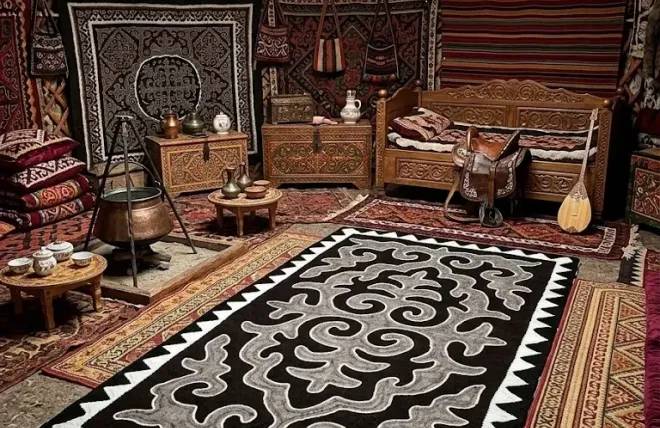
An old Kazakh proverb states: "The carpet is the soul of the home." Serving as floor insulation, wall draft protection, and decorative luxury inside the yurt, carpets remain central to Kazakh cultural identity.
Centuries-old records document a rich variety of regional carpet traditions, including Bukhara, silk, cotton, thick-pile, masaty (velvet-like carpet), flat-woven, tufted, black, and alasha styles.
Loom Setup and Materials
Master carpet makers utilize a sturdy vertical frame known as the hanging loom or carpet loom. Warp threads are arranged in three or four layers for structural strength. The foundation weft is spun from a durable blend of cotton, camel hair, or silk.
In contrast, the surface pile and decorative motifs are spun from soft sheep's wool or camel down, twisted loosely to remain plush. Weavers organize these plush fibers into color-coded bundles, pulling and knotting them onto the warp frame row by row.
The Weaving Process
Typically, two or three artisans sit side-by-side to weave a pile carpet:
- Looping: Weavers loop colored yarn around the warp threads according to precise pattern counts.
- Trimming: The yarn is cleanly sheared using a sharp blade.
- Compacting: Artisans use an adargi (heavy comb-beater) to pound the row tightly against the underlying weft.
By alternating warp positions between passes, the knots become permanently locked in place. Working together, two skilled weavers can complete a 3 × 3.5 meter carpet in approximately one month.
Symbolism and Color Palette
Kazakh carpets feature a vibrant color palette, prominently featuring deep red backgrounds contrasted with black, blue, yellow, and white motifs. Artisans rely on zoomorphic and protective symbols:
- Animal Motifs: Stylized representations such as ram's horns, single horns, dog paws, or butterflies.
- Geometric Symbols: Protective designs like the tumarsha (amulet motif), zigzags, and interlocking squares that weave cultural narratives into the fabric.
Arkan Esu: Heavy-Duty Rope Making
But Kazakh fiber crafts were not limited to decorative textiles. The same knowledge of wool, twisting, braiding, and binding was also used to make the strong ropes and cords essential to nomadic life.
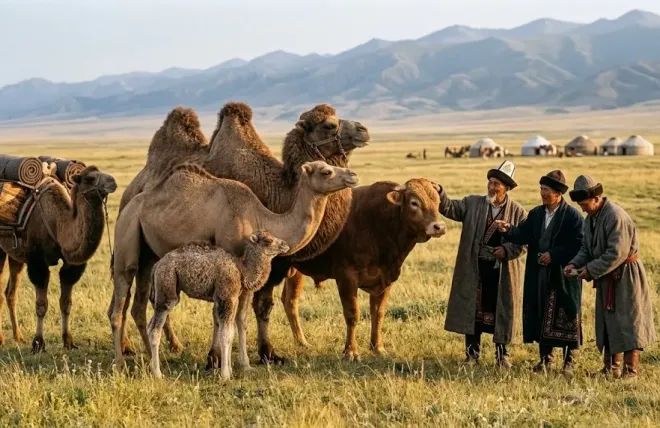
In rugged mountain pastures, dense forests, and lakeside camps, traditional transport—such as pack camels, horse-drawn carts, and sledges—demanded exceptionally strong cordage.
The arkan (heavy-duty rope) was among the strongest and most durable types of cordage used in traditional Kazakh life, engineered to endure high tension when tethering livestock, securing cargo during migration, and anchoring yurts against severe winds.
Construction Technique
An arkan features a multi-layered construction: three main strands, each hand-twisted from two sub-strands. Artisans spin these sub-strands from autumn sheep's wool or shed animal fibers.
To boost durability, the core is reinforced using shuyke—30 to 35 centimeter fiber bundles wrapped with coarse horsehair or goat hair. The artisan stretches a section of hair, lays wool over it, moistens their hands with water, rolls the fibers between their palms, and folds them to build uniform tension.
When joining fiber bundles:
- Septeu (fiber joining): Thinning, moistening, and twisting overlapping bundle ends so they interlock seamlessly.
- Selbestiru (fiber blending): The final melding of frayed ends to eliminate weak points along the cord.
While standard ropes utilize three main strands, heavy-duty variations incorporate four or five.
Zhel Arkan: The Storm Anchor Rope
To safeguard a yurt against destructive steppe storms, nomads anchor it with a zhel arkan (storm rope), bound to a heavy stake driven into the windward ground.
Crafting a four-strand zhel arkan requires a synchronized mechanical process:
- Artisans set up a horizontal board between two 1.5-meter posts equipped with four holes (or use the wooden apertures of a yurt's kerege wall lattice).
- Four individual strands pass through these openings and attach to a wooden crossbar 5 to 6 meters away.
- Four people pull and rotate the crossbar to twist the strands, while a fifth person at the junction pulls the rope's root toward themselves with immense force to compact the fibers into a dense, weather-proof cable.
Bau: Functional and Decorative Binding Bands
In Kazakh nomadic culture, a bau (binding band or cord) is rarely stored separately; it remains permanently attached to the specific item or structural element it serves:
- Ayakbau: Secures yurt roof rafters (uyk) or hunting birds.
- Basbau: Fasteners used to secure felt door coverings.
- Balak bau: Leather or rawhide tethers used for hunting falcons.
- Specialized Roof Cords: Includes tamakbau (throat straps), kulak bau (ear cords), uzikbau, tundikbau, zhelbau, and kuryk bau for holding down felt roof sections.
Kur and Terme Bau: Ornate Interior Furnishings
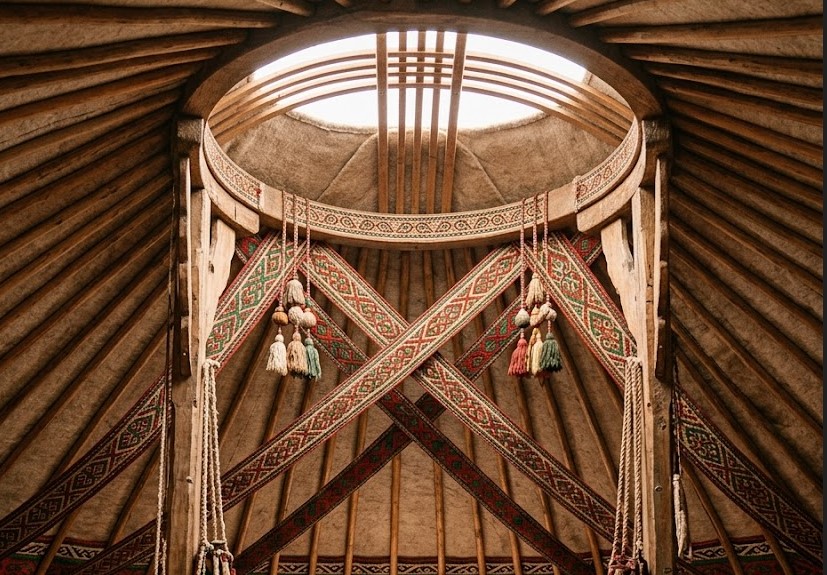
Broad woven bands known as kur (measuring 80 to 100 centimeters in width) and terme bau serve both structural and decorative roles inside the yurt:
- Baskur: Girdles the top of the yurt wall lattice (kerege) directly beneath the roof felts.
- Dodege kur: Embellishes the outer eaves and lower edges of the roof felt.
- Bastirma kur: Crisscrosses over the upper roof felts to hold them down during high winds.
- Kur ayakbau: Tasselled, pattern-woven bands draped elegantly from the junction where roof rafters join the shanyrak (central roof ring).
The grandest yurts feature kur woven from vibrant red, green, white, and yellow silk, embellished with gold or silver ornaments. Artisans also use these strips to craft ceremonial gear for prize camels, including asmaldyk (ornamental camel caparisons), halters, and bell-collars.
Everyday Uses and Symbolism
Narrower woven ribbons decorate riding gear (saddling pads, stirrup straps) and serve as protective trim along the hems and cuffs of robes (shapan), cloaks, and trousers. Utilitarian items—such as saddlebags, chest covers, and storage pouches—crafted from these bands remain prized for their exceptional durability and aesthetic beauty.
The visual language of kur bands centers on diamond geometric grids, su ("water") edge borders, triangles, and horn motifs. Combining artistic elegance with structural utility, the art of band weaving stands as a proud equal to the celebrated tradition of Kazakh carpet making.