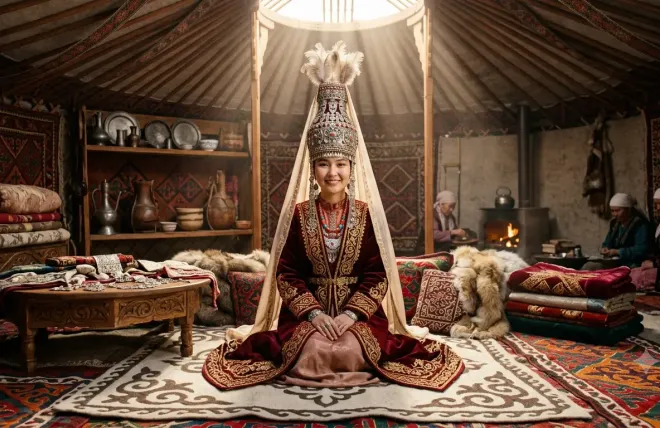
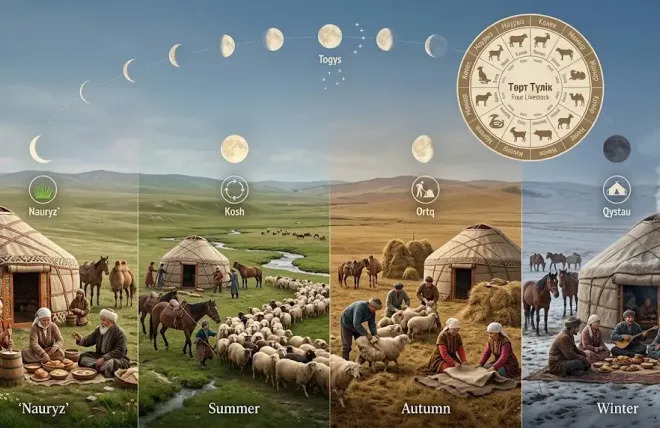
The Paternal Kin & Kazakh Kinship Terminology


Oz jurty (Paternal Kin): Refers to one's own paternal family, clan, or tribe; it is the core lineage through which a person traces their ancestry, identity, and heritage.
Tuystyk ataular (Kinship Terminology): The specific system of names and titles used to define relationships, hierarchies, and proximity between family members within Kazakh culture.
The Core Lineage: Complex Realities and Eternal Support
The Kazakh proverb, "Your own kin are envious; if you prosper, they cannot bear to watch, and if you struggle, they offer no aid," reflects the complex human reality of extended family dynamics. Yet, despite these occasional frictions, a man’s primary source of strength remains his people.
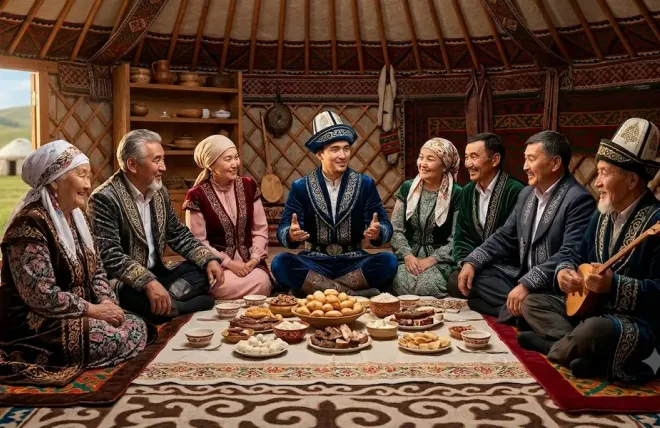
A traditional warrior, born to serve his nation, would sacrifice his life for the greater good; throughout his journey, he remained deeply rooted in those closest to him. As long as his three pillars of kinship—his paternal kin (Oz jurty), maternal kin (Nagashy jurty), and in-law family (Kaiyn jurty) — remain intact, a man stands secure, knowing he has an unbreakable support system during times of hardship.
The most intimate of these allies is the paternal clan. This lineage encompasses parents, siblings, and all relatives tracing back to a common male ancestor. Once a family line expands across seven generations, it forms a distinct tribal entity. A Kazakh traditionally champions the interests of his blood lineage, carrying immense pride in this shared heritage.
Traditional Bonds, Etiquette, and the Seven-Generation Rule (Zheti Ata)
According to long-standing Kazakh custom, marriage between relatives within seven generations (Zheti ata) is strictly prohibited. Ancestors firmly upheld this rule, knowing that inbreeding degrades the genetic strength of future generations. Thus, a person's paternal kin (Oz jurty) are strictly defined as those within this seven-generation threshold. Anyone beyond this boundary transitions into distant lineage and may eventually connect through marriage as in-laws.
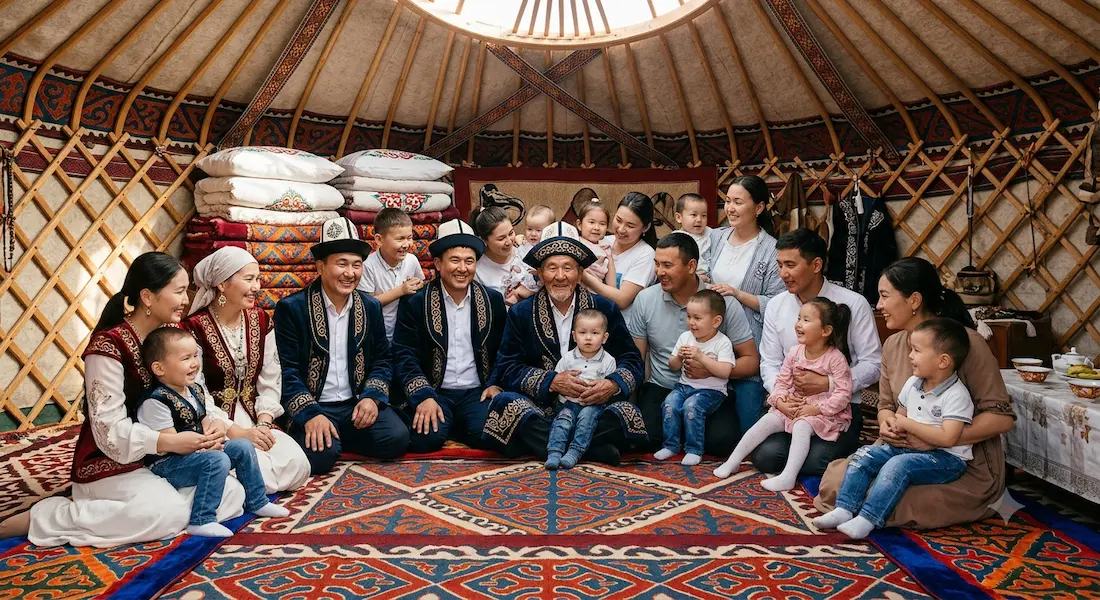
Dynamics Within the Clan
The Eldest Brother (Aga): Commands highest authority among siblings. Having experienced more of life’s trials, he guides and maintains discipline. Defying an elder brother violates tradition; younger siblings are expected to show respect and assist him. The saying goes: "He who has an elder brother has a protector."
The Sister-in-Law (Zhengeshe / Zhenge): A man owes reverence to his elder brother’s wife and must protect her dignity within the clan. Unlike the formal and solemn respect maintained toward an elder brother, the relationship with a zhenge allows for warm, witty, and lighthearted banter (kalzhangdasu). These respectful jokes build deep friendship and ease household tensions, provided they stay within the boundaries of good taste.
Sisters (Karyndas / Singli): Within the paternal circle, sisters hold a cherished, tender status. Although destined to marry into another family line, brothers honour and protect their sisters throughout their lives. A sister’s home remains a place where a brother can always arrive, assured of unconditional warmth.
Household Dynamics and Separations
It is natural for household harmony to face tests, especially when multiple generations live under one roof. Kazakhs metaphorically call minor domestic disputes the "clinking of teacups."
To preserve long-term peace, parents traditionally arranged for married sons to establish separate dwellings (otau shygaru). Even when living apart, external gossip could test sibling ties, giving rise to the cautionary proverb: "Brothers grow distant through the whispers of others." Ultimately, unity depends on wisdom; an elder brother often forgives a junior’s mistakes to protect the lineage bond. As the elders counsel:
"A united clan commands many horses; a united family enjoys an abundance of food."
Kazakh Kinship Glossary (Tuystyk ataular)
Ancestors & Direct Family
- Urim-butak — Ancestral Lineage: Descendants of a common ancestor; the extended family tree.
- Ata-baba — Forefathers: Collective term for ancestral generations and historical roots.
- Uly ata / Baba — Great-Grandfather: Great-grandfather or a distant historical forefather.
- Ata — Grandfather: Paternal grandfather (father’s father).
- Azhe — Grandmother: Paternal grandmother (father’s mother).
- Ake / Koke — Father: Male parent. (Koke is also used for an elder brother in certain regions).
- Ana / Apa — Mother: Female parent. (Apa can refer to an elder sister or relative depending on dialect).
- Bala / Bel bala — Child / Biological Offspring: Bala = child in general; Bel bala = direct biological offspring.
Lineage Generations (From Grandchild to 11th Generation)
- 3rd Generation — Nemere: Grandchild (child of one's son).
- 4th Generation — Shohere: Great-grandchild.
- 5th Generation — Shopshek: Great-great-grandchild.
- 6th Generation — Nemene: Child of Shopshek (6th generation descendant).
- 7th Generation — Tuazhat: 7th generation descendant (the threshold of the Zheti Ata marriage prohibition).
- 8th Generation — Zhurezhat: 8th generation descendant (outside the strict marriage prohibition boundary).
- 9th Generation — Zhuragat: 9th generation descendant.
- 10th Generation — Zhat zhuragat: 10th generation descendant; a very distant branch of the clan.
- 11th+ Generation — Zhezhat: Distant clansmen or tribal relatives.
Siblings & Extended Relatives
- Tuystyk bauyr — Blood relatives / siblings sharing a paternal origin.
- Aga — Elder brother.
- Apke / Tate — Elder sister.
- Ini — Younger brother (used by both males and females).
- Karyndas — Younger sister (used specifically by brothers).
- Singli — Younger sister (used specifically by sisters).
- Nemere ini / Nemere karyndas — Paternal cousins (children of one's paternal uncle).
- Bole (Karyn bole) — Cousins whose mothers are sisters.
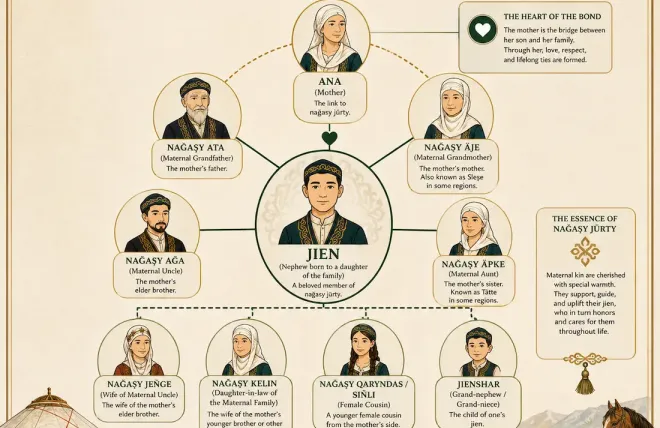
- Zhien — Children of one's married sister or daughter.
- Zhienshar — Grand-nephew / grand-niece through a Zhien.
- Zhenge — Wife of an elder brother or senior male relative.
- Zhezde — Husband of an elder sister or senior female relative.
- Kelin — Daughter-in-law; wife of a younger brother or nephew.