Kazakh Kinship, Code of Law, and Social Structure


A Man’s Three Branches of Kinship
"My paternal kin are wealthy, my in-laws are wealthy, and my maternal relatives are wealthy—how could I ever be poor, my God!"
Every citizen knows well that he has his paternal relatives (aghaıyn zhurt), his in-laws (qaıyn zhurt), and his maternal relatives (naghashy zhurt). However, young people who do not fully understand the specific nuances of interacting with them are frequently encountered everywhere today. Particularly among those who attended Russian-medium schools, many do not even know basic kinship terms such as zhezde-baldyz (brother-in-law / younger sibling-in-law) or zhenge-qaıyn (sister-in-law / spouse's relative), let alone the three branches of kinship.
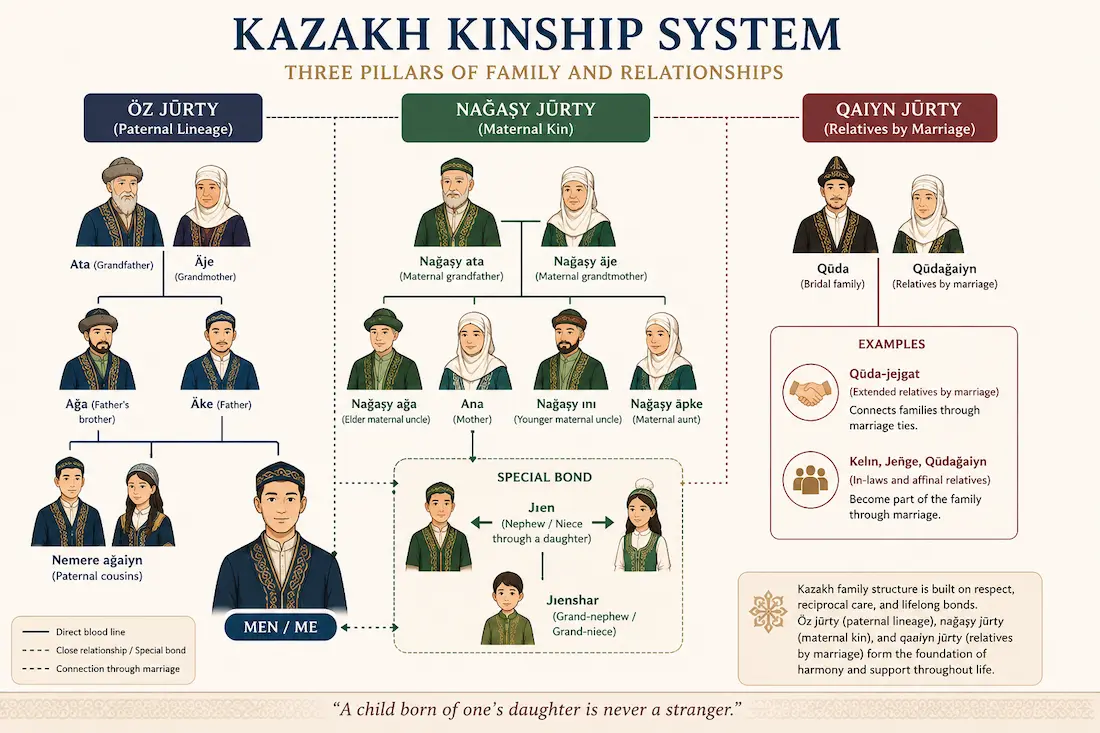
A man who knows how to preserve folk traditions holds his head high wherever he goes. His own relatives, his in-laws, and his maternal kin all hold him in the highest esteem. As the saying goes, "For a good person, there is always a place of honor." Conversely, if a man pays no attention to who his relatives are and tramples upon custom, failing to carry himself properly and showing a lack of resolve and stability in every affair, such a man will possess neither harmony nor authority. Therefore, while introducing the "three branches of kinship," let us recall the meanings of these terms...
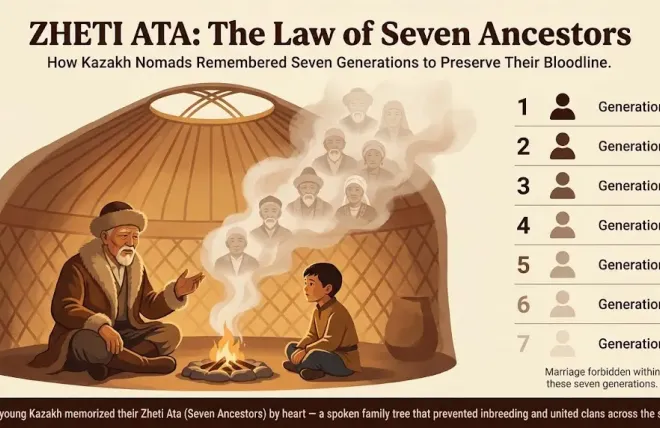
No Blood Mixing Up to Seven Generations (Prohibition of Intermarriage)
Stories about young blood relatives who married against the counsel of elders and were put to death by stoning in ancient times are often perceived by some today as ignorance or savagery. People do not always realize that behind this lay a profound concern for future generations and a sense of immense responsibility.
In reality, our ancestors knew since ancient times that if blood relatives unite, their offspring suffer from incurable ailments, resulting in children born blind, clubfooted, deaf, or cognitively impaired. This Kazakh wisdom is reaffirmed and proven today by genetics—the science that studies the laws of hereditary traits—and specifically by research in medical genetics.
This is because the genes of parents contain not only traits unique to them (facial features, character, skin tone, etc.), but also "written" markers of various hereditary diseases. For instance, when closely related individuals unite, the genes carrying conditions such as deafness within their reproductive cells are identical; thus, these traits compound and multiply in strength, leading to a point where, by the fourth generation, all children are born completely deaf. This is clearly demonstrated in genetics research.
Jeti Zharghy (The Seven Statutes)
During the reign of the Khan who came to be known as "Az-Tauke" due to his abundance of wisdom and intellect, a wonderful monument of Kazakh customary law called Jeti Zharghy was created. Incorporating the very essence of all traditional legal codes that preceded it, these statutes covered seven complex spheres of social life:
- Penalties for verbal insults, swearing, assault, bodily harm, and sexual violence against women.
- Homicide and the fines (qun) imposed for taking a life.
- Theft, burglary, and livestock raiding (barymta).
- Adultery and marital infidelity.
- Morality, showing respect to parents, and obeying the words of elders.
- The strict prohibition of blood mixing within seven generations (Jeti Ata — Seven Generations rule).
- Land disputes, migration patterns, and settlement regulations.
Encompassing various facets of society at that time, this code served as the primary foundation and golden thread that enabled the Kazakh state to remain a unified, independent nation grounded in morality and internal discipline for centuries.
Jeti Saty (The Seven Tiers)
The social structure of the former Kazakh Khanate was also divided into seven tiers:
- Aul (Village)
- Ata Aimaq (Patrilineal Region)
- Ru (Clan)
- Arys (Tribal Wing)
- Ulus (Province)
- Juz (Horde)
- Khandyq (Khanate)
- Aul: Consists of ten closely related, immediate households. It is led by an aulbasy (head of the village).
- Ata Aimaq: Formed by several villages connected within seven generations (jeti ata). Its leader is called an aqsaqal (elder).
- Ru: Composed of thirteen to fifteen regions (aimaq). It is overseen by a rubasy (head of the clan).
- Arys: Consists of several clans (ru). Its leader is a bi (judge/administrator).
- Ulus: Composed of several wings (arys). Its ruler is a sultan.
- Juz: Includes several provinces (ulus). It is ruled by a khan.
- Khandyq: Consists of the three hordes (juz). The supreme commander of the Khanate is the Khaqan (Great Khan).
It is from this structure that the famous wise saying passed down by our ancestors likely originated:
"The nation’s prosperity is the Khan, the clan’s prosperity is the judge, the region’s prosperity is the elder, and the village’s prosperity is the wife."