Kazakh Hospitality: Why Every Guest Brings Blessings


Qonaq Kelse – Qut: A guest brings blessings
Hospitality is the cornerstone of Kazakh identity. Since ancient times, the nomads of the steppe have prayed that their tables never lack food and their places of honor never empty. Proverbs like Qonaq kelse – qut (A guest brings blessings) and "When a lucky guest arrives, even the ewes give birth to twins" reflect this foundational philosophy.
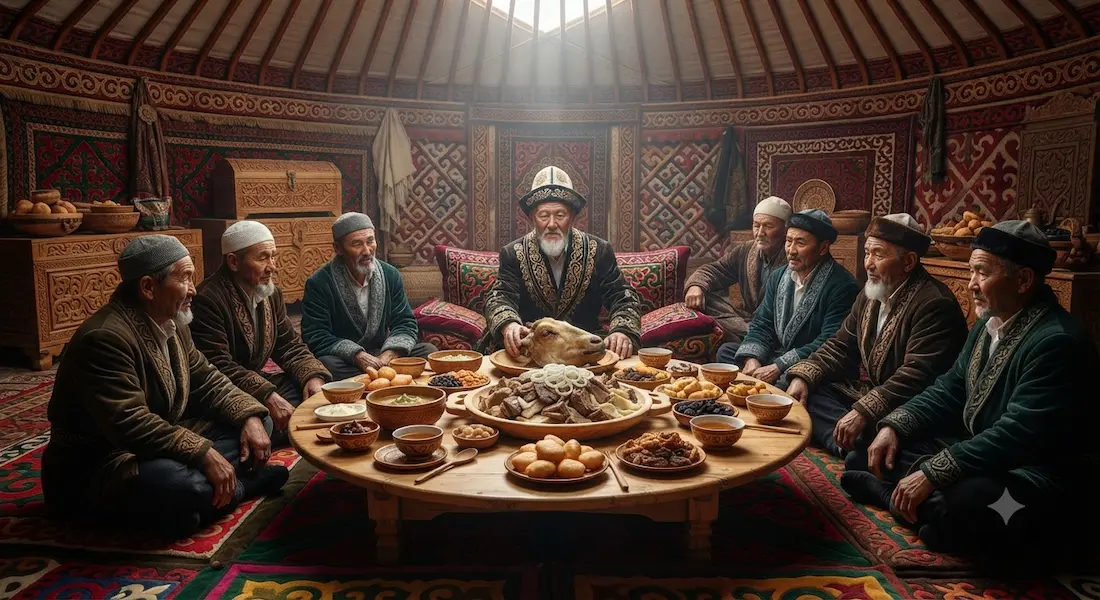
Kazakhs have always reserved their finest delicacies for travelers, treating anyone who enters their home with deep reverence, respect, and humility. While local customs, survival strategies, and everyday routines may vary slightly across different regions and villages, the core values of generosity and warmth remain universal.
The Elements of Steppe Hospitality
Traditional Kazakh hospitality follows a beautifully orchestrated sequence of rituals designed to honor the visitor from the moment they arrive until the final feast is served:
Warm Reception → Ritual Hand-Washing → The Tea Ceremony → The Grand Feast
The Warm Reception: Qarsy Alu
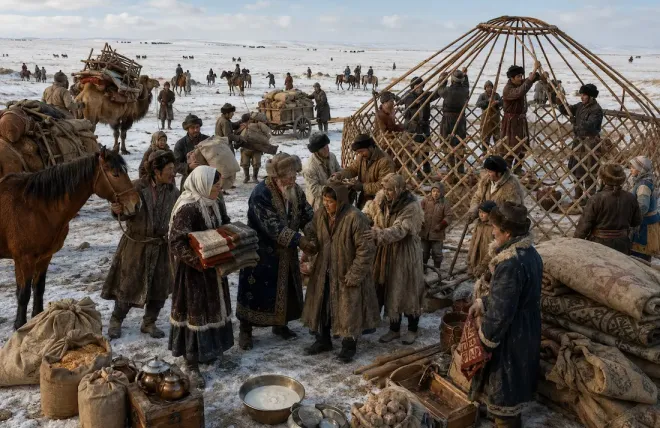
Guests may arrive by formal invitation or completely unannounced. An unexpected traveler is warmly welcomed as Qudayi Qonaq (God's guest). Kazakhs deeply believe that evening travelers are accompanied by the mythical, immortal saint Qyzyr Iliyas (Khidr, the legendary patron saint).
According to folklore, welcoming a traveler with genuine joy and receiving their heartfelt blessing invites his favor, bringing immense wealth and happiness to the household. Conversely, turning a stranger away empty-handed is believed to bring a generational curse of misfortune upon the family. Legend describes this immortal saint as a regular man with a unique trait—his right thumb has no bone, and wherever his feet tread, fresh springs and lush grass instantly burst from the earth.
When invited guests approach, the hosts must rush outside to meet them immediately. The famous steppe poet Boltirik Atykhanuly emphasized this essential social rule:
"If a guest knocks upon your door, Run to meet them, tarry no more. For the holy saint may be disguised in the crowd, And a cold reception turns blessings to cloud."
The hosting ritual begins immediately upon arrival:
- Caring for the Mount: The host helps the guest dismount, secures their horse, and provides it with prime fodder, straw, and oats.
- The Inward Welcome: The younger members of the household greet the arrivals with a respectful handshake and words of welcome like "Assalamu Alaikum" and Khosh kelipsizder! (Welcome!).
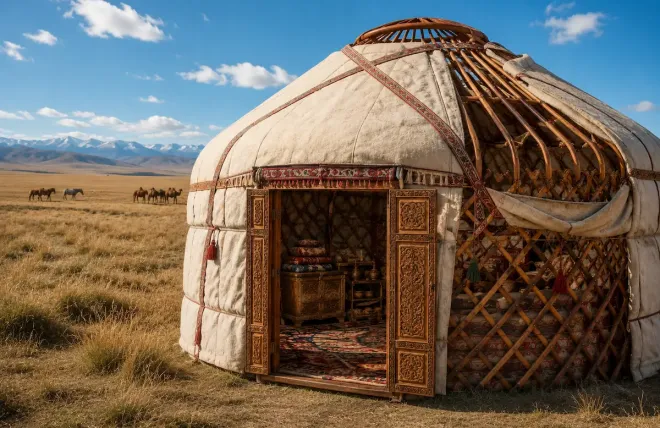
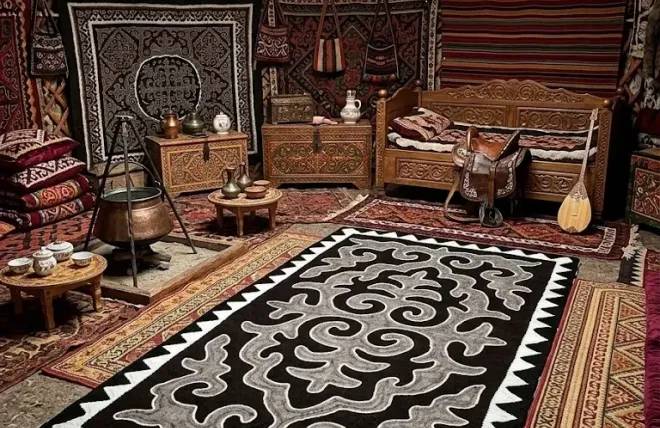
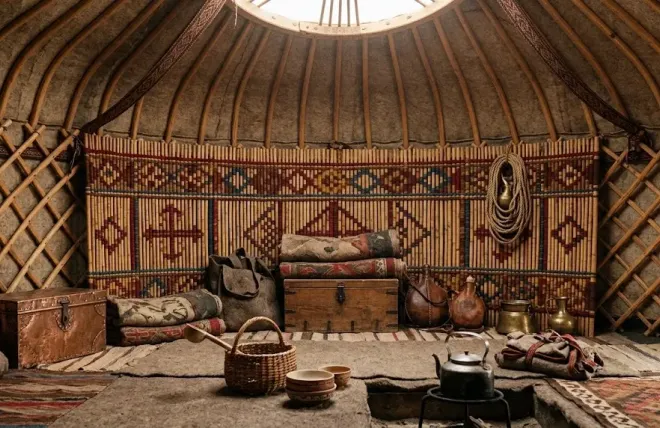
- Settling In: Inside the yurt, the guests are seated in the Tör (place of honor opposite the entrance)—the position furthest from the entrance. They are settled onto thick, beautifully quilted mattresses known as Quraq Körpe (patchwork quilted mats) and cushioned with soft pillows.
- Attentive Care: The hosts assist with heavy outerwear, hanging it respectfully on the wooden clothing rack called a Baqan (long wooden pole). Once everyone is comfortably seated, the host inquires about the guests' health, their families, their livestock, and the safety of their journey, listening intently to every response.
The Ritual Hand-Washing : Qolgha Su Quyu
Before sitting down to eat, guests must wash their hands. This service is traditionally performed by the older children of the family, teaching them respect and etiquette from an early age.
A well-mannered youth drapes a clean towel over their shoulder, holding a basin called a Shylypshyn (washbasin) in their left hand and a decorative pitcher called a Quman (water pitcher) filled with warm water in their right hand. Moving sequentially from the eldest guest downward, the youth smoothly pours water without splashing.
After rinsing, each guest offers a brief, powerful blessing to the child, wishing them safety and high honor. Kazakhs heavily value these blessings, noting that it is better to receive a wise elder's blessing than a chest of gold.
The Tea Ceremony - Shay Quyu -pouring tea, Shyny Aperu - handing the teacup
Tea must be brewed and served with absolute precision. The water from the samovar must remain boiling hot, and the tea itself must be rich and deeply crimson.
Flawless Tea Etiquette:
- Never use chipped or cracked teacups.
- Never let the samovar grow cold or the tea turn weak.
- Pour silently without clinking cups together.
- Serve the cup using the right hand while supporting the forearm with the left hand.
A dedicated family member sits at the table solely to manage the tea. They monitor everyone's preferences, ensure cups are never empty or left cold, and carefully prevent cups from being mixed up. When presenting a cup of tea, it is customary to hold it with the right hand while gracefully touching the left hand to the right forearm or chest as a sign of deep reverence. Serving a cup with a single, unsupported hand is perceived as dismissive and disrespectful.
The Presentation of the Feast :Tabaq Tartu -serving platters of meat
The pinnacle of Kazakh culinary hospitality is the preparation of Besbarmak (the national dish of boiled meat and flat noodles). A popular saying goes: "When a guest stays, meat is cooked; if no meat is cooked, the host loses face."
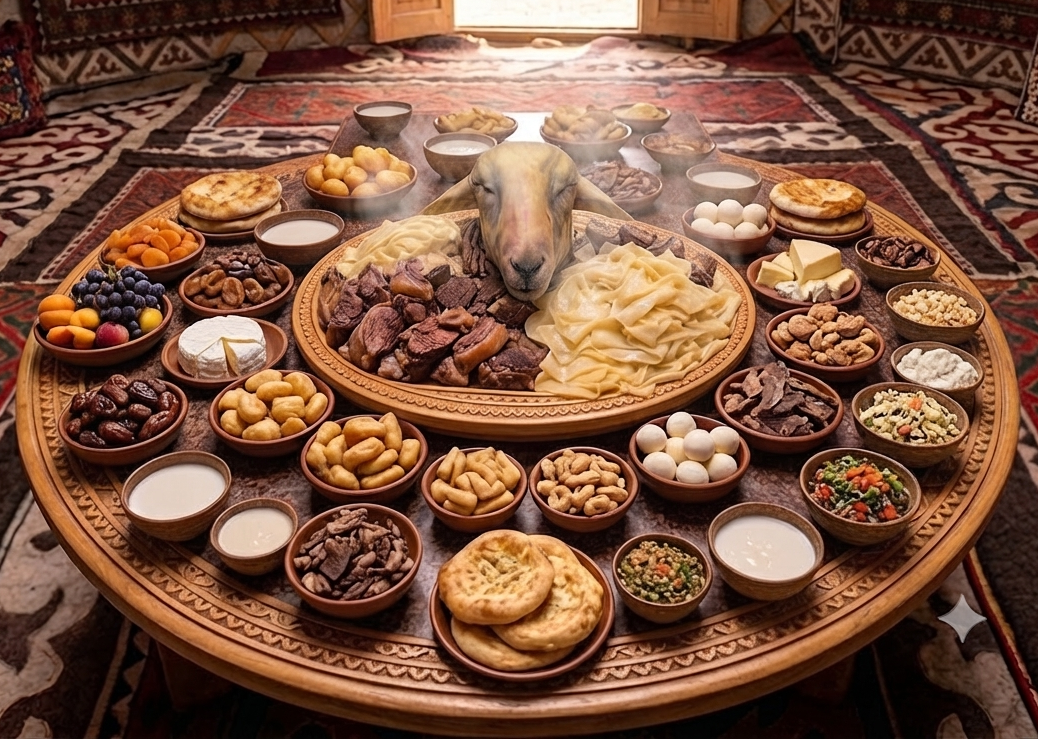
Arranging and serving the meat on large platters called a Tabaq (large serving platter) is a highly respected art form. Kazakh custom dictates exactly which cut of meat goes to which individual based on age, social standing, and family relationships.
A master carver coordinates with the host to distribute the appropriate cuts, known as Sybagha (customary meat portion reserved for specific guests), to specific platters. For the most distinguished guests, the platter features the highly prized sheep's head known as Bas (head), the pelvic bone known as Zhambas (pelvic bone), delicate horsemeat delicacies like Qazy-Qarta (traditional horsemeat sausages) and Zhal-Zhaya (special cuts of tender horsemeat), and savory ribs.
The meat presentation is split into four primary categories based on seniority: Bas Tabaq (the main platter for the eldest patriarchs), Orta Tabaq (the middle platter for mature adults), Syy Tabaq (the honorary platter for special dignitaries), and Ayaq Tabaq (the final platter for youth and helpers).
To ensure perfect readability on all mobile screens, the traditional specialized meat platters are detailed sequentially below:
- Quda Tabaq (Matchmakers' Platter)
- Recipients: The parents of a son-in-law or daughter-in-law.
- Key Cuts: Thigh bone, pelvic bone, and spine pieces. It is traditionally accompanied by Quyryq-Bauyr (sliced liver and tail fat seasoned with onions, sour cream, and yogurt).
- Qudaghi Tabaq (Female Matchmakers' Platter)
- Recipients: The mothers of the married couple.
- Key Cuts: Jawbone, choice horsemeat delicacies, tripe, and the hock bone. The jawbone is exclusively reserved for women in this category.
- Zheñge Tabaq (Sister-in-Law Platter)
- Recipients: The respected sisters-in-law of the family.
- Key Cuts: Hock bone, flank, ribs, neck vertebrae, and the abomasum known as Ultabar (abomasum / fourth stomach of the ruminant). Steppe tradition dictates that this specific cut is given as a special blessing for young women to grant them fertility.
- Küyew Tabaq (Son-in-Law Platter)
- Recipients: A newly married son-in-law visiting his bride's family.
- Key Cuts: Flank, brisket, upper wing bone, and ribs. By custom, the son-in-law must playfully "buy" this platter from the hosts by offering a small monetary gift.
- Qyz Tabaq (Daughters' Platter)
- Recipients: The daughters of the lineage or visiting young women.
- Key Cuts: Upper wing bone, spine pieces, flank, ribs, and savory horsemeat.
- Balalar Tabaq (Children's Platter)
- Recipients: The young children of the household and guests.
- Key Cuts: Lumbar vertebrae, ribs, kidneys, and ankle joints.
The Ritual of the Sheep's Head
Except in very rare circumstances, a sheep's head is never placed on a platter designated for women. It is strictly presented to the oldest patriarch or the most distinguished male guest at the table. No one else may touch any meat on the central platter until the head holder initiates the meal. The ritual follows a strict protocol:
- The First Bite (Initiating the Feast): The elder carves a small portion of the cheek meat for himself to officially open the feast.
- Sharing the Skin (Blessing the Table): The elder slices pieces of the flavorful ear-and-cheek skin known as Qujqa (cooked skin on the sheep's head) and distributes them to everyone sharing the platter, ensuring everyone tastes it.
- Passing the Honor (Respecting the Room): Keeping a portion of the head intact, the elder hands the remaining piece to a respected individual sitting at the middle table out of mutual respect.
Oshaq Maylau (Anointing the Hearth): Preparing for Grand Feasts
When an incredibly prestigious guest, community leader, or foreign dignitary visits, a massive feast requires flawless organization. To ensure the family preserves its honor, the hosts perform a preliminary ritual called Oshaq Maylau (Anointing the Hearth).
The organizers gather ahead of time to slaughter a smaller animal, test the fire pits, oil the large cauldrons, and run through the entire event itinerary. The individuals in charge approach this with deep sincerity, working tirelessly behind the scenes so that the grand hospitality shown to the guests will perfectly reflect the spotless reputation of the Kazakh people.