Kazakh Goats and Their Traditional Terminology


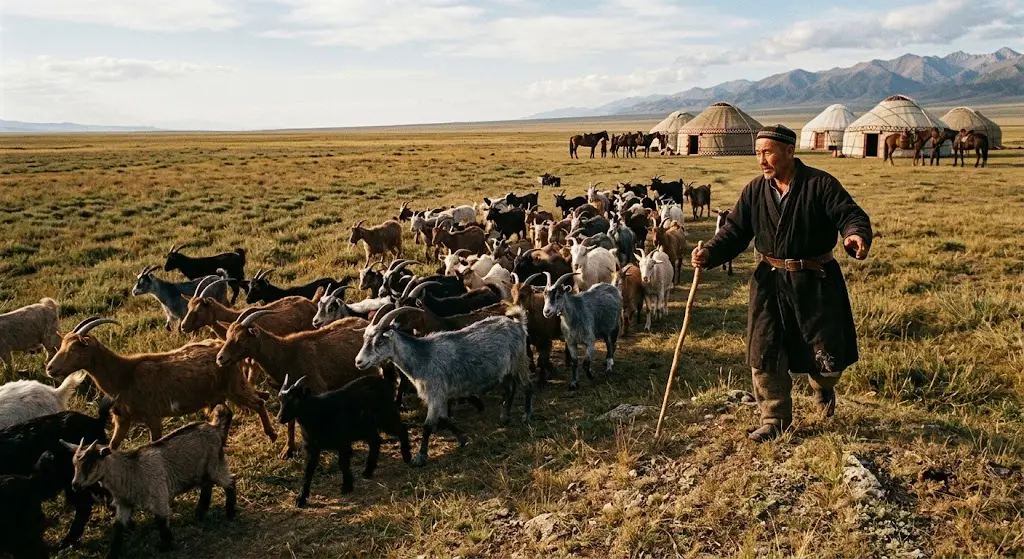
Goats have been an important part of pastoral life in Central Asia for thousands of years. Their ability to survive in harsh climates and make use of available pasture made them especially valuable to communities whose livelihoods depended on livestock.
In Kazakhstan, local goats have long been valued for their meat, milk, coarse hair, and fine undercoat or down. Modern studies also confirm the value of down from Kazakh goat populations, whose fiber can have fineness comparable to that of cashmere.
The Qazaq Eshkisi (Kazakh goat) represents this long pastoral tradition. Local goats are known for their hardiness and ability to make effective use of natural pastures. In regions with severe continental climates, Kazakh goat populations have demonstrated considerable ecological adaptability.
For Kazakh pastoralists, however, a goat was not simply a goat. Traditional livestock management developed a remarkably detailed vocabulary for identifying animals according to age, sex, reproductive status, physical condition, appearance, fleece characteristics, and behavior.
Age and Gender Terminology
Traditional terminology distinguishes goats according to both age and sex.
Age-related terms
- Ulken Teke: a mature breeding male goat.
- Serke: a castrated male goat, or wether.
- Donen Serke: a four-year-old castrated male.
- Qunan Serke: a three-year-old castrated male.
- Tu Eshki: a barren or non-breeding female.
- Ulken Eshki: a mature female goat.
- Saqa Eshki: an older, fully developed female goat.
- Tusa Shybysh: a young female that has not yet given birth.
- Shybyshsha / Shybysh: a young female goat, generally around one year old.
- Shybyshyq: a young female approaching maturity.
- Marqa Laq: a weaned, growing kid.
Gender-related terms
- Teke: an uncastrated breeding male, or buck.
- Serke: a castrated male.
- Laqty Eshki: a female goat nursing a kid.
- Eshki: the general term for a female goat.
- Erkek Marqa Laq: a male weaned kid.
- Urghashy Marqa Laq: a female weaned kid.
- Erkek Laq: a male newborn kid.
- Urghashy Laq: a female newborn kid.
This vocabulary reflects the practical importance of knowing an animal's exact status. In a pastoral economy, age, sex, fertility, and physical condition affected decisions about breeding, milking, castration, grazing, sale, and slaughter.
Breeding and Reproductive Cycle
Goats traditionally begin their breeding cycle in August. To prevent unwanted mating before the desired period, shepherds used a Kuyek (a felt covering or cloth marked with pigment) over the back of the male animal. Depending on local climatic conditions, the Kuyek was generally removed in October.
This timing was intended to ensure that kidding took place after a gestation period of approximately five months and five to ten days.
Birthing
Healthy, well-nourished females may give birth twice, and in some circumstances even three times, within a year. Goats may produce twins or a single kid, known as Synghar when referring to a single birth.
Newborn kids normally stand and seek their mother's teat soon after birth. By the second day, they can follow their mother. Within four or five days, they walk steadily, and by approximately nine or ten days they begin to graze.
Sexual maturity
Highly fertile females may mate at around six months of age and produce their first kid as yearlings, known as Shybysh. Male goats can also reach sexual maturity at approximately six months.
These ages should be understood as traditional husbandry observations rather than universal biological limits; actual reproductive maturity varies according to breed, nutrition, climate, and individual development.
Husbandry and Seasonal Care
Traditional goat husbandry involved close observation of the animals and regular seasonal care.
Bathing
During the summer months, goats were sometimes driven into flowing rivers or lakes two or three times a month. Bathing helped remove dirt and ticks and was believed to support healthy skin and down. It was also associated with vigorous regrowth of the coat after shearing.
Milk and fiber production
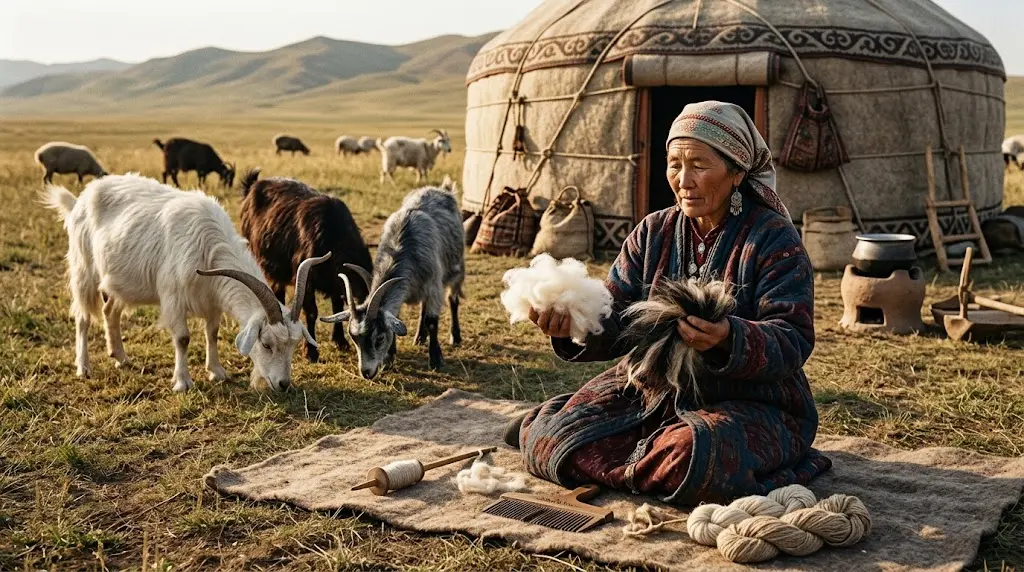
Goats were typically milked for about five months and shorn once a year. Traditional sources describe a lifespan of roughly twelve years.
Goats provided several useful resources:
- Milk for household consumption and dairy products.
- Meat for food.
- Tubit (fine undercoat or down) for warm and valuable fiber.
- Zhun (hair or wool) for practical uses.
- Skin for leather and other household goods.
The importance of goat down in Kazakhstan continues today. Research on Kazakh coarse-haired goats has shown that their undercoat can meet the fineness requirements associated with cashmere-type down.
Classification by Physical Condition
Traditional vocabulary also described an animal according to its body condition and development.
- Pisken Laq: a “ripe” or “ready” kid; from August onward, the term could describe a young goat that had reached a desirable weight for slaughter or sale.
- Semiz Laq: a well-fed kid that had nursed freely or had been deliberately fattened with additional feed.
- Biteu Eshki: a term with two recorded meanings. It could refer to an exceptionally fat goat with fat distributed evenly throughout the body, or to a female that remained infertile despite repeated mating.
- Zhetilmegen Eshki: an underdeveloped goat that had suffered during the winter but later gained weight and matured after reaching spring pasture.
- Aryq Laq: an emaciated or very thin kid, often associated with orphaning after the death of its mother, illness, or inadequate access to good pasture.
Classification by Kidding History
The reproductive history of a female was another important part of traditional terminology.
- Tusha: a female goat that gives birth to her first kid after the age of two.
- Shybysh: a female that mated at about six months and produced her first kid at approximately one year.
- Saqa Eshki: a large, mature, highly fertile female that produces kids consistently, particularly during the summer season.
Some terms overlap with age-based terminology because a female's age and reproductive history were closely connected.
Additional Age and Gender Terms
- Shybyshsha: a young female approaching one year of age that has not yet mated.
- Shybyshyq: a young female that has passed her first birthday, typically one born early in the season.
- Laq: a kid from birth to approximately six months of age.
- Laq Teke: a male kid that has reached about six months but has not yet been castrated.
- Serke: a mature castrated male, or wether. In some traditional classifications, the term refers specifically to an animal around six or seven years old.
- Serkeshik: a young male castrated shortly after his first birthday.
Traditional livestock terminology could therefore be highly specific, with the same basic word taking on different meanings depending on age, reproductive history, or regional usage.
Classification by Horn Structure
The shape and presence of horns also provided identifying characteristics.
- Topal Eshki or Toqal Eshki: a naturally polled goat, born without horns.
- Qaraghai Muizdi Eshki: a goat with “pine-tree horns,” described as straight, thick, and long.
- Ai Muizdi Aq Serke: a white castrated male with crescent-shaped horns, considered especially striking in appearance.
Descriptions such as these show that livestock terminology was not limited to economic characteristics. Appearance itself could be important when identifying and distinguishing animals within a herd.
The Three Main Herd Groups
Goats were broadly divided into three main groups.
Female Goats — Urghashy Eshkiler
- Laqty Eshkiler: nursing female goats, or dams currently raising kids.
- Urghashy Boidaq Eshkiler: barren or unmated female goats.
Male Goats — Erkek Eshkiler
- Tekeler: breeding bucks, or uncastrated males.
- Erkek Boidaq Eshkiler: castrated males and young males not intended for breeding.
Offspring — Laq
- Laq: kids, regardless of sex, until they reach the relevant stage of maturity.
Female Goats — Urghashy Eshkiler
Nursing Dams — Laqty Eshkiler
The terminology for female goats could become particularly detailed according to pregnancy, kidding history, and lactation.
- Buaz Eshki: a pregnant goat that has successfully mated from November onward.
- Kenzhe Eshki or Tusa Shybysh: a goat that missed the normal seasonal mating period and bred later, giving birth in late May, June, or July.
- Laqty Eshki: a goat that bred during the normal seasonal cycle and gave birth in April or May; such goats were typically milked for about five months.
- Sauuly Eshki: a “milking doe,” a female whose kid had died or been lost but which continued producing milk until lactation naturally ceased.
- Laqty Tusa: a young female, over two years old, that has produced her first kid.
- Laqty Tushashyq: a young female of about one and a half years that has produced a kid.
- Laqty Shybysh: a yearling that mated at six months and produced her first kid at one year.
- Laqty Shybyshyq: a precociously fertile young female that mated before six months and produced her first kid before turning one.
Traditional terminology could also use dental development to indicate age and maturity. Terms referring to animals as “four-toothed” or “six-toothed” could be applied to both sheep and goats.
Non-Breeding Females — Urghashy Boidaq Eshkiler
- Tu Eshki: a barren female that failed to conceive for one or two consecutive years.
- Musin-siz Eshki: a poorly structured goat, generally referring to an animal considered genetically inferior, poorly tolerant of cold, and a poor producer of down (Tubit).
- Shynghylyr Eshki: a goat that suffered inadequate nutrition during early development, often because its mother produced little milk, resulting in stunted growth and poor weight gain.
- Buira Eshki: a “curly” goat with matted, coarse hair that produces little down, sheds excessively in strong sunlight, and is prone to insect irritation. Such an animal may gain weight mainly toward autumn.
Male Goats — Erkek Eshkiler
Breeding Bucks — Tekeler
- Teke: a fully mature, sexually active breeding buck.
- Laq Teke: a young male selected for future breeding and therefore left uncastrated.
- Eshki Keni: a term for an exceptional, high-quality breeding buck.
- Tekeshik: a young buck over one year old that has been only partially or incompletely castrated.
Castrated Males — Erkek Boidaq Eshkiler
- Azban Teke: a mature buck, approximately six to seven years old, that has been castrated.
- Serkeshe: a young castrated male, or wether, just under two years old.
- Bas Serke: a prime castrated male, generally between four and five years old.
Additional Traditional Descriptions
Beyond the main categories, pastoral vocabulary included many terms describing specific physical features and qualities.
- Tuimeli Eshki: a goat with small, vestigial accessory teats.
- Toqal Eshki: a polled or hornless goat.
- Shunaq Eshki: a goat with small, stunted, or vestigial ears.
- Tumse Eshki: a young female, or yearling, giving birth for the first time.
- Zhalbyr Eshki: a goat with a shaggy or ragged coat.
- Budan Eshki: a crossbred or hybrid goat.
Classification of Kids — Laq Ataulary
The word Laq forms the basis of a number of expressions describing young goats.
- Laq: the general term for a newborn or young kid.
- Sut Laq: a “milk kid,” allowed to nurse freely from its mother without being separated for milking.
- Qozy Laq: a kid that has lost its mother and is fostered onto a nursing ewe when no nursing doe is available.
- Laqeshim or Laghy-m: a term of affection for a beloved kid, literally meaning “my little kid.”
- Tolghan Laq: a well-nourished kid that has thrived on its mother's milk throughout the full nursing period.
- Zhetilgen Laq: a kid that was initially thin or underdeveloped because its mother was being milked but later recovered and grew strong through adequate grazing.
Vocalizations
Traditional pastoral vocabulary could even distinguish different sounds made by goats.
- Baqyra Manyrau: the loud, piercing cry of a female goat when she is about to nurse her kid.
- Baqyru: a distressed bleat made during difficult labor or when the animal is threatened by predators such as wolves or stray dogs.
- Baqyldau: the distinctive call or grunting sound made by a buck (Teke) when pursuing females during the breeding season.
These terms demonstrate how closely herders observed animal behavior. In a pastoral society, recognizing an animal's sounds could have practical value in breeding, nursing, and herd management.
Coat and Color Characteristics
Goats were also classified according to the color and pattern of their coats.
- Borte Eshki: a gray-white goat with black spots or patches along the spine and underbelly.
- Zhaghal Eshki: a goat with a variegated coat combining black and yellow hairs.
- Sur Eshki: another name for Borte, referring to a gray-colored goat.
- Aq Sur Eshki: a goat with a mixture of light colors, including off-white, yellowish, or light-brown shades.
- Qara Sur Eshki: a dark-gray goat, often with brownish or reddish guard hairs.
- Qara Kok Eshki: a blue-gray goat whose guard hairs have black tips.
- Buryly Eshki: a roan-patterned goat with a complex mixture of blue, red, brown, and black hairs.
Such terminology allowed herders to describe animals precisely without relying on generic color categories alone.
Terms for Hair and Down
Goat fiber was important enough to have its own terminology.
- Tubit: the fine, soft undercoat or down beneath the coarse outer hair; this is the part associated with cashmere-type fiber.
- Tubit Zhun: the fine down collected from the animal.
- Qylshyq Zhun: the coarse outer hair, clearly distinguished from the finer undercoat.
The distinction was economically important because different fibers had different uses and values. Research on Kazakh coarse-haired goats confirms that their down can be suitable for producing valuable fine fiber, although the amount of commercially recoverable down varies.
Traditional Herding Commands
Herders also used specialized calls to control goats and direct their movements.
- Shek bylay: used to turn the herd back when animals were scattering or wandering too far.
- Shek: used to drive goats away from household belongings, wagons, or ash pits near the hearth.
- Shege-shege: a command used to make goats stand still or to prevent nervous animals from running away when being caught.
- Shore-shore: used to call a kid to its mother.
- Quai-quai: used to call goats to water.
- Yr-hait shek-shek: used when driving goats into water, for example when washing them.
- Teke-teke: used to encourage bucks to fight, stimulate mating behavior, or tease the animals.
These commands formed part of the practical language of pastoral life, allowing herders to communicate with animals through short, recognizable vocal signals.
Curses and Expressions Associated with Goats
Traditional herding culture also produced expressions connected with difficult animals.
The expression Kebenek Kelgir was used as a curse meaning roughly “may kebenek take you.” It reflects the fact that Kebenek was not only associated with a serious goat disease but could also appear in traditional expressions of frustration or anger.
Traditional Veterinary Terminology
Several disease names were associated with goats and other small livestock.
- Kebenek: a dangerous and contagious disease traditionally associated with goats. Historical terminology sources describe it as a serious goat disease and also record the word as a curse directed at a goat.
- Sekirtpe: a highly contagious and potentially fatal disease traditionally associated specifically with goats.
Other livestock disease terms could also apply to goats and sheep, including:
- Topalang: traditionally associated with anthrax.
- Saryp: associated with foot rot.
- Qara Suiel: associated with warts and infectious lesions affecting young small livestock.
Modern veterinary diagnoses should not, however, be assumed to correspond exactly to traditional disease names. Traditional livestock terminology was based on observed symptoms and local knowledge, whereas modern veterinary medicine uses standardized diagnostic criteria.
A Vocabulary Built Around Pastoral Life
The traditional terminology of the Qazaq Eshkisi reveals much more than a system for naming animals. It reflects a way of life in which herders constantly observed the age, sex, fertility, physical condition, appearance, behavior, and productivity of each animal.
A single herd could contain breeding bucks, nursing females, barren does, young males, yearlings, newborn kids, fattened animals, underdeveloped animals, and goats distinguished by the color or structure of their coats and horns. Each category could have its own name.
For nomadic and semi-nomadic pastoralists, such precision was practical knowledge. Livestock represented food, milk, fiber, leather, wealth, and the ability of a household to sustain itself. The vocabulary surrounding goats therefore preserves a detailed record of how Kazakh pastoral communities understood, managed, and depended on their animals.
The Qazaq Eshkisi was not merely one more domestic animal. It was part of a sophisticated pastoral system in which close observation of livestock was essential to everyday survival.