Qaiyn Zhurty : In-laws / Affinal Kin


Qaiyn zhurty (In-laws / Affinal Kin): This refers to the family and relatives of one's spouse. In Kazakh culture, this represents the vital social and ancestral link established through marriage.
Tuystyk ataular (Kinship Terminology): This denotes the specific system of titles and social labels used to define the nature of relationships between relatives and family members.
The In-Laws (Qaiyn Zhurty)
The Kazakh saying, "Your in-laws are critical; they judge the brightness of your collar and the reach of your hands. If you are too meek, they will treat you like loose wool; if you are strong, they will envy you like the sun," captures the complex, delicate nature of this relationship.
Naturally, a man’s in-laws consist of his wife's entire extended family. While the term "in-laws" encompasses this broad group, a man’s deepest devotion is directed toward the immediate household of his spouse. This circle includes his parents-in-law, his wife's elder siblings (qaiyn aga and qaiyn bike), and her younger siblings (baldyzdar). The respect owed to parents-in-law is understood implicitly, but the relationship with elder siblings-in-law is equally significant. Adhering to the tradition of honoring seniority, a man treats them with the same reverence he accords his own older brother or sister. He maintains decorum in their presence, speaks thoughtfully, and avoids inappropriate jesting.
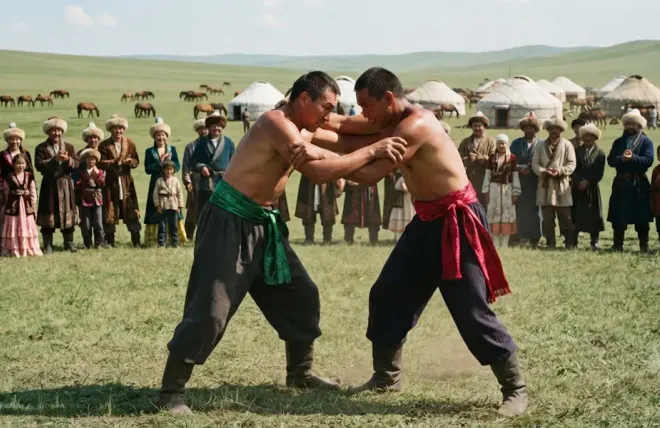
Conversely, the interaction between a jezde (brother-in-law) and his wife's younger siblings—the baldyz—is marked by a vibrant, playful freedom. Tradition allows for lighthearted teasing and boisterous, humorous battles; it is not uncommon for a group of baldyz to playfully gang up on their brother-in-law. In these moments, the jezde is expected to remain good-natured. He, in turn, defends himself with sharp wit, engaging in a spirited, intellectual "duel" that never crosses the line into genuine malice. This banter is a cherished, joyful aspect of Kazakh culture. Unfortunately, some modern men fail to grasp this tradition, becoming easily offended or overly authoritarian when faced with such playful energy. Embracing this whimsy and responding with humor is considered a sign of true character.
The Bond of the Bazha
Men who are married to sisters are known as bazha. There is a famous proverb: "Even-hoofed animals share their fodder, but among humans, it is the bazha who share the deepest friendship." This holds true because sisters, bound by blood and mutual affection, rarely harbor jealousy toward one another. When the women maintain a harmonious household, their husbands inevitably find it easy to forge a deep, respectful camaraderie. Consequently, brothers-in-law rarely quarrel; if a minor disagreement does occur, they do not hold grudges, preferring to live in peace.
Mutual Respect and Household Protocol
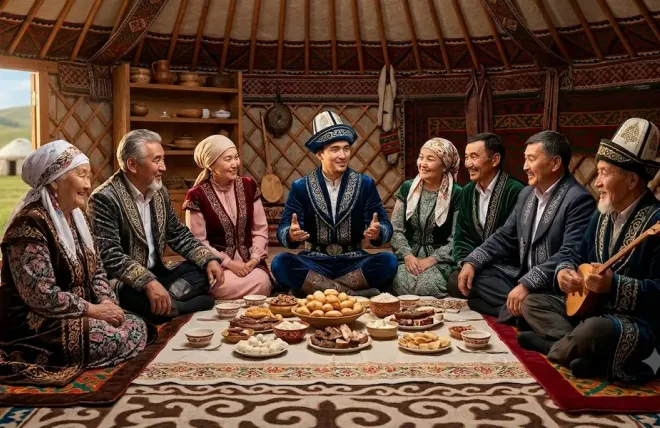
The son-in-law holds a unique place of honor among his in-laws. Parents who have cherished their daughter treat her husband as their own child, welcoming him with open arms. Following the adage that "even the Prophet honored his son-in-law," they shower him with hospitality, which in turn inspires the man to deepen his devotion to their family.
However, social etiquette dictates strict rules within the home. Traditionally, neither the son-in-law nor the daughter-in-law is permitted to sit in the tor—the seat of honor at the back of the room facing the entrance. Occupying this space would be viewed as an act of arrogance, as it is reserved exclusively for the father-in-law and his elder male kin. Sitting in a lower position is a mark of humility and proper breeding. Yet, this protocol evolves with time: as the man ages, the elders observe the saying, "When a son-in-law grows old, he becomes like a grandson," and they eventually invite him to take the place of honor.
The Balance of Loyalty
Cherishing one's in-laws is a virtuous duty. Some men become so attached to their spouse's family that they neglect their own kin, spending all their time at their in-laws' doorstep. Such individuals are often criticized as qaiynsaq (obsessed with in-laws), a term that serves as a reminder not to forget one’s own roots. A wise man, deeply versed in the traditions of his people, knows how to hold the reins of life firmly. He strives to balance his loyalties, ensuring that both his blood relatives and his wife's family remain satisfied and respected.
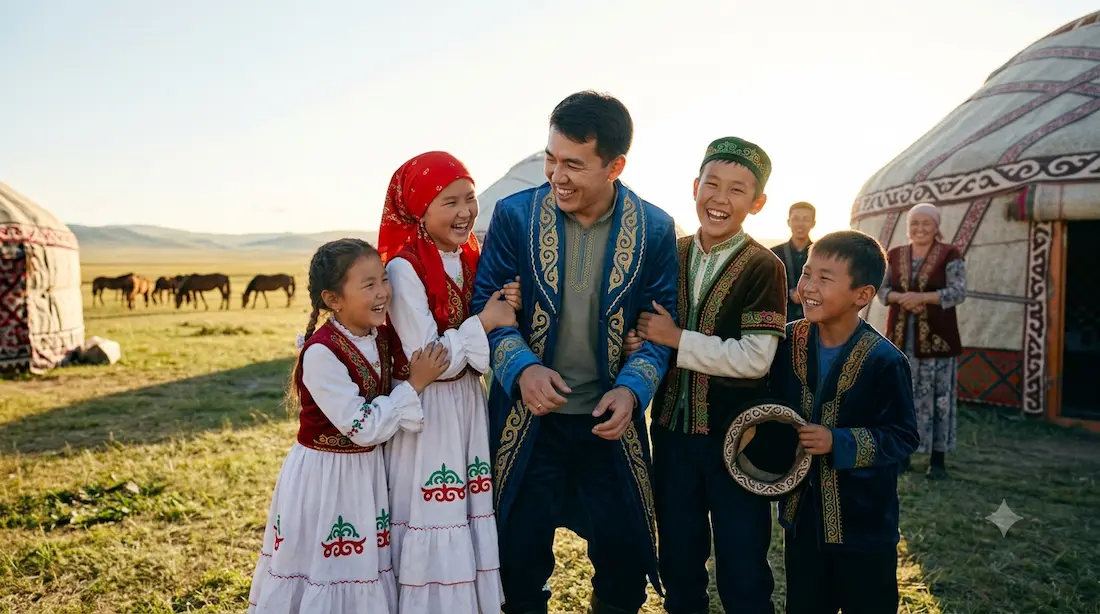
Ultimately, the in-law relationship extends far beyond a single household. It encompasses the entire paternal branch of the father-in-law, reaching out to distant elders and relatives. As a man learns to honor this vast network with sincerity and grace, his own reputation and standing within the community grow in tandem.
Kinship Terminology Related to Marriage and In-Laws
- Kuyeuk: The title for a man who has formally proposed to or married a woman, defining his kinship connection to her paternal family.
- Qaiyn zhurt: A collective term for the relationship between two families linked by marriage, specifically describing how the bride and groom relate to each other’s wider clan networks.
- Quda: A formal relationship established between the parents, grandfathers, and other elder male relatives of a bride and groom, effectively binding the two families together.
- Qaiyn ata: The father-in-law; specifically, the father of a spouse in relation to the person they married.
- Qudagi: The female counterpart to Quda; it refers to the mothers or grandmothers of a married couple, or any wife within these linked families.
- Qaiyn ene (or Ene): The mother-in-law, denoting the maternal bond between a parent and their child’s spouse.
- Quda bala: A term used for the son of one’s Quda (in-law), typically denoting a younger male relative within that family.
- Qaiynaga: The elder brother-in-law; this title applies to the older brother of one's spouse.
- Qaiyn apa: The elder sister of a husband, viewed as a senior relative by his wife.
- Qaiyn bike: The elder sister of a wife, who holds this specific status in relation to her brother-in-law.
- Qaiyn ini (or Qaiyny): The younger brother of a husband, who is considered a younger relative by the wife.
- Qaiyn singli: The younger sister of a husband, who maintains this distinct kinship role toward his spouse.
- Baldyz: The younger siblings of one's wife; they maintain this playful and familiar connection to their brother-in-law.
- Bazha: The relationship between two men who have married sisters; they share a bond as brothers-in-law.
- Qudasha: A term for the younger female relatives of a spouse or the daughters of those linked by marriage.
- Abysyn (or Abysyn-azhyn): The term describing the relationship between women who are married to brothers; they are essentially sisters-in-law to one another.
- Torkin: Refers to the original paternal family, relatives, and ancestral home of a woman who has married and moved into her husband’s household.