Camels of the Kazakh Steppe: Breeds, Terminology, and Nomadic Life


The camel was domesticated and incorporated into human life approximately 5,000 years ago. Over the subsequent 7,000 years, it became the most indispensable mode of transport for peoples inhabiting arid, desert regions.
While it is believed that the camel originated in North America, today these animals are found across Africa, Central Asia, Western Asia, and the western regions of North America.
Types of Camels
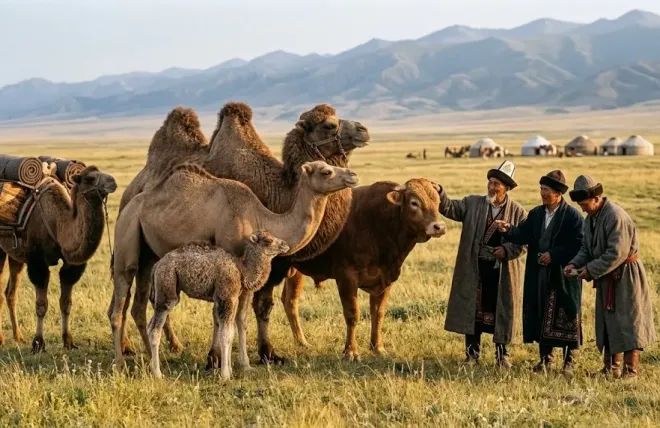
There are two primary types of camels: the double-humped camel and the nar (single-humped camel). Purebred double-humped camels are known as Bactrian, and purebred single-humped camels are known as Dromedary.
- Bactrian (double-humped): Height (between humps) is 178 cm, length is 158 cm, and their wool is dark brown.
- Dromedary (single-humped): Height (at the withers) is 210 cm, length is 155 cm, and their wool is a reddish-grey color.
Camels differ from other ruminants in that they have two incisor teeth on their upper jaw and lack a gallbladder. They reach sexual maturity between 2–3 years of age, though females (ingen for Bactrians, maya for Dromedaries) are generally first bred at 3–4 years old. Males (bura) are introduced to the herd at 5–6 years of age.
Physiology and Behavior
Well-cared-for camels store energy for the winter in their bodies and humps. This allows them to survive for long periods in winter without food or water by utilizing these fat reserves. In terms of strength, they are far superior to both horses and oxen.
The mating season for Bactrians lasts from January to April, while for Dromedaries, it runs from January through May. During the mating season, a bura (male) will go for up to a month without eating or drinking. Once he is in peak condition, he becomes restless, foaming at the mouth, striking his neck against his shoulders, and hitting his hindquarters with his tail. During this time, the male becomes highly aggressive and dangerous. Ten days before reaching this peak, a metal restraint is often placed on the male's mouth to control him; it is only removed once his sexual urge has subsided.
Productivity and Lifecycle
A strong Dromedary male can manage a herd of up to thirty females, while a Bactrian male can manage up to twenty. A Bactrian female has a gestation period of fourteen months, while a Dromedary female has a gestation period of thirteen months. A lactating camel can be milked up to twelve times a day. Their milk is used to produce shubat (fermented camel milk), which is exceptionally beneficial for human health.
Camel wool is sheared in April and May. A mother camel nurses her calf (bota) for 15 to 18 months, and they typically give birth only once every two years. A purebred camel can live up to 30–40 years.
Cultural Significance
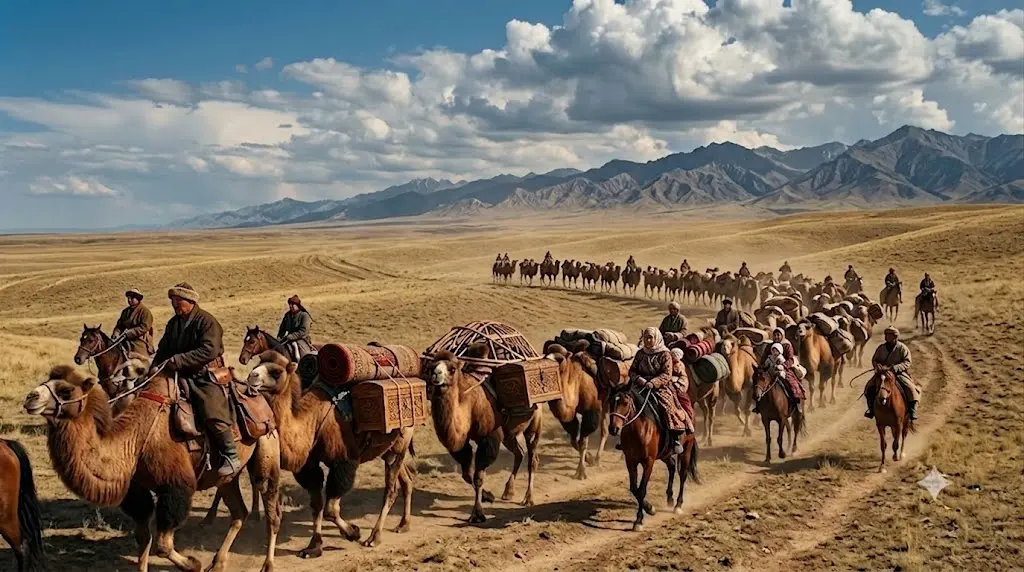
It is well-known that the camel has long been vital to the nomadic life and rural economy. Renowned for their endurance in the desert and their reliability in pathless, arid terrain, they are affectionately called the "Great Ships of the Desert."
In nomadic culture, camels are classified and named according to a wide variety of characteristics, including their region of origin, the family that raised them, their pedigree, strength, physical build, color, as well as the shape of their head, tail, humps, and their age.
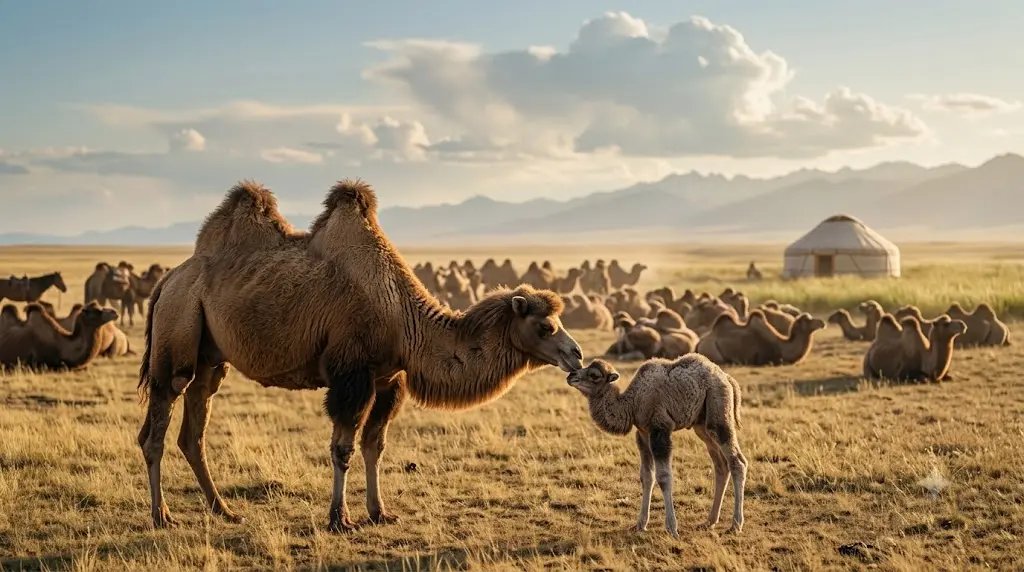
Breed Classification
Traditionally, livestock breeders divided camels into two main groups based on their strength and breed:
Single-humped camel (Dromedary):
Nar (female) — Female single-humped camel.
Nar (male) — Male single-humped camel.
Double-humped camel (Bactrian):
Ingen — Female double-humped camel.
Bura — Male double-humped camel.
Classification by Condition and Reproductive Status
- Qayytqan nar — A female single-humped camel that has been brought to the male for mating with human assistance.
- Qayylghan nar (or ingen) — A female camel (Bactrian or single-humped) that has mated with a male naturally during the breeding season.
- Qayymaly ingen — A female camel ready to be mated.
- Muiizgek ingen — A female that is constantly seeking the male but is not conceiving.
- Zharday tuie — An exceptionally fat, well-conditioned camel.
- Qur tuie — A "free" camel; one that has never been bridled or packed, living solely on pasture and becoming very fat.
- Zharaghan tuie — A working camel that has become lean and "hard as wire" from constant travel and lack of grazing time.
- Azghan tuie — A camel that has become severely emaciated and weakened.
- Qara qayys tuie — A camel that has shed its winter coat and has not yet grown a new one, leaving it with just its skin exposed.
Note on Hump Shapes: Herdsmen also evaluate a camel’s condition by the shape of its humps, using descriptive terms such as Tik orkesh (upright), Zhuan orkesh (thick), Zhapyryq orkesh (flat/leaf-like), Bala orkesh (small), Qausyrma orkesh (hugging/curved), Qulama orkesh (sloping), Zhal orkesh (ridge-like), and Qalaq orkesh (blade-like).
Classification by Age
- Bota — A newborn camel calf.
- Nar-bota — A single-humped camel calf.
- Tailaq — A one-year-old camel.
- Qunansha — A camel over two years old.
- Buyrshyn — A four-year-old ungelded male reaching sexual maturity (ready to be a Bura).
Classification by Physical Features
- Zhyryq tuie — A camel with a torn nose (often caused by the nose-peg being pulled too hard during travel).
- Qamshy quyryq — A camel with a tail that has a "whip-like" snap and agility.
- Shal quyryq — A camel with a tail that is slightly longer and hairier than average.
- Taraq quyryq — A short tail where the hair parts naturally down the middle like the teeth of a comb.
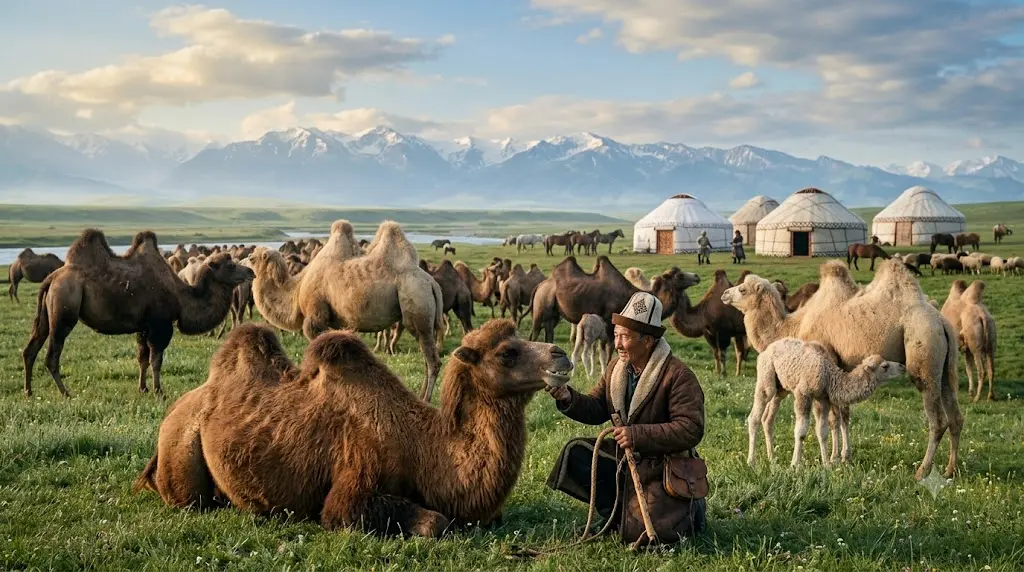
Classification by Strength and Capacity
- Alyp atan tuie — A "giant" pack camel; extremely strong, powerful, and capable of carrying massive loads.
- Shalaghay tuie — A weak, low-stamina camel.
- Borteki tuie — A term derived from the "Borte" lineage; describes a lazy, fleshy camel that tires easily, lacks stamina, and is unsuited for long journeys.
- Shau tuie — An elderly, aged camel that has lost its strength.
Breeding Behavior and Wool Characteristics
This section details traditional terminology regarding camel breeding behavior and the different characteristics of their wool.
Breeding and Mating Behavior
- Bura shogeru — Refers to two actions: first, the process of a handler assisting a male camel (bura) in mating with a female (ingen or nar); second, the act of the handler pulling the lead rope (buyda) to signal the camel to kneel (sit down).
- Bura shogu — Also refers to two actions: first, the male camel mating with the female naturally, without human assistance; second, the camel kneeling down on its own accord.
Classification by Wool Characteristics
- It zhun (Dog-hair) — The soft, fluffy, down-like coat of a newborn camel calf, which resembles the fine hair of a dog.
- Tuie zhabaghy — The thick, matted, and dense winter coat of a camel.
- Bozdaq — The fine, soft, and sparse layer of new hair that begins to grow during the summer after the camel has been sheared.
- Oli zhun (Dead hair) — The old, matted winter hair that has not yet shed and remains on the camel into the summer.
- Tiri zhun (Live hair) — The healthy, new hair that begins to grow underneath the old winter coat, as well as the new growth that appears after the animal has been sheared.
- Shuda — The coarse, long hair that grows around the camel's humps, the nape of the neck, the joints (knees/elbows), and the underside of the throat.
- Koterilgen zhun — The stage in late spring when the new hair growing underneath pushes the old winter coat upward, signaling that the camel is ready to be sheared.
Detailed Condition, Health, and Physical Status
- Qyrysqaq tuie — A slow, sluggish camel that moves very deliberately when ridden or led.
- Qaghylzhyn tuie — A camel that stays thin and fails to gain weight or flesh regardless of the season.
- Toqyraghan tuie — A camel that was fat but has begun to lose condition due to poor grazing, lack of saline pastures, or extreme heat.
- Barlyqqan tuie — A camel that was fat but became exhausted and stressed from heavy riding.
- Qondy tuie — A camel in good condition, grazing on a mix of saline and sweet grasses, with firm flesh and developing humps.
- Shymyr tuie — A fat, well-muscled camel with a dense, compact build.
- Azghan tuie — A camel that has become severely emaciated, to the point where its bones are visible.
- Qara qayys tuie — Often synonymous with a camel that has lost its hair and is lean.
- Shi arqa tuie — A camel prone to back sores (zhauyr) and spinal sensitivity from the pack saddle.
Behavior, Temperament, and Quirks
- Buralqy tuie — A stray camel that has wandered away from its herd or followed a group of travelers; essentially a camel without an owner.
- Qaghylghan tuie (or Qanghy bas tuie) — A stray camel that, due to exhaustion or overwork, cannot keep up with its herd and wanders off aimlessly.
- Zhaby tuie — A wild, untamed camel that has never been ridden.
- Sabyylghan tuie — A camel that has arrived at a destination foaming at the mouth from a hard, fast run.
- Soqtyqqan tuie — An exhausted, drenched-in-sweat camel that has been overworked to the point of collapse.
- Qysy-raghan tuie — A female camel that habitually loses her pregnancies.
- Borteki tuie — A weak, "lazy" camel with poor stamina that tires very easily.
- Zhel ayaq tuie — A restless camel that never grazes in one place, constantly moving on after only a few bites of grass.
- Qanyltaq tuie — A fast, agile young camel.
- Ketegen tuie — A "homesick" camel that refuses to settle in a new pasture or with a new owner, constantly attempting to return to its birthplace.
- Boshalauyq — A pregnant female that, when labor begins, feels insecure, hides from the herd, and goes to a secluded spot to foal.
- Elgezek tuie — A spirited, energetic camel that moves quickly and does not require the whip.
- Baya tuie — A troublesome, aggressive camel that constantly bellows and spits at people.
- Qutymsyz tuie — A poor-quality, difficult camel that is stubborn, noisy, and aggressive.
Utility, Domestic Role, and Husbandry
- Bayyrghy tuie — A camel raised by the owner since it was a calf (a "home-raised" camel).
- Atan tuie — A gelded male camel; they gain weight faster and are more durable for work.
- Kelishken tuie — A well-proportioned, large, and powerful camel.
- Ornyqty tuie — A sturdy, reliable camel with a heavy build, well-suited for labor.
- Iesiz tuie — An ownerless camel wandering without a herdsman.
- Tuma tuie — A camel born and raised within the household.
- Tumsa tuie — A maiden female that has reached adulthood but has not yet mated or foaled.
- Kiseli tuie — A pregnant female that has a strap (kise) tied around her neck to prevent her from losing the foal or causing issues during transport; these camels are typically not loaded with heavy cargo.
- Tabandy tuie — A camel whose feet are protected with special "shoes" made from old leather skin (saba) to prevent foot injuries during long-distance travel.
- Koben tuie — A camel that, after being turned loose in spring, is just beginning to regain flesh and show signs of hump development.
- Zhabyq tuie (or Etti tuie) — A camel with moderate body fat, beginning to look healthy.
- Berik etti tuie — A camel with slightly below-average body condition and underdeveloped humps.
- Bosalan tuie (or Bosan tuie) — A poor-quality camel that is fat but loses that weight immediately upon being ridden or worked.
Advanced Temperament, Management, and Gelding Terminology
This section outlines terminology used to describe the temperament, behavioral quirks, and management of camels, including the process of gelding.
Temperament and Behavioral Terms
- Bas asau — An unbroken camel that refuses to let anyone put a halter on its head.
- Shoge qalu — A camel that becomes exhausted during work and lies down, refusing to move.
- Bozdauyq tuie — A mother camel that is constantly bellowing while searching for her calf.
- Zhebir — A "greedy" camel that chews and eats things it shouldn't—such as horse tails, sheep wool, or even the shaggy neck hair (shuda) of itself or other camels.
- Tabandap qalu — A stubborn camel that refuses to be led, planting its feet and standing still.
- Bezer — An aggressive camel that kicks and strikes, not allowing anyone to approach it.
- Qytybas — A grieving mother camel that has lost her calf (e.g., to wolves) and refuses to accept a foster calf, and subsequently refuses to be milked.
- Tuskish — A camel that likes to rub its body against things, often damaging the felt covering of a yurt.
- Zhanasqy (or Zhanasu) — A mother camel that constantly nuzzles her calf while tethered, letting it nurse secretly and making it difficult for the milker to collect milk.
- Isinu — The physiological "let-down" reflex; when a mother camel stays close to her calf, her affection causes her milk to let down prematurely, making it difficult to milk her later.
- Isinshek — A camel prone to the isinu reflex (letting milk down too easily).
- Ury tuie — A "thieving" camel that, having grown up as an orphan, develops the habit of stealing milk from others whenever the opportunity arises.
- Mezhir tuie — A stubborn, difficult-to-lead camel.
- Shau tuie — An elderly camel that has reached the end of its working life and lost its strength.
- Tos tabany zhayylu — The stage at age five when a male camel reaches full physical maturity and maximum strength.
Udder and Teat Anatomy
- Zhelin sau — The stage when a pregnant camel's udder begins to fill/swell in preparation for birth.
- Zhelin saba — The skin or "casing" of the udder (a term used for all livestock).
Gelding Terminology
To ensure camels grow to a large size and produce high-quality wool, owners select one prime male to be a Bura (stud) and geld the rest. The following terms describe this process:
- Sytu — The act of cutting or surgically removing the testicles of a male camel.
- Pishu — Synonymous with Sytu (the act of gelding).
- Qysqysh — A specialized tool used to clamp or hold the testicles firmly before removal.
- Qaryghysh — A wide, flat metal tool used to cauterize the surgical site after the testicles have been removed, preventing infection and stopping bleeding.
Vocalizations, Expressive Sounds, and Rest Behaviors
This section outlines the terminology used by herdsmen to describe the vocalizations, physical actions, and resting behaviors of camels.
Vocalizations and Expressive Sounds
- Baqyru — The general term for a camel’s cry (bellowing), used when the animal is annoyed, angry, or afraid.
- Ynqyq qaghu — A mournful, sobbing sound made by a mother camel who has lost her calf (whether to death or separation). Such camels are often seen with tears streaming from their eyes.
- Shabynu (Rutting display) — A display of dominance and aggression by a male camel (Bura or Ulek). The camel foams at the mouth, spreads its hind legs, lowers its rump, arches its back, lifts its chest, and strikes its humps and hindquarters with its tail, creating a loud, rhythmic sound to intimidate rivals.
- Tisin qayrau — The gnashing of teeth; a male camel in the rutting season foams at the mouth and grinds its teeth together to create a loud, grating sound.
- Kurkireu (or Kurkildeu) — The rumbling or roaring sound made by a male camel when it is in peak condition during the rutting season.
- Ynyldau — A soft, grunting, or moaning sound a camel makes periodically while being ridden or carrying a load.
- Baqyldau — A louder, more vocal sound made by a camel while being ridden at a fast pace.
- Tairandau — The playful leaping, running, and frisking behavior of young camels (tailaq or bota).
Resting and Movement Behaviors
- Aldynan shogu — The process of a Bactrian or single-humped camel lying down. Unlike other livestock that lie down sideways, the camel does not simply collapse; it carefully folds one front leg (right or left), then the other, and finally tucks all four legs underneath its body to rest.
- Artynan turu — The process of rising from a kneeling position, where the camel rises on its hind legs first, then extends its front legs one by one to stand up.
- Zhylqysha turu — A behavior of weak or emaciated camels that cannot stand normally, causing them to struggle and rise in a manner similar to a horse (extending their front legs first).
- Aunau (Rolling) — The act of a camel rolling on the ground—often on dusty, sandy, or saline patches—stretching out all four legs, rubbing its head against the earth, and waving its legs in the air.
- Tyrandau — A state of relaxation where camels, having reached good pasture, nap while lying flat on the ground, doze in the sun, or roll playfully.
- Uieleu — A dangerous situation where a camel lies down in a hollow or uneven patch of ground and becomes stuck, unable to rise. If not helped, the camel's stomach can bloat, potentially leading to death.
- Silkineu — The act of a camel shaking its body after lying down or rolling to remove dust, debris, and dry grass from its coat.
- Tizdeu — A management technique involving tying a camel's front knees while it is kneeling to prevent it from standing up, or manually forcing an uncooperative camel to kneel by striking its knees or folding its leg.