Kudalyk: Matchmaking and Marriage Traditions


Kazakh culture features a rich tapestry of matrimonial rituals guiding families from the initial interest to the final wedding feast.
Biz Shanshar: The Symbolic Piercing with an Awl
In the old days, Kazakh hospitality operated on an entirely cashless, communal system. Lodging, food, transport, and banking were essentially built into the social fabric. In fact, hosts who failed to entertain a traveler properly faced public scorn and custom-enforced fines. For instance, if a host served meat without removing the tough white tendons from the hip joint or the lymph nodes from the brisket, they would be penalized for their carelessness despite offering the food for free.
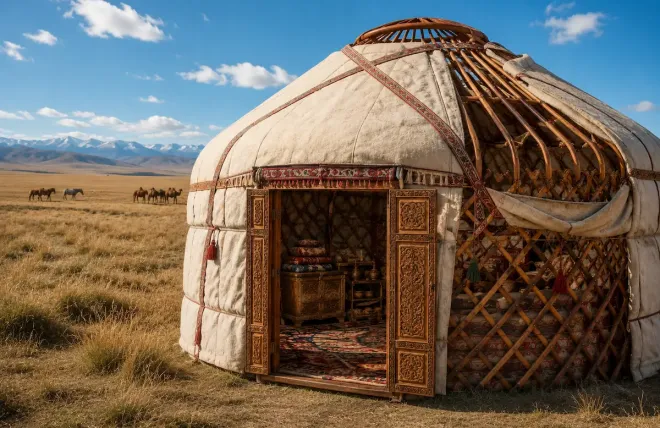
Among these free hospitality customs was Tustik (lunch). In the summer, when the midday sun cast no shadow and stood directly above the yurt's central roof ring (shanyrak), travelers would stop by. They drank tea, ate meat, rested their horses, and went on their way without staying the night.
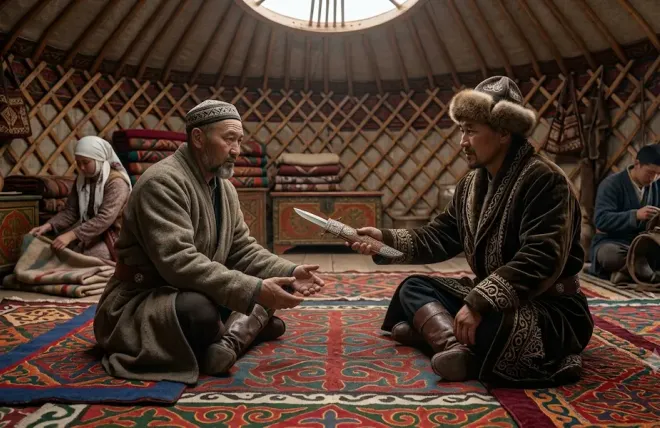
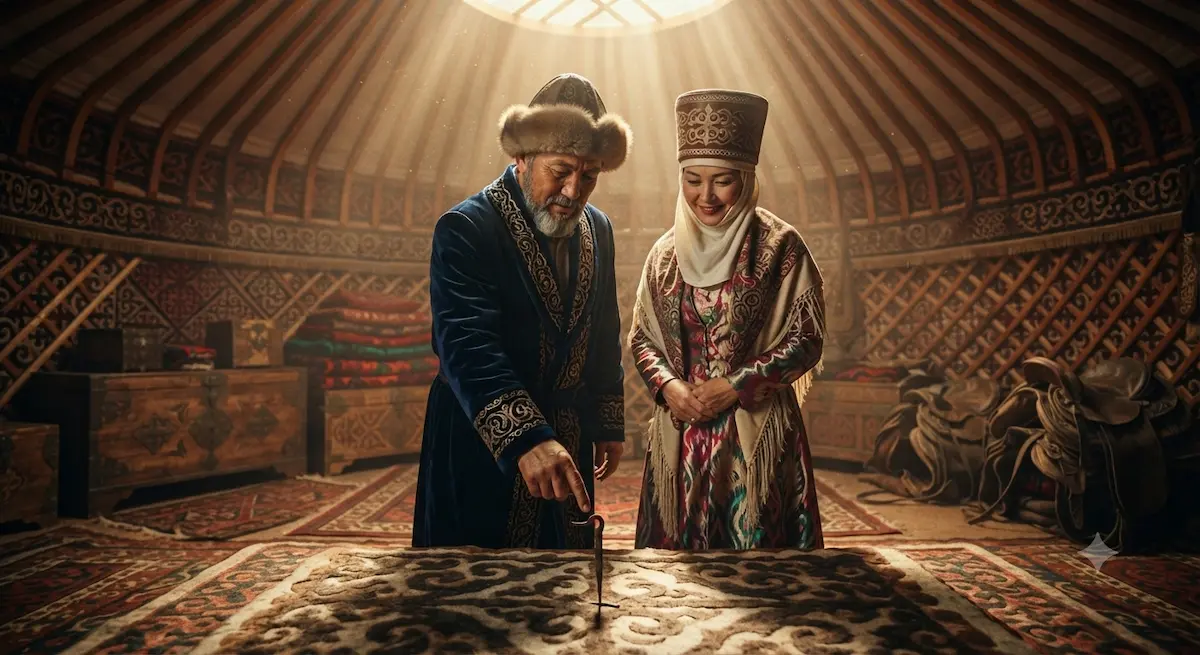
However, a group arriving for the Biz Shanshar (symbolic piercing with an awl) ritual behaved very differently. They spoke to no one, piled their saddles in one place, and stayed put long after lunch. Recognizing this, the host would slaughter an animal for a proper evening feast. The next day, around the time the cattle returned for midday watering, the mysterious guests would leave silently. Interestingly, these groups consisted almost entirely of respected elders.
Once the guests departed, the family—fully aware of what this meant—would carefully shake out the floor felts (syrmaq) and search for the household whetstone. Upon inspection, they would find an awl (biz) pinned into the felt and notice that their whetstone (qayraq) was missing.
This silent riddle carried a profound message:
"Our son has come of age, and your daughter has grown into a beauty. We have a noble boy, you have a beautiful girl—let us become kin."
This marked the very beginning of a family’s care for their child's future. If the girl's father chose not to ask for the whetstone back, it signaled his consent. A week later, the elders would return to officially propose.
The Symbolism of the Awl and Whetstone
The tools were chosen with great purpose. In nomadic life, an awl was a sharp, sturdy tool used by men to pierce heavy leather, while a needle (ine) was used by women for fine embroidery. Pinning the awl into the felt asked: "We have a son; would you welcome him into your home as one of your own?"
Meanwhile, taking the whetstone symbolized sharpening and strengthening that bond, meaning: "If you accept our tool, let us forge a sacred oath." In the Kazakh language, the word for this lifelong marital bond, Qudanda, derives from Quday (God) and the Arabic Ahd (oath)—signifying an alliance made before the Almighty.
Kyz Ayttyru: Arranging a Marriage
Finding a suitable bride for a son was a parent's ultimate dream. Families sought out honorable, respected, and reputable households. They carefully avoided families with known hereditary illnesses, prioritizing unions with social equals to foster strong kinship ties.
Arranging a marriage took several forms depending on the children's age:
- Bel Kuda (loin matchmaking): Close friends or allies agreed to unite their children before they were even born.
- Besik Kuda (cradle matchmaking): The alliance was struck while the children were still infants in their cradles.
- Karsy Kuda (reciprocal matchmaking): Two families exchanged a son and a daughter with each other, creating a double bond.
- Suyek Zhanghyrtyu (renewing the bone): Families that had successfully intermarried in past generations arranged a new marriage to refresh their historical kinship.
The formal matchmaking ceremony, Quda Tusu (official proposal visit), occurred only after the boy reached maturity. To maintain genetic health, Kazakh law strictly forbade marriage between relatives within seven ancestral generations (Zheti Ata). Additionally, unions were barred if a woman was eight or more years older than the groom, or if a man was twenty-five or more years older than the bride. This careful arrangement ensured that young couples grew up with a shared understanding, laying the foundation for a stable family.
Kyz Koru: The Custom of Choosing a Bride
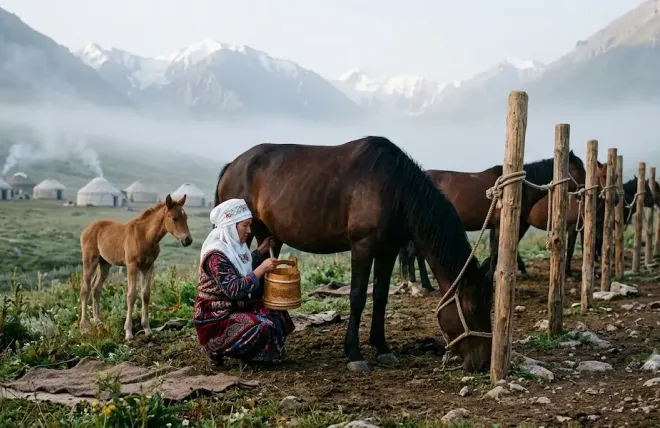
Also known as Kyz Tandau (choosing a maiden), this custom allowed young men from notable families to actively seek out a partner. If rumors spread of a beautiful and intelligent young woman in a distant village, young men would travel there to meet her. This gave rise to the famous Kazakh proverb: "Who doesn't look at a beautiful maiden, and who doesn't drink fresh koumiss (fermented mare's milk)?"
This tradition granted young men the freedom to travel and visit prospective brides without facing resentment or suspicion from the girl's village; instead, they were welcomed warmly.
Furthermore, free-spirited, mature, and articulate young women used this opportunity to voice their own standards, famously declaring: "If these men have come to inspect us, let us inspect them in return!" They openly expressed their opinions about the suitors. Often, these meetings turned into witty poetry duels (aytys) between the young men and women. If a mutual connection and trust blossomed, the young man would ask his family to send official matchmakers.
While this freedom of choice was highly valued, it was a privilege typically enjoyed by the children of prominent and influential figures. For a deeper look into this tradition, one can read T. Zhomarbaev’s classic novel, Let Us See the Maidens (Kyz Korelik).
Shege Shapan: The Ceremonial "Nail" Robe
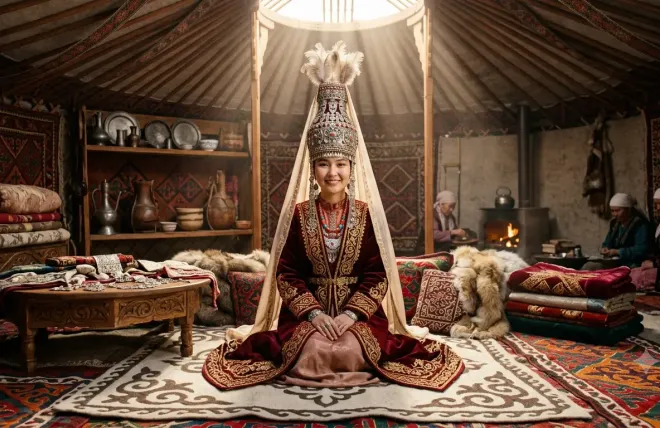
Once the parents of both parties reached a mutual agreement, they exchanged formal tokens. The bride's father would drape a brand-new ceremonial robe—the Shege Shapan (literally "nail robe")—over the shoulders of the groom's envoy (zhaushy). This symbolized that the marital agreement was securely "nailed" and locked in place.
Karghybau: The Engagement Promise
Before the grand matchmaking event, the groom’s family sent their zhaushy (herald) to the bride's village to secure an initial agreement, outline the size of the bride price (qalyn mal), and set a basic timeline.
As a gesture of good faith, the herald presented the bride's father with the Qarghybau (engagement promise gift). The term originally refers to the reins and lead ropes of a swift, prized stallion. Following this successful preliminary meeting, the groom's father would arrive in person to finalize the matrimonial alliance alongside close relatives, elders, and maternal uncles.
Oltiri Otkizu: The Sacred Oath of the Living and Dead
Though pronounced as a single word, Oltiri combines Oli (the dead) and Tiri (the living). This ritual carries a solemn vow: "To make this union eternal, both sides swear an oath before the living and the memory of the deceased."
To seal this promise, livestock brought by the groom's side was dedicated and slaughtered. Crucially, the bride's family was not allowed to slaughter this animal; an independent third party did the honors. This ensured that neutral witnesses would be present on Judgment Day to testify to the sacred covenant. After the completion of the Oltiri (sacred oath ritual), both families gained the official right to address one another as Kuda (co-father-in-law) and Kudaghi (co-mother-in-law).
During this ritual, the groom's side presented a special feast. The bride was strictly forbidden from tasting this food because she had not yet officially crossed her family's threshold to join her new home; tasting the groom's food prematurely was considered improper and a breach of custom.
Following the feast, the groom's family presented a young three- or four-year-old horse adorned with owl feathers (ukili qunan). Much like branding livestock to show ownership, the owl feathers served as a sacred amulet, publicly declaring that the young woman was officially spoken for and protected as their future daughter-in-law.
Kuda Tusu: The Matchmaking Ceremony
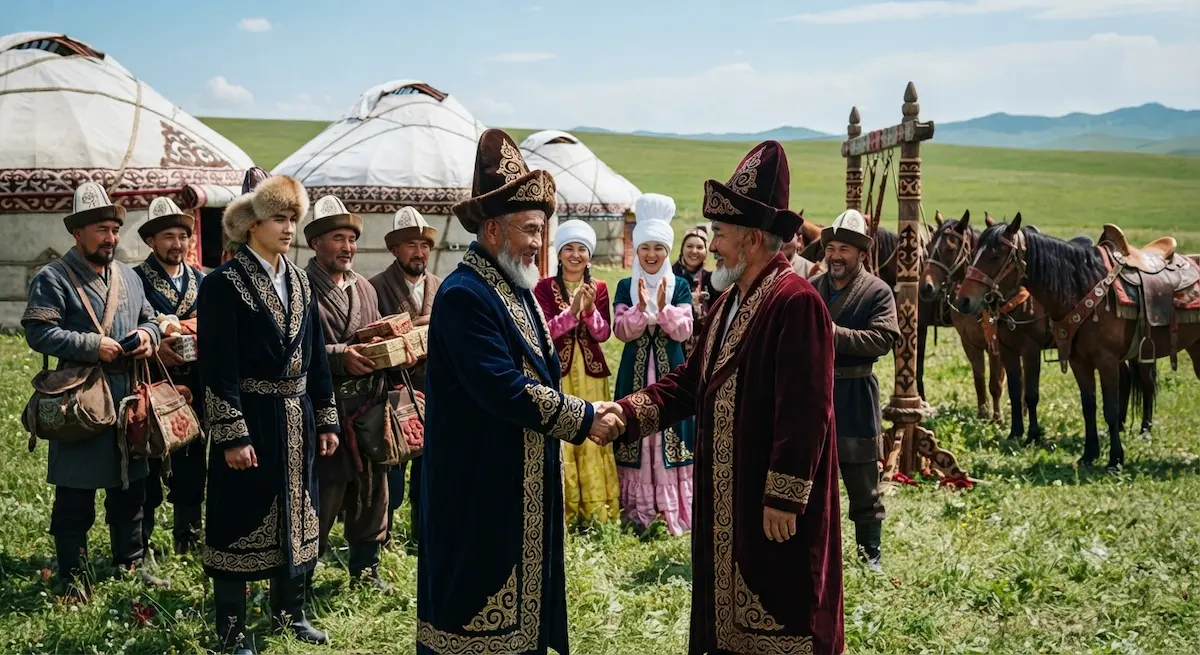
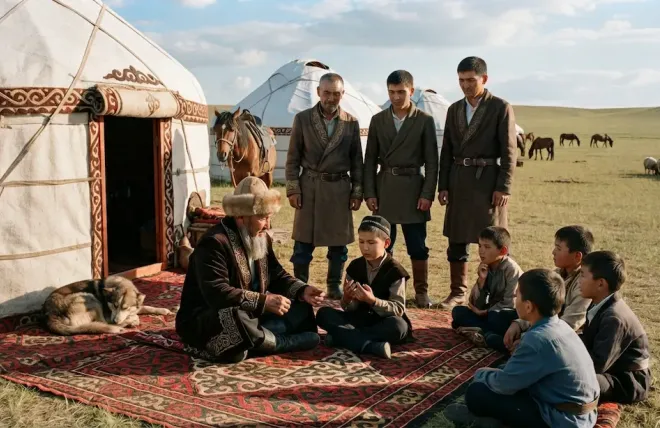
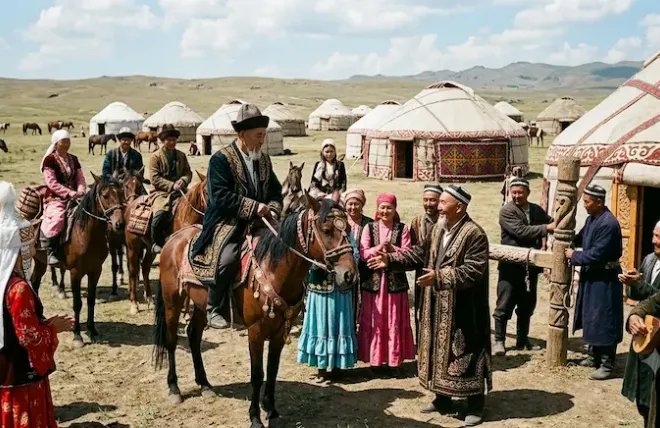
Kuda Tusu (official proposal visit) is one of the most vibrant and theatrical pillars of Kazakh culture. The groom’s father—accompanied by close relatives and sometimes the groom himself—arrived at the bride's village for the official matchmaking.
With advance notice, the bride's father would gather his own relatives and respected neighbors to welcome the guests with immense pomp and pageantry. The two sides exchanged valuable gifts and participated in several traditional games and sub-rituals, such as Kuda Attanar (sending off the matchmakers), At Baylar (tying the horses), and the tasting of Kuyryq-Bauyr (sour cream and liver dish).
The hierarchy of the matchmaking party was well-defined:
- Bas Kuda (head matchmaker): The leader of the groom’s delegation. He remained a deeply revered figure for the bride throughout her life. In her new home, she would affectionately address him as Agheke (honored older brother), and he would look after her well-being.
- Bauyzdaý Kuda (blood matchmakers): The biological fathers of the bride and groom, representing the core of the new family alliance.
Bata Ayak: The Final Binding Agreement
This ritual marked the conclusion of the formal negotiations. The groom’s father returned to the bride’s village to finalize the wedding dates, the exact amount of the bride price, and the specific ceremonial obligations (kade). This finalization was known as Bata Ayak (concluding the blessing), though some regions called it Syrgha Taghar (the wearing of earrings) or Batalasu (the covenant).
The blessings were categorized into two distinct types:
- Kesimdi Bata (definitive blessing): A firm, final decision where the exact date of the wedding, the financial expenses, and the precise number of livestock were set in stone.
- Kelisimsiz Bata (flexible blessing): An open-ended agreement where the exact number of livestock and expenses remained flexible, depending on future circumstances.
Among wealthy and prominent families, the exchange of gifts reached extraordinary heights, categorized into three tiers:
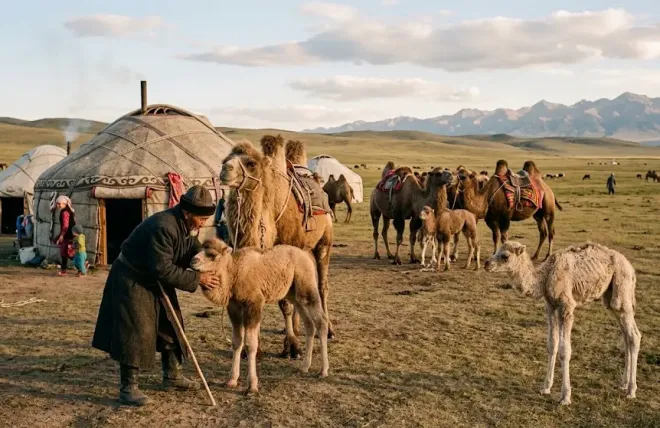
- Bes Zhaxsy (the five finest goods): A camel with its calf, a mare with its foal, and highly valuable items crafted from pure gold or silver.
- Orta Zhaxsy (the mid-tier finest): Highly prized horses or camels.
- Ayaq Zhaxsy (the standard finest): Healthy horses, cattle, or sheep.
Kuda Tartar: The Playful Initiation of the Matchmakers
Kazakh culture features a rich array of lighthearted rituals designed to break the ice between new in-laws. The most entertaining of these is Kuda Tartar (teasing the matchmakers). After the main feast was cleared and the elders settled in for conversation, the village women and youth would playfully "ambush" the visiting matchmakers.
Following ancient custom, they might force a distinguished matchmaker to ride a bull backward through the village, place them on a large felt carpet to toss them up and down, tie their legs and hoist them toward the yurt's roof frame using ropes, drench them in water, or force them to dress in women’s clothing.
To escape these playful tortures, the matchmakers had to pay a ransom in coins or gifts. The matchmakers took these pranks in stride without any offense. The entire spectacle offered fantastic entertainment for the village, rivaling professional theater. This good-natured hazing forged deep, resilient friendships between the two families through shared laughter.
Kalyn Mal: The Bride Price Livestock
Following the formal agreement, the groom’s family transferred a designated number of livestock to the bride’s family. The scale of this transfer depended entirely on the family's wealth:
- Wealthy Aristocrats: Provided anywhere from 200 to 500 horses, sometimes reaching up to 1,000 heads of livestock.
- Modest Families: Might provide only 5 to 6 heads of cattle.
Beyond the Kalyn Mal (bride price), the groom’s family also paid Sut Aky (the mother’s milk fee) and provided offerings for the deceased (Oltiri). During the Soviet era, authorities mischaracterized this custom as "buying and selling women." In reality, the bride’s family returned this wealth entirely to the young couple by preparing a massive, luxurious dowry (Zhasau) that often equaled or exceeded the value of the livestock received.
The composition of the livestock followed specific customary terms:
- Dongelek Kalyn (the rounded bride price): Consisted of a standard unit of 10 cows.
- Balama Kalyn (the equivalent bride price): Allowed families to substitute equivalent livestock, such as trading sheep or cattle for 1 or 2 high-quality horses.
- Olqy Kalyn (the deficit indemnity): If a betrothed young woman passed away before the wedding, and the groom wished to marry her younger sister instead, he provided an additional 27 head of horned cattle to restore the balance.
The distribution of this livestock followed strict protocols. The groom's family paid a Kuryq Bau (lasso fee) to the horse herders who helped sort the animals, and a Kosaqbau (tether fee) to the shepherds managing the sheep. They also provided a gift called Kelin Tili (the bride's voice gift) to bless the young woman's health.
Baldyz Kalyn: The Sister-in-Law Indemnity
If a betrothed young woman passed away before the wedding took place, the groom held the right to marry her younger sister (baldyz), since the bride price had already been paid. However, the rules shifted depending on whether the groom had already visited his bride in secret:
- If the groom had already completed his clandestine preliminary visits (uryn kelu) and spent time with the bride, the bride's family would return half of the original Kalyn Mal (bride price). If the groom then chose to marry the younger sister, he had to pay a supplementary fee known as the Baldyz Kalyn (sister-in-law indemnity).
- If the groom had never visited or met the deceased bride, the younger sister (baldyz) would take her place without the groom having to pay any extra fees.
Kiit: The Ceremonial Exchange of Garments
Before the matchmakers departed, the bride’s father hosted a formal farewell ceremony known as Kiit (the ceremonial exchange of garments). The most valuable and prestigious gifts were reserved for the groom’s father, even if he was not present in the delegation. The remaining gifts were distributed among the matchmakers based on their seniority, lineage, and closeness to the family.
Wealthy hosts would present the groom's father with an entire herd of horses, exquisite robes, and a magnificent riding stallion. While the groom’s family also gave gifts to the bride’s relatives upon their arrival, the bride’s family traditionally brought a slightly larger delegation and received grander honors, offset by the Qalyn Mal (bride price) they had received.
Esik Koru: The Groom’s First Clandestine Visit
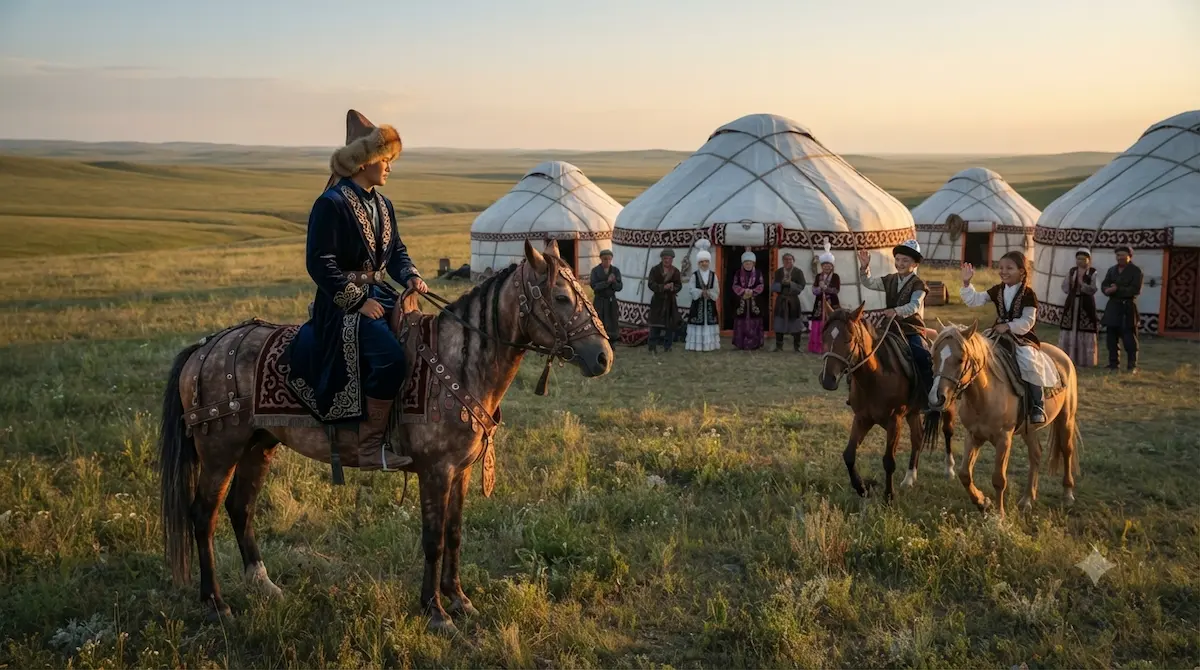
Once the bride price was largely paid, the bride’s family granted the groom permission for Esik Koru (literally "to see the door"). If the livestock had not been delivered, this privilege was strictly denied. During this engagement period, even though the groom could not visit freely, the two families interacted constantly, exchanging fine horses, gifts, and visits. This period was the true honeymoon of the matchmaking process.
Interestingly, many grooms never saw their brides face-to-face until this official visit. In fact, out of traditional modesty (uyat), the bride avoided showing her face to her future in-laws, brothers-in-law, and older sisters-in-law. If a relative caught a glimpse of her by accident, they had to pay a korimdik (a viewing fee) to excuse themselves.
When the groom finally arrived for Esik Koru (to see the door), he was forbidden from entering the village in broad daylight. Doing so was considered arrogant, rude, and uncultured. He had to wait until dusk began to fall.
As twilight settled, the groom would wait at a distance. His future young brothers-in-law or sisters-in-law (baldyz) would ride out to meet him, take his horse, and tend to it. This gave rise to the old Kazakh saying: "Ride the groom's horse until it turns to ash," meaning the youth were free to enjoy the groom's resources.
The Educational Value of Waiting
This enforced delay carried a profound lesson. It taught the youth to respect their elders and honor their future in-laws. Just as gold mined from deep beneath six layers of mountains is far more precious than gold found lying on the open ground, a bride who remained elusive and hard to reach became infinitely more cherished.
While Kazakh tradition did not let things reach the tragic extremes of the legendary star-crossed lovers Layla and Majnun, elders certainly used their story as a guide. They believed that allowing a groom unrestricted, casual access to his bride before the wedding would ruin his character and diminish his respect for the family.
Exceptions and Hidden Compassion
Naturally, life in the steppe was not without its complications. Occasionally, a young woman might find herself betrothed to a child who had not yet grown up, an elderly man decades her senior, or destined to become a junior wife (toqal) in a polygamous household. In these rare situations, the bride’s mother and sisters-in-law would quietly conspire to grant the young couple some freedom.
Even if the village dogs barked through the night as the young suitor slipped past the yurts, the sympathetic mother would pretend not to hear or see anything. Her leniency came from a place of deep maternal love: "My poor child is heading toward a difficult life; let her enjoy her freedom while she still can."
This balance of strict public morality, deep educational values, and quiet family compassion defined the unique worldview of traditional Kazakh society. Turn-of-the-century Kazakhs viewed Esik Koru (to see the door) not as a casual encounter, but as a formal crossing of a cultural border—a sacred rite of passage granting a young man official entry into his new extended family.