Traditions and Customs Dedicated to Children


Kazakh culture features a rich tapestry of life-cycle rituals guiding a person from birth to maturity.
Early Childhood and Sacred Milestones
Besikke Salu: Placing the Infant in the Cradle
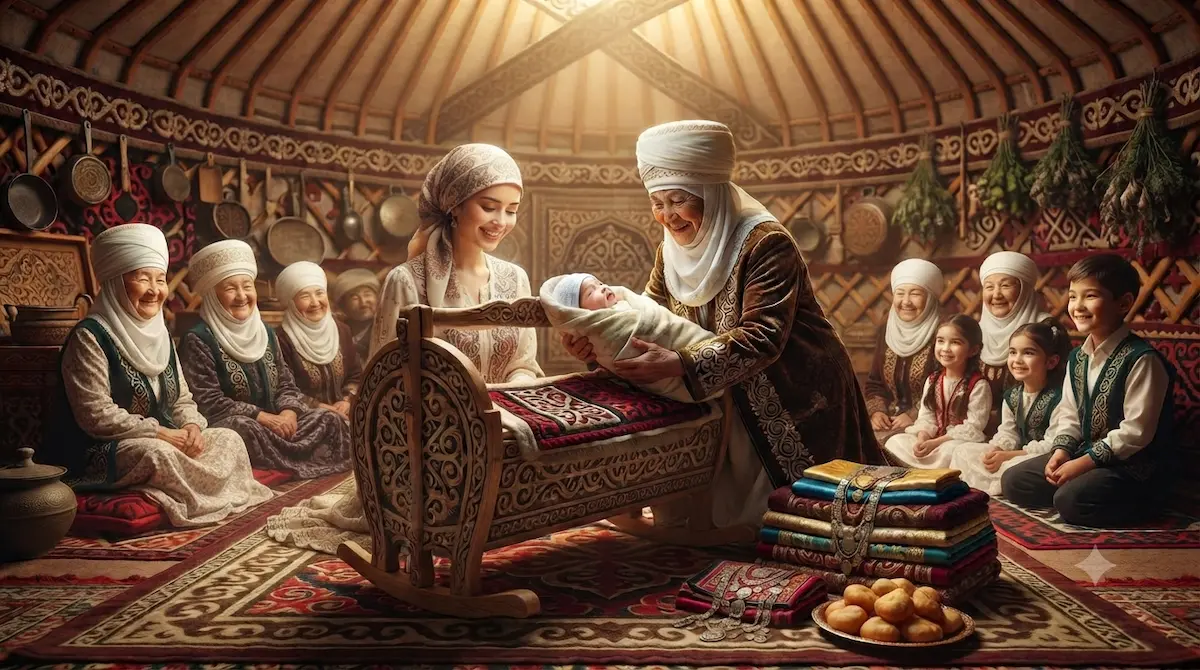
The traditional Kazakh cradle (besik) is highly valued for keeping the infant clean, warm, and secure. The honor of placing the newborn into it for the first time is given exclusively to a baibishe—a respected, elderly matriarch who has raised many successful descendants. As she secures the baby, she sings a soothing lullaby (Besik Zhyry). Afterward, the family honors her with valuable gifts for performing this sacred task.
At Qoyu: The Art of Naming
Naming a child is a highly celebratory event. Parents strive to choose beautiful names or name the infant after honorable individuals, hoping the child will grow up to match their reputation. A highly respected elder is chosen to bestow the name, shouting it into the infant's ears followed by a formal blessing (bata).
Names are frequently inspired by seasonal circumstances, natural phenomena, or holidays occurring at the time of birth:
- Nauryzbai: Born during the vernal equinox (Nauryz).
- Oraz or Orazaly: Born during the holy month of Ramadan (Oraza).
- Aitbai or Aitgul: Born during the festive days of Eid (Ait).
- Shoptibai: Born during the summer hay-harvesting season.
If a family keeps having consecutive daughters, they give them names like Ultugan (a son is born), Ulbolsyn (let there be a son), Ulmeken, or Ulzhan out of hope that the next child will be a boy. Conversely, if a family has many sons, they might give them unconventional names like Bashai (Toe), Qosqhulan (Wild Donkey pair), Kepter (Pigeon), or Kushik (Puppy) to deflect the evil eye. Today, names of revered historical and literary figures like Baurzhan, Abai, Saken, Ablai, Fariza, and Olzhas remain incredibly popular.
The Custom of At Tergeu
While naming is important, Kazakhs also practice at tergeu (the respectful avoidance of names). Out of deep courtesy, a young bride never addresses her in-laws or her husband's relatives by their first names. Instead, she uses affectionate and honorable titles: calling the father-in-law ata (grandfather), the younger brother-in-law qainy, the younger sister-in-law qainysinilim, and older brothers agheke (honored brother) or myrza qainagha (noble brother-in-law). Uttering an elder’s actual name is considered a severe breach of etiquette and a sign of poor upbringing.
Qyrqynan Shygharu: The Forty-Day Milestone
The numbers 3, 7, and 41 are considered highly auspicious in Kazakh folklore. Once a newborn safely survives its first forty days of life, a close circle of women gathers to give the infant a ritual bath, shave its birth hair, and clip its first fingernails. The family rewards these women with beautiful gifts, expresses deep gratitude, and hosts a joyful feast for the community.
Asyrap Alu: Traditional Adoption
When a childless couple desires a family, they can adopt a child from relatives with the biological parents' mutual consent. To formalize the bond, the adoptive mother gives the child a new name and hands them an asyqty zhilik (a sheep's marrowbone with the playing-bone attached), a symbol of lineage. She then officially announces to the gathered community that the child is fully hers. In rare historical instances, if an adopted child passed away, their biological lineage was invoked during memorial prayers, highlighting the enduring transparency of blood ties.
Satyp Alu: The Symbolic "Purchase"
If a family repeatedly suffered infant mortality, they turned to a protective shamanic ritual called satyp alu (buying the child). Shortly after birth, a local healer or shaman would burst into the home, dramatically exclaiming to the parents, "You have stolen my child! Give it back!" and take the newborn away despite the parents' staged protests. A couple of days later, the parents would "buy back" the infant by offering gifts. The healer would hand the baby back through the lower lattice wood (kerege) of the yurt. The community considered the child successfully "bought" and thus hidden from evil spirits. To ensure a long life, the infant might also be passed between the legs of seven elderly matriarchs.
Bauyryna Salu: Grandparent Fostering
This beautiful kinship custom involves transferring the upbringing of the firstborn child to their paternal grandparents or close elder relatives. The grandparents raise the child as their own, instilling ancient ancestral values, heritage, wisdom, and nomadic traditions. This ensures the eldest grandchild becomes a responsible, well-rounded individual. Once mature, the youth either returns to their biological parents or chooses to stay with the grandparents permanently.
Community Celebrations
Shildekhana: The Birth Feast
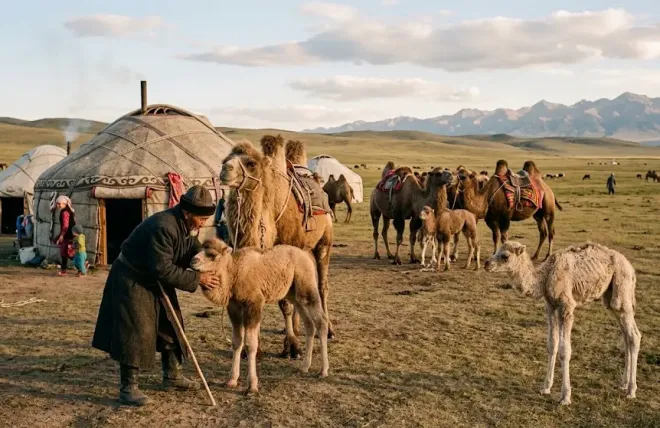
Directly following the birth, the community gathers for the Shildekhana, a lively night-long celebration dominated by the youth. Young people arrive in grand style on their finest horses. Children who do not yet own a mount will hitch a ride on an elder's camel or arrive riding steers and oxen, singing loudly across the valleys as they converge on the host's yurt.
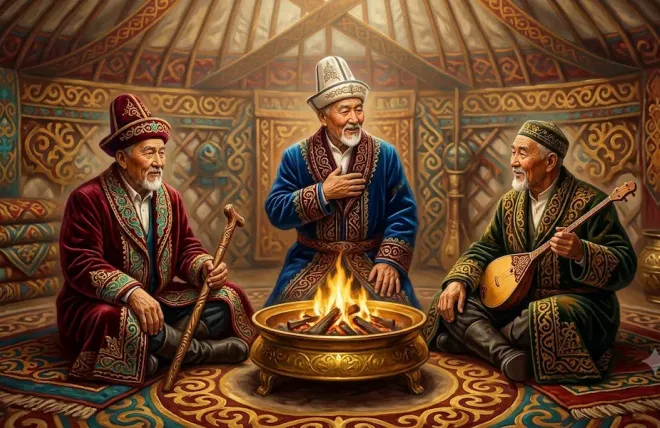
Inside, food and koumiss (fermented mare's milk) flow limitlessly. The youth sing, play the dombra (two-stringed lute), engage in witty poetry battles (aytys), and dance the energetic Kara Zhorgha. Historically, if a young woman of legendary beauty was inside the yurt, young men who couldn't fit into the crowded room would peer through small gaps in the felt walls just to catch a glimpse of her face. The merriment continues until the first rays of dawn.
The Spine Bone Custom
During the feast, the women managing the kitchen might jokingly complain that they haven't sampled the sacred meat from the kalzha (the postpartum sheep). To appease them, an expert carver must clean the twelve vertebrae of the sheep's spine perfectly, ensuring everyone gets a taste without breaking the bone structure. Once cleaned, the bare vertebrae are strung onto a sturdy twig of wild tamarisk and hung at the highest point of the home—either from the central wooden ring (shanyraq) or the roof poles (uyq). This ritual is believed to help the newborn's neck and spine strengthen quickly. The women take this very seriously; exclusion from this ritual is seen as a major insult, as every woman desires to eat this meat as a blessing for her own future safe deliveries.
Besik Toyi: The Cradle Feast
Nomadic life required an efficient, transportable way to care for infants on horseback, making the besik indispensable. It features a unique wooden funnel and container system (tubek) embedded with clean ash, providing unparalleled hygiene without requiring modern soaps or constant diaper washing.
When a baby is ready for the cradle, the family hosts the Besik Toyi. The chosen baibishe heats an iron rod over the fire and singes the wooden arches of the cradle to banish evil entities and bad luck. Other grandmothers tie an eagle's talon to the frame so the child grows as fierce as a raptor, or attach written protective amulets (tumar).
The baby stays in this cradle until it is weaned. Once the infant starts crawling and outgrows it, the cradle is meticulously cleaned and stored in an honored part of the home. Kazakhs revere the cradle so deeply that a single besik is passed down from a grandfather to his grandsons, which is why the Kazakh people poetically refer to their ancestral homeland as the "Golden Cradle" (Altyn Besik).
Tusau Kesu: Cutting the First Steps
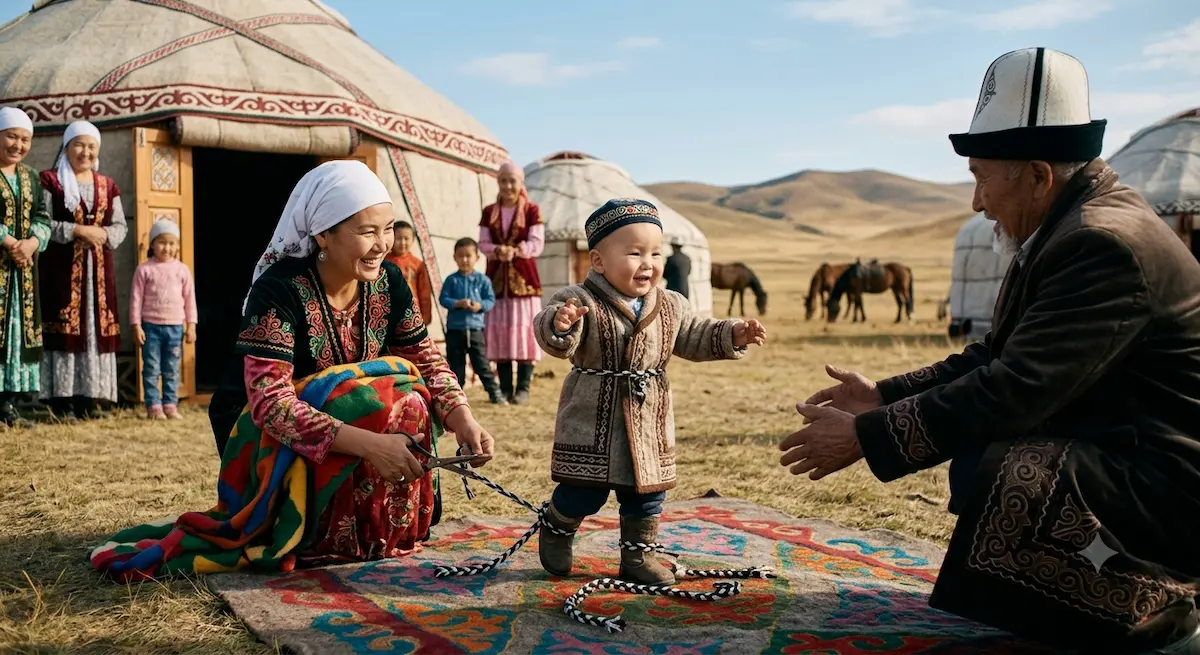
When a child transitions from crawling to taking their first tentative steps, the family celebrates Tusau Kesu (Cutting the Bonds) to wish them an auspicious path through life. The mother prepares a two-to-three-foot cord braided from black and white wool (ala zhip). She hands it to the swiftest, most energetic woman in the village, saying, "Cut my child's bonds so they may become as quick-footed and efficient as you."
The woman ties the black-and-white cord around the toddler's ankles like a shackle and snips it down the middle, prompting the child to take their first free steps toward an expectant relative.
Why Use a Black-and-White Cord? This choice of colors carries a profound ethical lesson taught at the very dawn of a child's cognitive development. From the moment their bonds are cut, Kazakh children are taught never to step over another person's "black-and-white rope"—a famous idiom meaning never commit theft, abuse power, or envy someone else's property. The colorful cord serves as a life-long moral guide: it reminds the child to walk a righteous path and cut out any dishonest temptations before they can take root.
Gender-Specific Traditions
Sundet Toyi: The Circumcision Feast
When a boy reaches an odd-numbered age—usually three, five, seven, or nine, but absolutely before the onset of adolescence at thirteen—he undergoes circumcision (sundet). This tradition blended seamlessly into Kazakh nomadic life following the adoption of Islam, serving as a vital measure of personal hygiene.
Traditional Techniques: Kesu and Shetu
- Kesu (Cutting): Used for younger boys. The specialist inserts a smooth, dried wooden peg under the prepuce to protect the glans, then swiftly removes the excess skin using a sterilized razor. To halt bleeding, a cup filled with cool herbal or wood ash is inverted over the area and secured to the boy's thighs with a clean cloth. The boy is kept under constant supervision beneath a blanket, entertained with toys, stories, and songs until the wound scabs over.
- Shetu (Incising): Used for older, more mature boys, where a straight incision is made along the top rather than a circular cut. Elders note that older boys often tried to hop on horses and flee the village if they caught wind that the circumcision specialist was arriving.
For the celebration, the boy is dressed in fine clothes adorned with owl feathers and mounted onto a specially decorated horse called the Sundet At. He rides through neighboring villages, personally inviting relatives to his grand feast. Parents rejoice during this feast, celebrating their son's official entry into the Islamic spiritual community.
Ashamaigha Mingizu: The First Riding Saddle
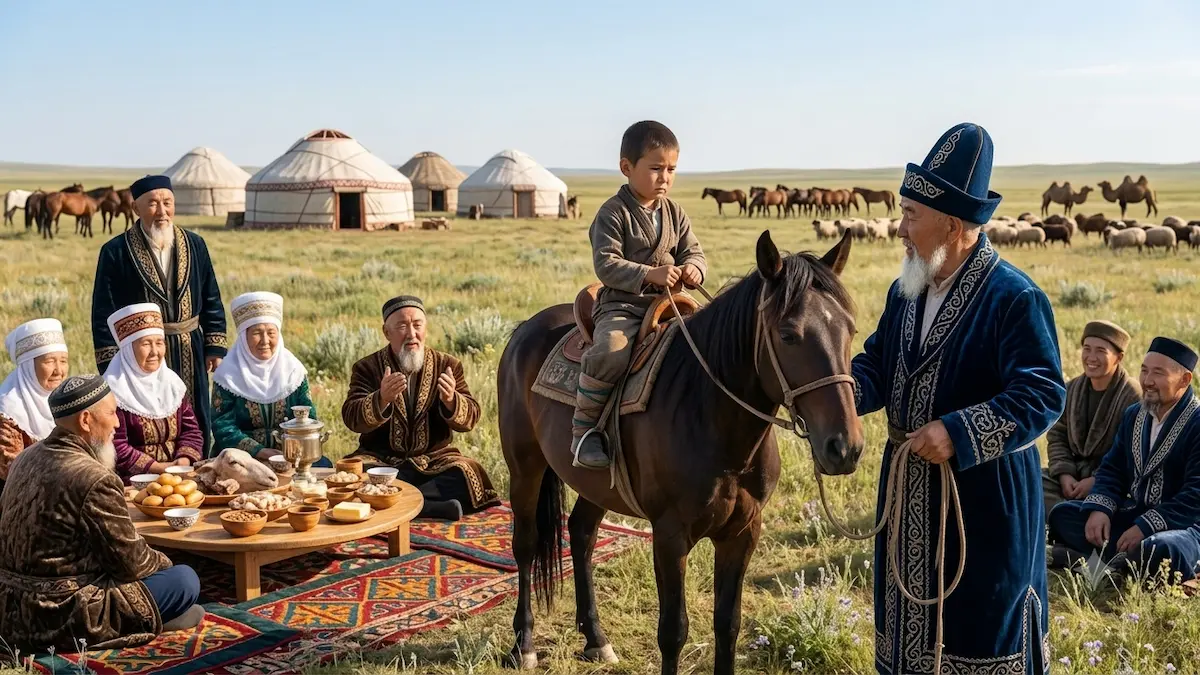
Around the age of seven, a boy's upbringing diverges sharply from that of young girls, who stay closer to the yurt playing with dolls and crafting. A boy's destiny is tied to livestock and the open steppe. To initiate him into horsemanship, he is introduced to the Ashamai—a lightweight, high-backed wooden training saddle designed specifically to prevent a child from falling off.
The boy is placed on a gentle horse with his legs safely secured to the saddle frame. An elder leads the horse by a long rope, gradually teaching the boy how to hold the reins. Within a week, the young Kazakh abandons the training device for a standard saddle.
This milestone signifies that the boy has grabbed "the mane of a horse" (at zhalyn tartty), which means he has taken his first steps toward manhood. Wealthy families slaughter large cattle for this feast, while less affluent families slaughter a goat, sharing the rich organ meats with neighbors for blessings. Elders deliver grand speeches about ancient heroes, inspiring the boy to face the wilderness, endure winter blizzards, and defend his homeland on horseback.
Toqym Qaghu: The First Journey Feast
Immediately after a boy masters horse riding and prepares to embark on his first journey away from the family yurt, his parents host the Toqym Qaghu feast. They slaughter livestock to bless his safe travels. Following this event, the father crafts a personalized set of adult riding gear for his son—including custom stirrups, reins, hobbles, and ropes—marking the beginning of his formal education in nomadic survival and labor.
Qyz Balanyn Qulaghyn Tesu: Piercing a Girl's Ears
When a young girl reaches two or three years of age and begins showing an interest in vibrant clothing and shiny ornaments, the village women gather to pierce her ears. She is dressed elegantly in a tiered dress, an embroidered waistcoat, and a cap decorated with owl plumes (taqiya).
Methods of Piercing
- The Silver Needle Method: A sterilized silver needle is swiftly pushed through the earlobe. A silk thread or fine silver wire is left in the opening until it heals, after which she receives her first light earrings.
- The Millet Grain Method: A completely painless method where two grains of husked millet are placed on either side of the soft earlobe. The specialist firmly rubs the lobe between her thumb and forefinger. The pressure of the hard grains easily passes through the soft cartilage within moments, and light earrings are inserted immediately.
The family celebrates this milestone with an expansive feast, marking the first unique, gender-specific celebration in a young girl's life.
Social Customs, Kinship, and Courting
Kinship and Etiquette
- Kokentup: When a child visits extended maternal or paternal relatives, the hosts present them with a young animal—a foal, calf, or lamb—as a token of deep family bonding and affection.
- Zheti Ata (Seven Ancestors): Kazakhs maintain strict genealogical records up to seven generations. Marriages between individuals sharing an ancestor within these seven generations are strictly prohibited to maintain healthy bloodlines.
- Asatu: A hospitable gesture where village elders scoop choice portions of meat directly from the communal platter and feed it to guests or children with their own hands, passing on their blessings.
Sacred Childhood Hairstyles
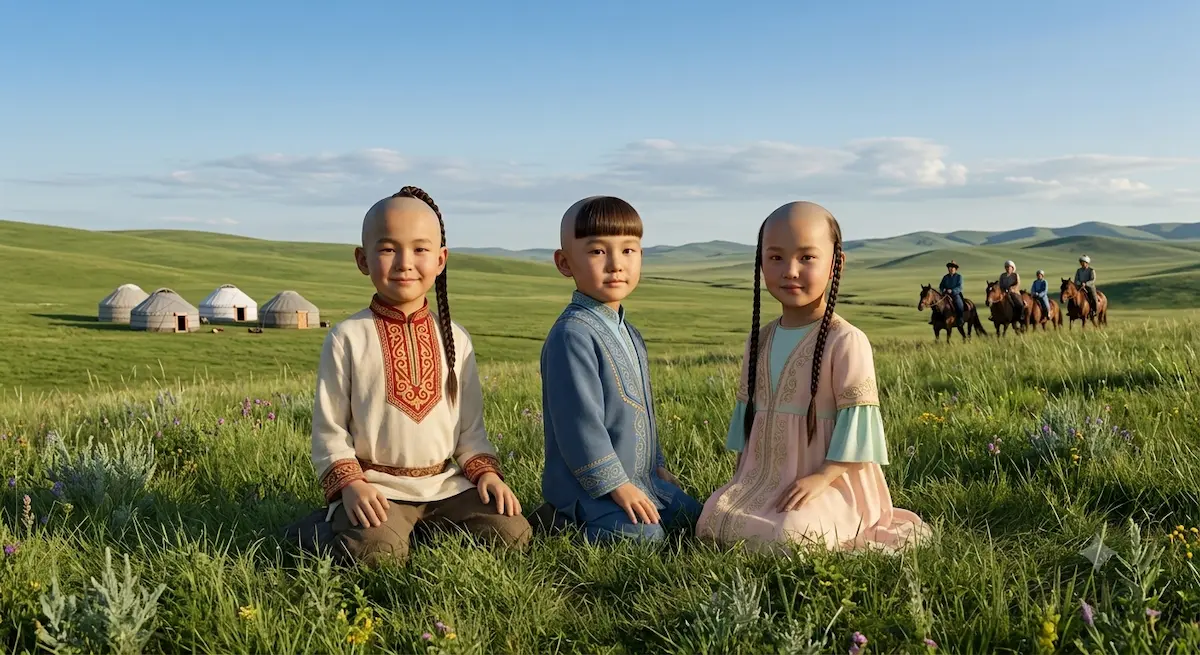
- Aidar: A decorative lock of hair left on the crown of a young boy's otherwise shaved head, often braided into a single plait for good luck and distinction.
- Kekil: A fringe of hair left over a young boy's forehead to frame his face, symbolizing a charming, youthful appearance.
- Tulym: Twin locks of hair left on the temples or sides of the head near the neck. While primarily a young girl's hairstyle, it was occasionally given to young boys for spiritual protection.
Spring Courting Traditions
- Seltetkizer (The Heart-Stirrer): During the spring festival of Nauryz, young men present their sweethearts with gifts like finely crafted mirrors, combs, or perfumes, symbolizing purity, fresh beginnings, and romantic devotion.
- Uiqyashar (The Sleep-Awakener): In return for the courtship gifts, young women prepare a delicious, rich dish combining early spring colostrum milk (uyiz) with tender choice meats, designed to keep the young men alert and energized during the night festivities.
Auzyna Tukiru: Bestowing Greatness
When an exceptionally eloquent orator, a courageous warrior, a brilliant poet (aqyn), or a wise judge (bi) visited a village, parents would bring their young children to them. They would ask the legendary figure to symbolically spit into the child's mouth (auzyna tukiru). The Kazakhs believed that through this symbolic act, a spark of the great person's genius, bravery, and charisma would pass directly into the child's soul.
Tiyym: Foundational Taboos
To raise respectful, disciplined individuals, children are taught strict daily taboos (tiyym):
- Clasping the knees: Sitting while hugging one's knees is banned, as it resembles a posture of deep grief and loneliness.
- Whistling indoors: Whistling inside a home is believed to summon poverty or evil spirits.
- Leaning on sticks or hips: Resting your weight on a staff or standing with hands planted firmly on your hips is prohibited; historically, women only assumed this posture when mourning the loss of a husband or child.
- Stepping on the threshold: Stepping directly on the wooden threshold of a yurt is considered an insult to the host and an omen of bad luck.
- Gifting knives or dogs: Handing a knife or a dog directly to a close friend as a gift is avoided, as it is believed to cause the relationship to turn hostile.
- Crossing paths with elders: Walking directly in front of an approaching elder is considered incredibly disrespectful; one must always step aside and yield the path.
The Four Creative Ages of Nomadic Labor
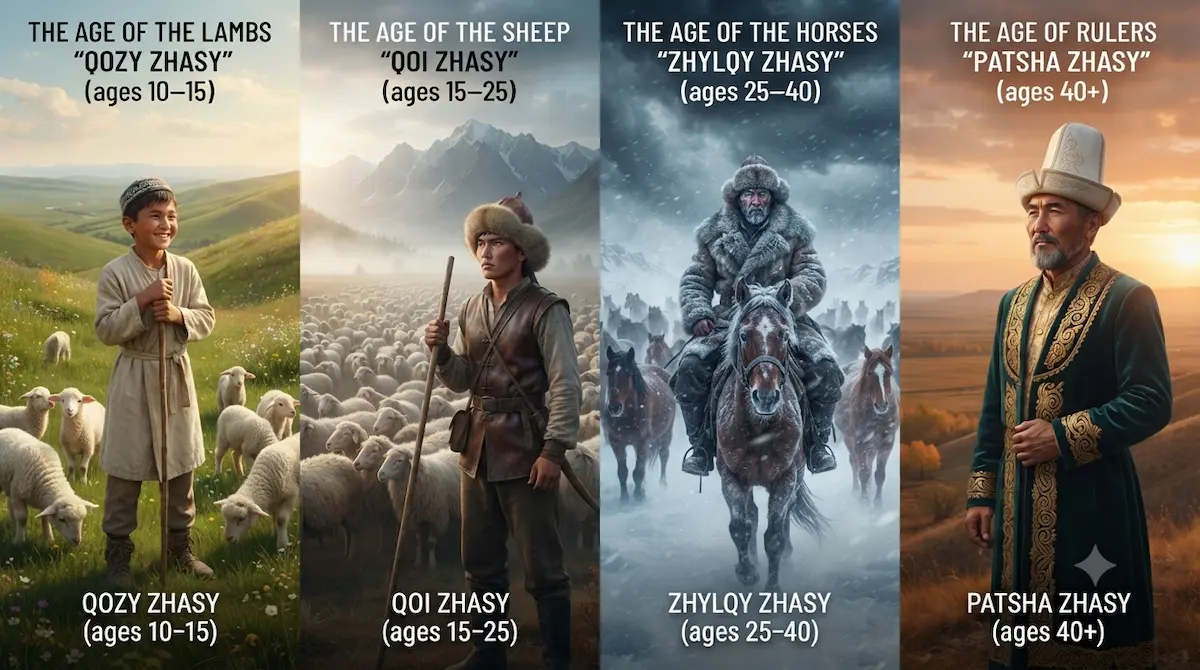
Instead of evaluating a youth's maturity by paper records, ancient Kazakhs judged a person's development by their capacity to handle specific livestock duties, dividing youth and adulthood into four progressive stages:
1. Qozy Zhasy: The Age of the Lambs (Ages 10–15)
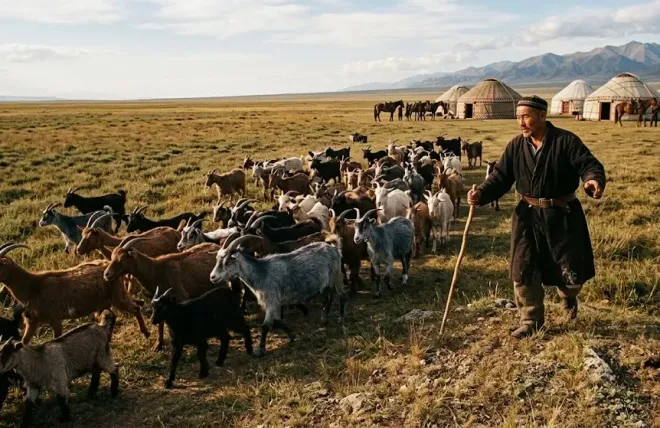
When a boy crosses the age of ten, he enters Qozy Zhasy. His primary responsibility is herding the young lambs. This serves as the elementary school of nomadic life. While children in other societies sat at school desks, a young Kazakh stood on the open plains with a herding staff, building physical endurance and learning animal psychology. Lambs are the gentlest livestock, making them the perfect entry-level responsibility for a child learning to manage the vast steppe, helping them develop deep resilience from an early age.
2. Qoi Zhasy: The Age of the Sheep (Ages 15–25)
At fifteen, a youth is considered the "master of his own hearth" (otau iesi) and graduates to Qoi Zhasy. Managing a flock of hundreds of sheep requires high vigilance. The youth must guide the flock across empty wilderness from dawn to dusk, protect them from wolves, and keep them calm through torrential rain and blinding blizzards. This stage thoroughly tests a young person's emotional and physical limits, forging the focus needed for ultimate nomadic responsibilities.
3. Zhylqy Zhasy: The Age of the Horses (Ages 25–40)
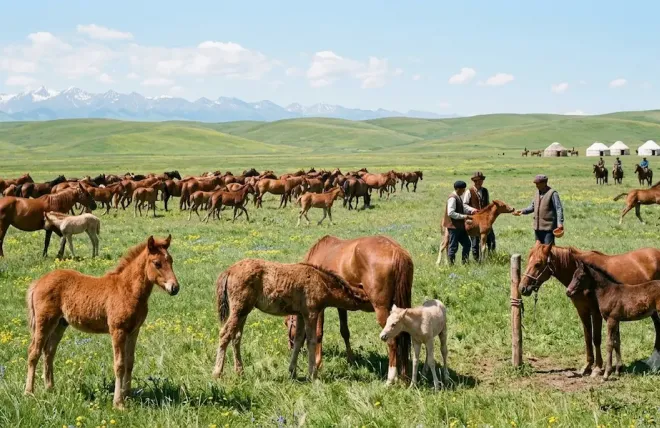
By twenty-five, a man's character is fully forged. He enters Zhylqy Zhasy, the highest tier of nomadic labor. Horses represent a tribe's ultimate wealth, power, and military mobility, but herding them is incredibly dangerous. The horse herder must spend days in the saddle through brutal winters, surviving sub-zero blizzards where the horses' faces freeze over with ice. He must protect the herd from aggressive wolf packs and stand ready to fight off armed enemy raiders (barymta) at a moment's notice. Graduating from this stage means a man has completed the highest education in survival, courage, and tactical leadership.
4. Patsha Zhasy: The Age of Rulers (Ages 40+)
In Eastern Islamic and nomadic traditions, forty is considered the ultimate age of intellectual and emotional maturity. A man was rarely chosen to lead a tribe or act as a ruler (khan) before turning forty, as absolute wisdom and emotional control take decades to steady. Kazakhs compare a forty-year-old man to a "sharp sword drawn cleanly from its scabbard"—he stands fully realized, wise, and ready to lead his people with honor.