Traditional Kazakh Headwear


Traditional Kazakh Men’s Headwear
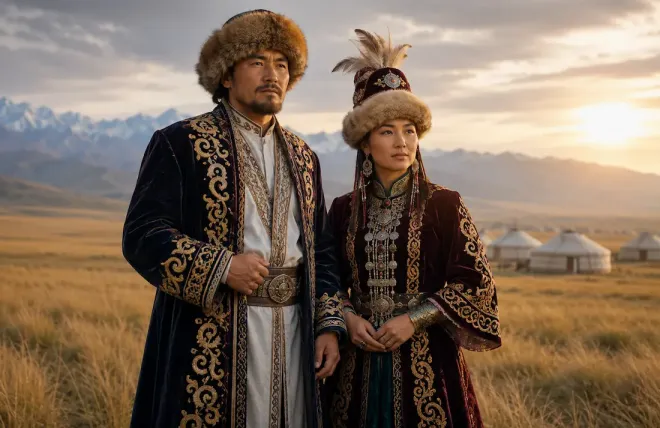
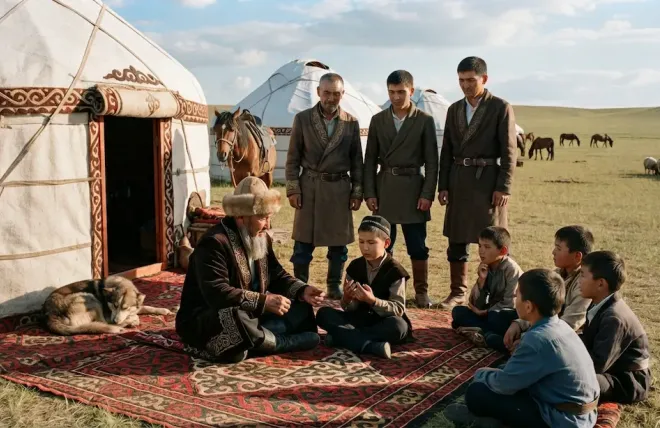
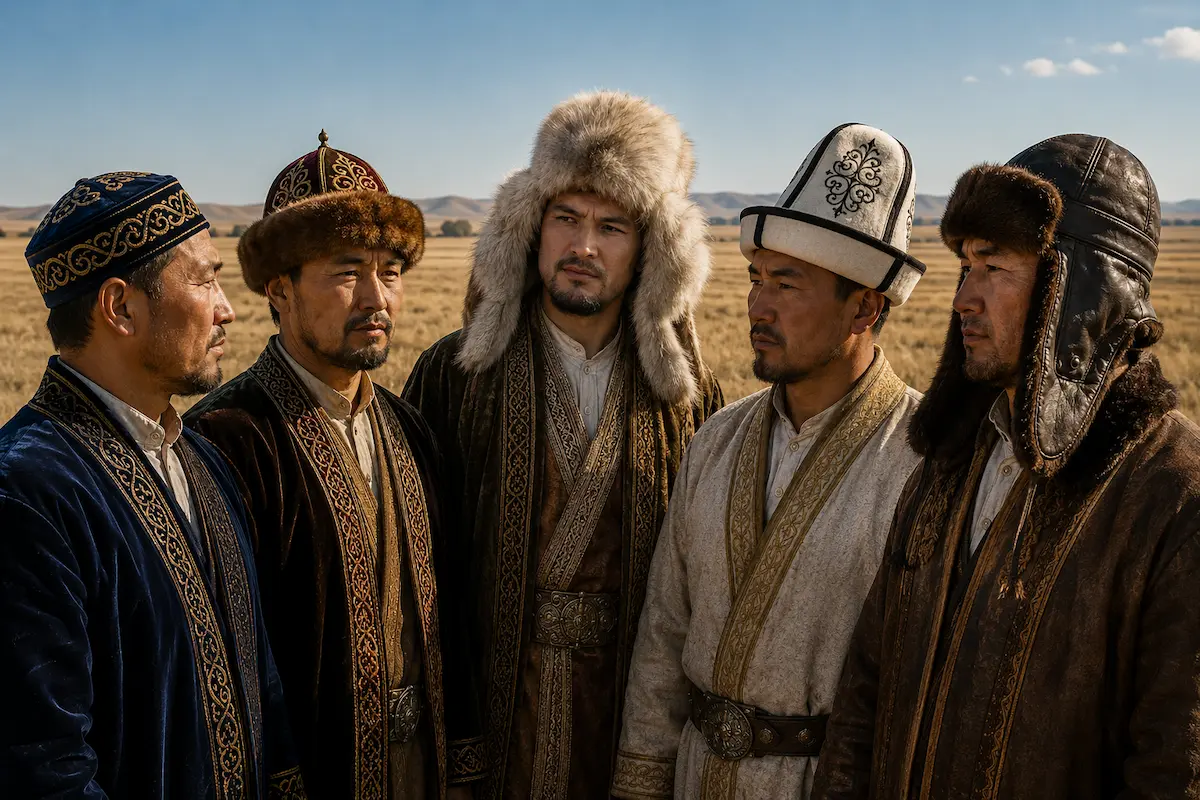
In Kazakh tradition, headwear is highly gender-specific, with distinct styles for men and women. Men’s headwear includes the taqiya (skullcap), borik (fur-trimmed cap), tymak (winter fur hat), kulakty borik or kulakshyn (ear-flapped fur hat), kalpak (felt hat), shalma (turban), shytkulapara or bashlyk (hood), and zhalbagaj (a simple, wide-brimmed hat). These are crafted from animal hides, furs, or padded with textiles. Women’s headwear includes the kimeshek (a hooded headdress for married women), zhaulyk (headscarf), kundik (a ceremonial turban-like headdress), sharshy (square headscarf), saukele (elaborate bridal headdress), zhelek (bridal veil), shali (shawl), and bergek (protective head covering). While everyday headwear is often made from lightweight inner-wear fabrics, the most prestigious pieces—such as the katypa takiya (velvet skullcap), kundyz borik (beaver-fur cap), and shoshak borik (conical fur cap)—are fashioned from the most valuable furs available.
Cultural Significance
Headwear in Kazakh culture is considered a sacred symbol of beauty, status, and prosperity. The cultural importance of headwear is reflected in the common proverb, "A friend looks at your feet, but an enemy looks at your head," implying that a man’s headwear signals his standing. The deep respect for these items is further evidenced by customs such as removing one's hat to show humility, apologize, or demonstrate deep supplication, occasionally even casting the borik at one's feet to signal extreme distress.
Traditional headwear was categorized not only by the season—winter or summer—but also by the occasion, with specific styles reserved for weddings, social gatherings, or long-distance travel. Tymak and borik were typically fashioned from lambskin, fine pelts, or goat hide, with a layer of wool quilted between the leather and the outer fabric. Winter tymak made from fox fur were especially prized, lined with expensive, warm materials such as velvet, plush, satin, or shugha (woolen cloth).
Regional and Style Variations
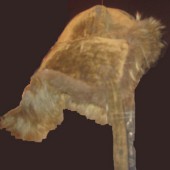
The zhekei tymak is a lightweight, stylish fur hat worn in summer and autumn. The term zhekei carries the connotation of elegance. These were lined with refined silk fabrics like duriya or shaghi. Stylistically, they were worn in various ways: with the back flap folded upward, or tilted at an angle on the head with one earflap pulled forward.
Borik styles also vary by region:
- Southern Regions: Men often wear large caps made from sheepskin.
- Oral and Guryev Regions: The most fur-dense, warm varieties of borik are common.
- Zhetisu, Semey, and Oskemen Regions: Styles with wide, high crowns are more prevalent.
Historically, poets, singers, saldar (trendsetters/dandies), and young artists often wore highly decorative, conical beaver-fur borik adorned with uki (owl feather) plumes.
The takiya also exhibits significant regional diversity:
- Southern Regions: Takiya with low brims and four-paneled, embroidered conical crowns are most common.
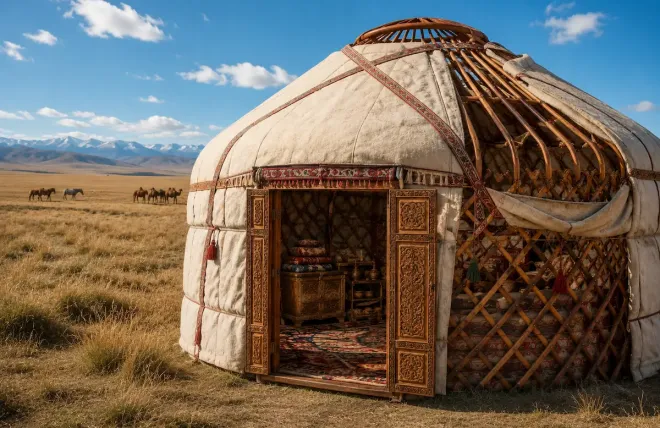
- Middle Zhuz: Styles with a low brim and a flat, circular crown, reminiscent of a yurt's shanyrak (roof ring), are prevalent.
- Junior Zhuz: Takiya with wide crowns and high brims, or rounded "bowl-like" styles, are standard.
Unlike women's headwear, men’s takiya typically do not feature coins, beads, or decorative plaques. Instead, they are adorned with intricate embroidery in motifs like muiz (horn), aterin (a floral-inspired pattern), and shyrmauyk (vine-like patterns), or they are quilted with decorative "scallop" or "zigzag" stitches. Some feature a small, self-fabric conical protrusion at the very peak. Young men, saldar, and bridegrooms would often further personalize their takiya by attaching ashak, uki, or other ornate tassels and decorative clusters.
Traditional Kazakh Women’s Headwear
Kazakh women’s headwear comprises a wide variety of styles, including the takiya (skullcap), borik (fur-trimmed cap), orama (kerchief), zhaulyk (headscarf), kimeshek (a hooded headdress for married women), kundik (a ceremonial turban), saukele (bridal headdress), zhelek (bridal veil), shali (shawl), bergek (protective head covering), and karkara (a feathered ornament). In accordance with Kazakh custom, it is considered improper for either men or women to appear in public bareheaded; this is especially strictly observed by women.
The Saukele: Bridal Elegance
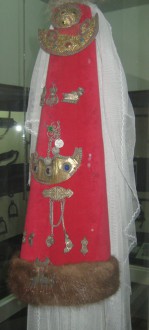
The saukele is the most ornate and complex of all women’s headwear. It is worn by brides during their wedding ceremony and by the noker (entourage of female friends) who accompany her to the groom’s village while singing syngsu (traditional sorrowful parting songs). The bride continues to wear her saukele until the wedding festivities conclude, after which it is carefully set aside, and she adopts the bergek and zhelek for daily wear.
The foundation of the saukele is a high, sturdy crown—sometimes reaching two spans or more in height—crafted from white felt pressed from lamb’s wool or from high-quality fabric stiffened with horsehair. The exterior is covered with an outer layer that is intricately embroidered, trimmed with beaver fur, or decorated with gold and silver oka (metallic braid). The surface is lavishly adorned with gold, silver, pearls, coral, and precious stones.
Two chains of coral, known as betmonshak (face beads), hang from the temples to the chin, framing the bride’s face. At the very peak of the saukele sits a decorative fitting called a katyrghy, to which the veil of white silk or precious fabric—known as the bergek—is attached. Sometimes, a plume from a peacock or other exotic bird is fixed vertically to this fitting, which is called the karkara. The back of the saukele extends down to the waist, similar to a shashkap (hair sheath), and is covered by a decorative silk fabric with tassels that trails behind the bride like the train of a dress. Historically, warriors also wore highly ornamented helmets of a similar shape, often reinforced with metal and chainmail, known as zhygha.
The Kimeshek: A Symbol of Matriarchy
The kimeshek is a sacred headpiece for Kazakh women. Typically tailored from white fabric or white silk, it is cut to drape over the head, shoulders, chest, and back. A woman’s kimeshek served as an identifier of her age, social status, and marital standing, and even reflected her personality and domestic habits. Historical styles of the kimeshek varied greatly based on tribal and clan affiliations:
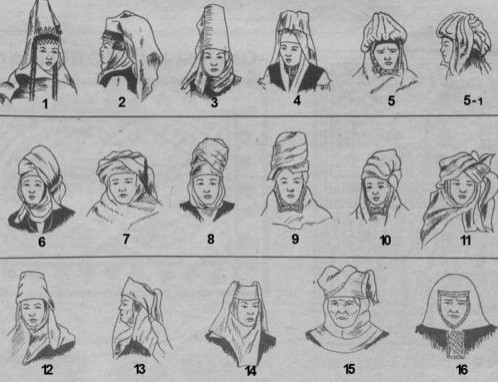
- Orama Kimeshek: This is the most ancient and widespread version. It is made from a continuous piece of fabric where the lower corner is rounded, and the upper section is cut out to fit the wearer's face. While styles vary, in many parts of Kazakhstan, it is cut in a trapezoidal shape or as a short triangle, with the back length sometimes reaching the heels. In eastern Kazakhstan, the kimeshek is shorter and made from multiple pieces of fabric joined together.
- Burmeli Kimeshek: Prevalent among the women of the Syr Darya region, this style features a square face opening, a long tail covering the chest, and a gathered top that is sometimes tied, occasionally under a small borik.
- Southern Variations: Women in the south traditionally fold fabric in two and cut it, sewing it in a way that the seam falls along the back. The kimeshek styles of the Zhetisu region are noted for their rich variety and distinctive tying methods.
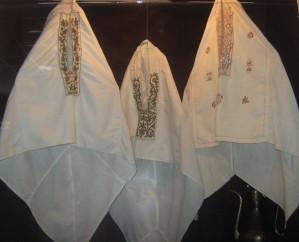
A kimeshek is never without decoration. Artisans utilize gold, silver, akyl (a type of ornamental trim), carnelian, coral, and pearls, with the intensity of the ornamentation reflecting the wearer's age and social position. Simpler versions worn by older women are referred to as shylauysh or kundik. The most elderly matriarchs may also wear a shalma (turban).
Collectively, all white head coverings made from white fabric are known as ak zhaulyk. The ak zhaulyk is more than just a garment; it is a symbol of a woman’s purity, piety, and transparent, virtuous character—a garment held in the highest esteem by the people.
Traditional Kazakh Fabric Terminology
Kazakh textile history is enriched by a diverse vocabulary of fabric names. While many are widely recognized, others are archaic, rarely utilized today, or largely unknown, such as akzu, mynsym, tukaba, and tapta.
The following is an extensive list of traditional fabric names historically found in Kazakh culture:
- Kyzham: Plush or heavy velvet.
- Beren: A durable, heavy-duty fabric.
- Batsaiy: A fine, high-quality material.
- Zerip: Fabric adorned with metallic (gold or silver) thread.
- Maghankara: A specific type of dark, durable textile.
- Kymkap: A rich, patterned fabric, often equated with brocade.
- Zhibek: Silk.
- Tapta: A specialized textile of uncertain origin.
- Atlas: Satin.
- Mynsym: A rare, traditional fabric type.
- Kyrmyzy: A deep crimson silk or velvet.
- Zhibekatkan: A specific woven silk blend.
- Sylang: A lightweight, smooth fabric.
- Akzu: A high-quality white textile.
- Mauyty: Broadcloth.
- Kamka: Damask or figured silk.
- Duriya: A fine, luxurious silk fabric.
- Suryp: A durable, woven cotton or blend.
- Shyt: Chintz or light cotton fabric.
- Shaghi: A fine, delicate silk.
- Kenep: Hemp or canvas-like fabric.
- Deke: A traditional textile variety.
- Syngsyma: A smooth, flowing material.
- Shibarkyt: A type of textured or patterned velvet.
- Pai: A specific fabric grade or weave.
- Boz: Calico or coarse cotton cloth.
- Tik: A thick, sturdy fabric.
- Sandip: A decorative fabric variety.
- Shydaghan: A reinforced, durable textile.
- Pulish: Plush.
- Beihasap: A term denoting an abundance or a specific variety of fine fabric.
- Tukaba: A type of plush or heavy, nap-surfaced fabric.
- Sisa: Chintz or printed cotton.
- Shai: A fine tea-house silk.
- Laili: A delicate or decorative fabric variety.
- Boiagh: A dyed fabric.
- Torqa: Fine silk or lustrous fabric.
- Stambul: A fabric imported from or modeled after Istanbul styles.
- Shugha: Woolen cloth.
- Parsha: Brocade.
- Bates: Fine muslin or batiste.
- Torghyn: Soft, fine silk.
- Saldeboz: A thin, white cotton fabric used for turbans.
- Makpal: Velvet.
- Kuntun: A dual-sided or reversible fabric.
- Barkyt: Velvet.
- Barsha: A rich, heavy silk or brocade.
- Saten: Sateen.
- Manat: A fine, plush, or velvet-like fabric.