Traditional Kazakh Flour and Grain Dishes


Kazakh Flour Specialties
Baursak
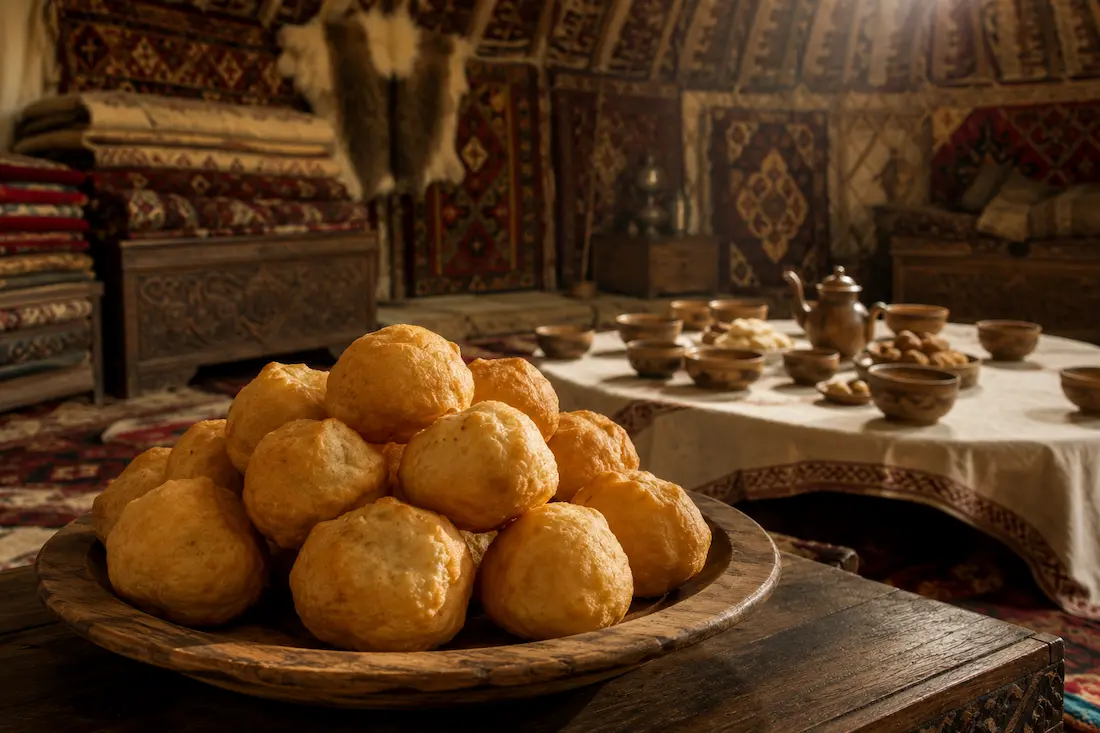
Baursak is a staple served with tea, Qymyz, or Shubat at every traditional feast. These golden dough bites are crafted from high-quality wheat flour. There are two primary techniques for preparation: one using a leavened (yeast) dough and the other an unleavened version. Unleavened baursak remains fresh for longer periods, whereas the yeast-risen variety can become dry and tough if not eaten promptly. To make the unleavened version, the dough is kneaded with butter, eggs, milk, salt, and sometimes a splash of Ayran. It must be worked until firm, then rolled out and sliced into squares or thin, twisted strips. Covering the dough while resting prevents it from drying out. They are fried in a cauldron of piping-hot oil, requiring constant agitation to ensure an even, deep-brown color and a perfectly cooked interior. An intense heat will leave the centers raw, so temperature control is vital. A standard recipe requires 4–5 cups of flour, one cup of milk or water, a teaspoon of salt, two tablespoons of butter, and two eggs.
For the leavened version, yeast, sugar, and flour are dissolved in warm water and left in a cozy spot until frothy. Once active, the remaining ingredients—salt, fat, eggs, and flour—are folded in to create a very soft, elastic dough. This softness allows the baursak to puff up beautifully during frying. After rolling the dough to a thickness of approximately 2 cm, it is cut into uniform pieces and left to rise for 10–15 minutes. This resting phase is crucial to ensure the centers cook thoroughly in the hot oil.
Taba Nan (Pan Bread)
Taba Nan is a traditional bread kneaded with butter and milk. Traditionally, the dough is placed in a heavy pan, covered with a second inverted pan, and buried beneath hot embers and ash. It can also be baked in a conventional oven. Like baursak, it can be made leavened or unleavened; yeast-raised dough results in a fluffier texture, while unleavened dough is kneaded more vigorously to be firm. If using yeast, the dough is covered and kept warm; if making the unleavened variety, it is wrapped in a damp cloth and chilled for 20 minutes before rolling. The dough should be flattened to a thickness of 1–1.5 cm. During the rising process, the baker gently presses the surface with wet fingers to encourage an even rise. A typical batch uses 1 kg of flour, a tablespoon of yeast, a teaspoon of salt, two eggs, and 200 grams of butter.
Taba Nan with Tail Fat (Quyryq Mai)
This is a savory variation of the classic pan bread. Once the firm, butter-enriched dough is rolled out and placed in a greased pan, the baker pokes small holes across the surface using their fingertips. Tiny pieces of diced sheep’s tail fat are inserted into these holes, and the pan is covered and baked. The fat melts into the dough, creating a remarkably flavorful and aromatic bread.
Salma (Noodles)
Salma serves as the essential flour component for meat dishes. Depending on the region, it is known by various names such as kespe, zhayma, shelpek, naryn, or uzbe. The dough is made from flour and water—often with eggs added to improve the flavor—and kneaded until stiff. It is rolled out very thin, sliced into fine strips, or torn by hand into smaller pieces, then boiled directly in the meat broth. To prevent the dough from sticking to the meat, the meat is usually removed from the pot just before the noodles are added. This method creates a meal that is both hearty and easily digestible.
Mai Shelpek (Buttered Flatbread)
Mai Shelpek is a dense, flavorful flatbread prepared by kneading wheat flour with a generous amount of butter. Unlike other breads, it is not rolled out too thinly. For a richer, more rustic version, diced mutton or horse fat cracklings (shyzhyp) are sometimes folded into the dough before frying.
Qattama (Layered Bread)
Qattama is a sophisticated and highly prized type of bread. The dough, enriched with butter, eggs, and milk, is kneaded until firm and rolled out into very thin sheets. Each sheet is generously brushed with melted fat, rolled tightly onto a rolling pin, sliced into smaller segments, and then re-rolled. These segments are fried in a cauldron of hot oil. The result is a spectacular, flaky, multi-layered bread that is exceptionally rich. Alternatively, some chefs prepare it by brushing the cauldron with fat and cooking the layers directly in the pot. A standard recipe requires 1 kg of flour, a teaspoon of salt, 150 grams of fat, a cup of milk, and two eggs.
Traditional Kazakh Grain Specialties
Talkan (Roasted Grain Meal)
Talkan is a nutritious, flavorful meal prepared from roasted wheat, barley, or millet. Traditionally, it was made by either grinding the grains in a stone mill or pounding them in a mortar. Because these methods left behind coarser particles known as "talkan saǵy" (the coarse husk or germ), the mixture was sifted through a flat plate to separate the fine meal from the coarser bits. Talkan is incredibly versatile; it can be enjoyed mixed with butter, cream, or kaimak, or stirred directly into tea—which creates a rich, hearty, and quick-cooling beverage. It is also a key ingredient in Zhent.
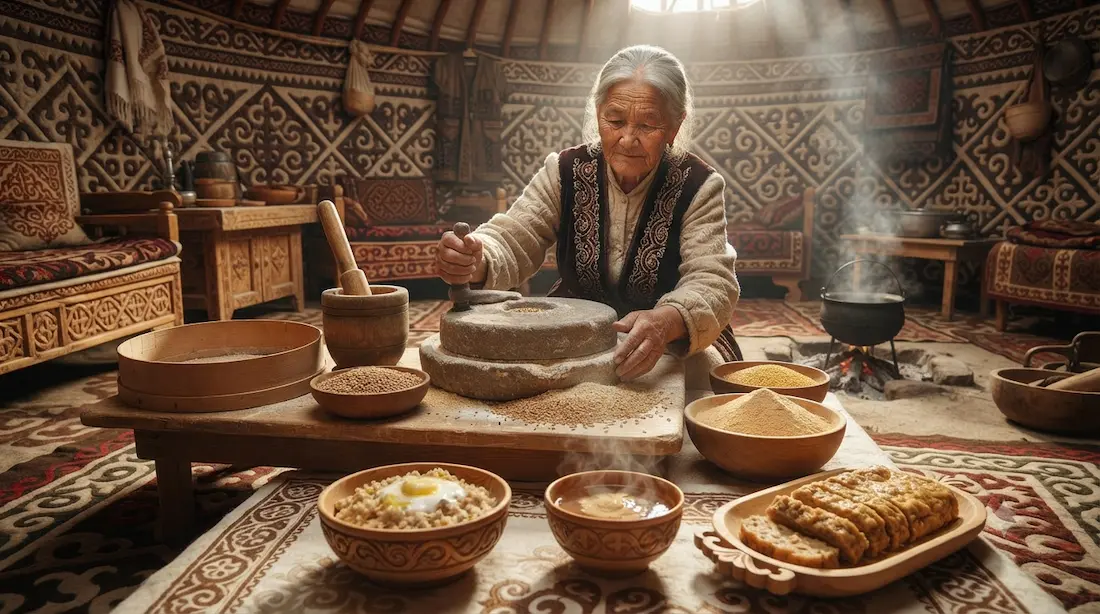
There are several ways to serve it: as a dry, sugar-sweetened snack, or as a cooked dish called Sartalkan or Maitalkan, where the meal is sautéed in mutton tail fat or horse fat over low heat. It can even be made from unrefined, whole-wheat flour by gently browning the flour in a greased cauldron until it turns a deep, reddish-brown color, then stirring in butter and sugar. This version is particularly popular with children. A standard recipe calls for 1 kg of Talkan, 200g of sugar, and 200g of butter.
Biday Kozhe (Wheat Soup)
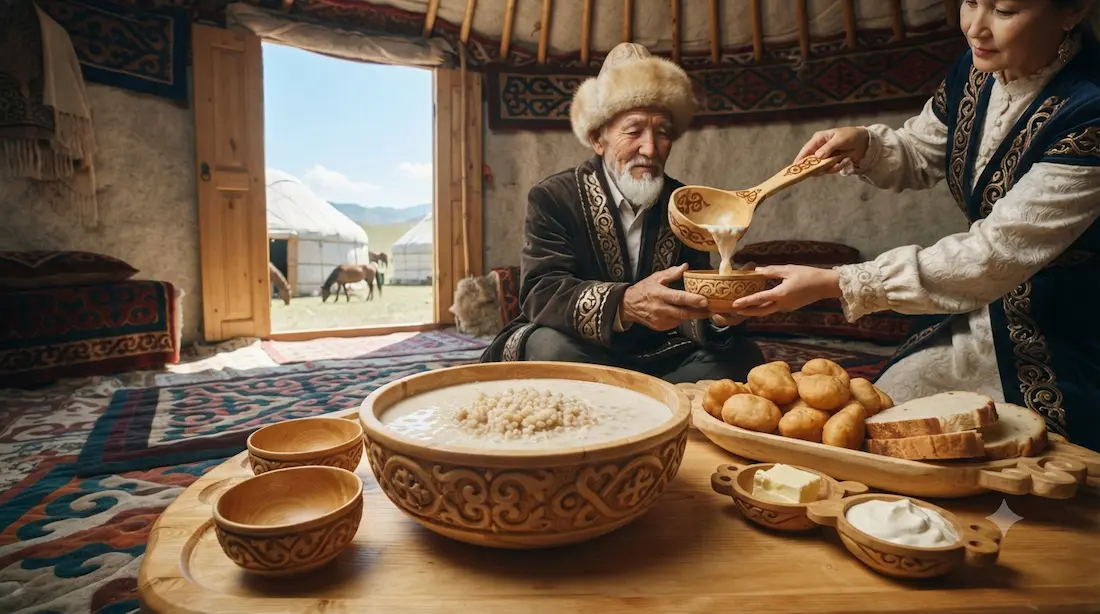
This hearty soup is made by cleaning the wheat thoroughly, lightly dampening it, and pounding it in a mortar to remove the outer bran. After winnowing away the chaff and letting the grains dry for 10–15 minutes, the wheat is moistened again and pounded until crushed. The resulting grains are then boiled in water or milk. Once boiling, the heat is lowered, and the pot is covered to let the mixture steam for 30–40 minutes. Before serving, the texture and seasoning are adjusted, and it is brought to a final boil. It is typically enjoyed with a generous splash of Katyk, Ayran, or milk.
Tary Kozhe (Millet Soup)
Tary Kozhe is a simple and refreshing soup prepared by boiling husked millet in water. Once the mixture has cooled, it is finished by stirring in Suzbe (strained curd), Katyk, or fresh milk to provide a creamy, tangy depth.
Zhent (Qospa)
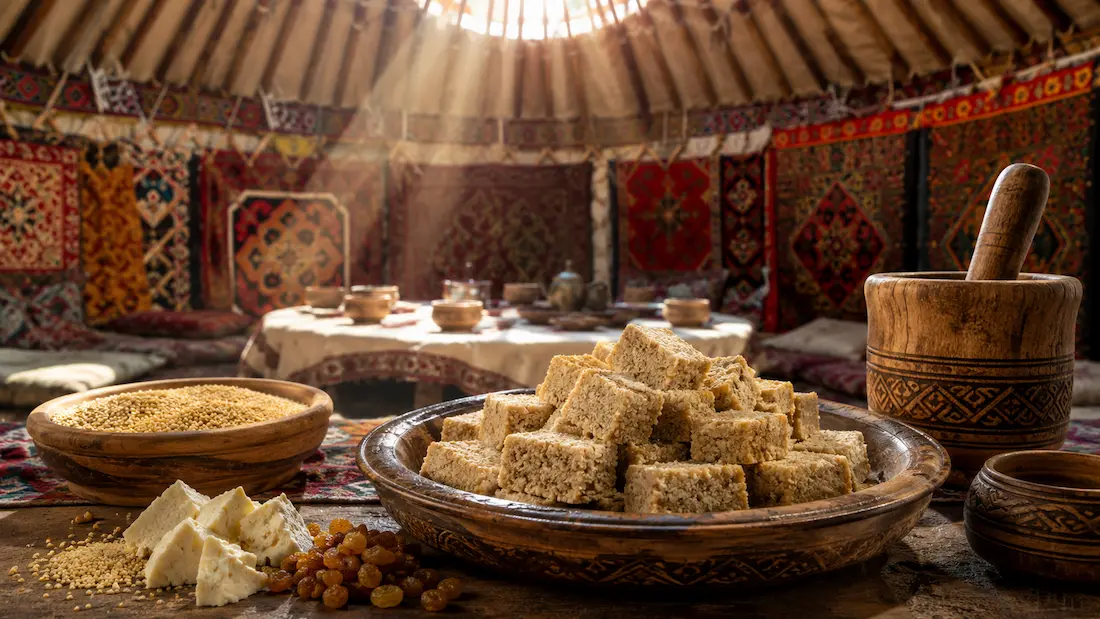
Zhent is a highly esteemed traditional dessert, valued for its ability to withstand extreme temperatures—it neither hardens in winter nor spoils in summer. Preparing it requires a certain level of culinary skill. First, husked millet is pulverized until fine, then mixed with granulated sugar and crushed artisanal cheese. A small amount of horse fat is heated in a pan, and the mixture is added and stirred briefly over very low heat until the fat is fully absorbed. Once cooled, it is stored in animal skins (traditionally goat or sheep), which keeps it airtight and preserves its flavor and texture. While horse fat is preferred for its stability, butter is a suitable substitute (though rendered hard fats should be avoided, as they harden the dessert). It is frequently prepared during the winter slaughtering season. A typical recipe requires 5 cups of millet groats, 4 cups of dried cheese, 2 cups of sugar, and 2 cups of fat, sometimes enhanced with crushed fried dough or raisins.
Maisok (Maitary)
Maisok is a savory snack consisting of husked millet fried in fat. Mutton tail fat is diced and rendered in a pan; the millet is then added and fried in the resulting liquid along with the cracklings. It can be eaten as a dry snack or stirred into hot tea. If mutton fat is unavailable, it can be prepared using horse fat, butter, or even rendered lard. Beyond being a household favorite, it is a staple "field food" for travelers due to its convenience and long shelf life.
Roasted Wheat
To prepare this crunchy treat, wheat is first cleaned, winnowed several times, and washed in warm water. A cauldron is greased with diced tail fat and heated; once the fat is smoking, the wheat is added and roasted until it takes on a dark, reddish hue. The heat is then turned off, and the cauldron is covered with a damp cloth to steam for 10–15 minutes, which softens the grain slightly. It is served as a delicious, nutty snack alongside tea.
Bokpe
Bokpe is a rich, porridge-like dish made by swelling husked millet in milk. Millet is added to raw, whole-fat milk and simmered gently over low heat, stirring constantly to prevent scorching. As the milk evaporates, a knob of butter and a sprinkle of sugar are added, allowing the grains to continue absorbing the liquids. When prepared correctly, the surface of the Bokpe should form a delicate skin, and the texture should be soft and almost custard-like. This is not only a nutritious everyday family meal but also an elegant dish served to honored guests. A standard recipe requires 1 liter of milk, 1 cup of millet, and 2 tablespoons of butter.