Classifying Camel Calves


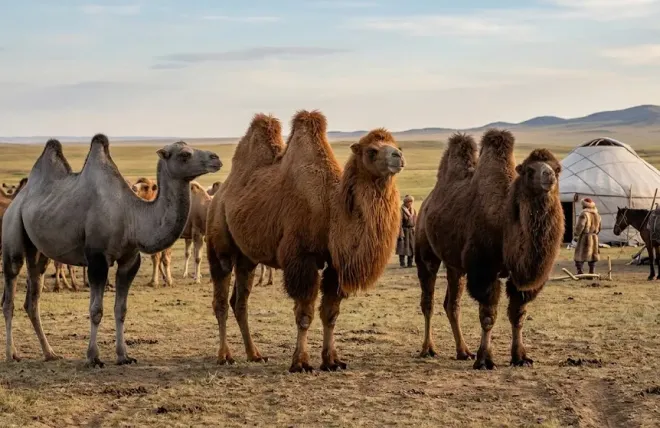
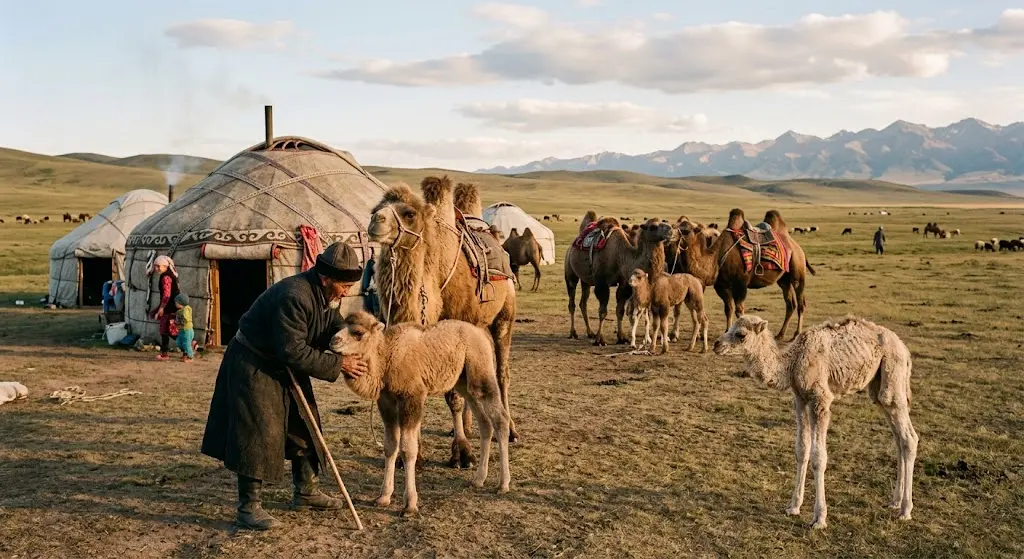
This section explores the traditional Kazakh classification of camel calves, known as bota. Nomadic pastoralists carefully observed the health, birth circumstances, physical development, and temperament of every calf. These precise categories helped them track the well-being and future productivity of their herds — essential knowledge for survival in the harsh steppe environment.
Classification by Health, Birth, and Development
- Aramza Bota: A calf born prematurely or outside the normal season.
- Ak Kemik Bota: A healthy, robust calf that freely drank its mother’s nutrient-rich colostrum from birth. Receiving colostrum was vital, as it provided crucial antibodies and strength in the first days of life.
- Kara Kemik Bota: A weak or sickly calf that did not receive enough colostrum, resulting in poor health and slower development.
- Kun Kakkan Bota: A calf born in the peak of summer (July or August) that suffered heat stress after being tethered too long under the scorching sun.
- Buralky Bota: A stray calf that wandered away from its own herd and joined another.
- Jasyk Bota: A lethargic or frail calf that failed to gain proper strength and vigor.
- Kok Baka Bota: A severely emaciated calf that remained stunted due to poor nutrition or illness.
- Marka Bota: A calf born three to four months earlier than the standard birthing season.
- Sut Bota: A calf that is still exclusively nursing from its mother.
- Tolgan Bota: A well-nourished, plump, and hearty calf belonging to a healthy, productive mother.
- Kyzyl Shaka Bota: A very premature or underdeveloped calf born without a full coat of hair.
- Kudyra Bota: A calf born slightly prematurely — larger than most newborns but smaller than a full-year-old tailak.
- Kos Kindik Bota: A rare biological anomaly — a calf born with two umbilical cords.
- Kutymsyz Bota: A stubborn calf that is difficult to handle. It refuses to follow when led and creates problems for the milker.
- Maimak Bota: A calf with a congenital defect in which the ankle joints turn inward or outward, producing a clumsy or hobbled gait.
- Nar Bota: A calf born to a single-humped nar camel.
- Kospak Bota: A hybrid calf born from a female two-humped camel and a bir tuar (elite nar) bull.
- Ulek Bota: A purebred calf resulting from the crossing of a purebred ulek (nar bull) and an aruana (nar female).
- Aiyr Bota: A calf born from purebred two-humped (Bactrian) parents.
- Jetim Bota: A motherless calf (an orphan).
- Oli Jetim: A “dead orphan” — a calf whose mother died and that was not successfully fostered by another nursing camel.
- Tiri Jetim: A “living orphan” — a calf whose mother is still alive but constantly used for transport work, forcing the young animal to remain behind in the camp and effectively live as an orphan.
- Kenzhe Jetim: A very late-born calf that became orphaned after its mother died or was killed by wolves.
- Aramza Jetim: A calf born in the depths of winter (three to four months earlier than the others) whose mother died, leaving it to face the cold alone as an orphan.
Classification by Temperament (Minoz)
Kazakh breeders also paid close attention to behavioral traits. They understood that early experiences often shaped a calf’s personality for life:
- Zarjak Bota: A “wailer” — a calf that constantly bellows or cries, whether it is nursing or already satisfied.
- Tilenshek Bota: A “beggar” — typically an orphan raised on hand-fed milk by humans. Because it associates people with food, it persistently seeks human attention and begs for more milk.
- Eminshek Bota: An “anxious feeder.” These calves were usually born to mothers heavily used for labor during pregnancy. The mothers often could not bond properly or let down milk right away. As a result, the calves become insecure and shadow humans, constantly seeking comfort and food no matter how much they have already eaten.
These detailed classifications reveal the deep observational knowledge of Kazakh nomadic camel herders and the practical importance they placed on every aspect of a young camel’s life.