Pregnancy and Childbirth in Kazakh Tradition


The Kazakh expression Togyz Ai, Togyz Kun ("Nine Months and Nine Days") refers to the entire period from pregnancy to childbirth, marking the sacred journey that brings a new life into the world.The Longing for an Heir

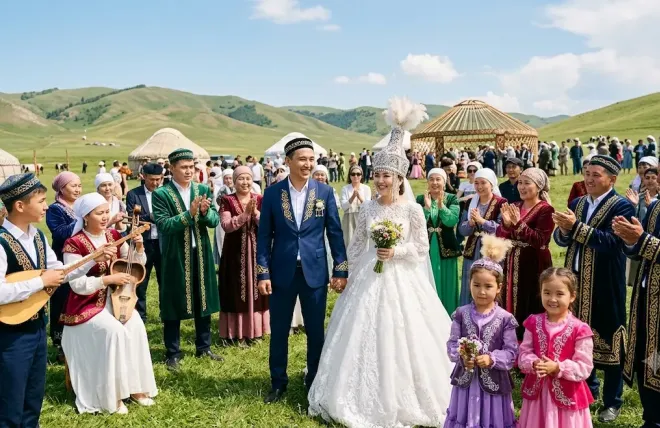
Once a young woman leaves the comfort of her family home—traditionally symbolized as the on zhak (the right-hand side of the yurt reserved for unmarried daughters)—and enters her husband’s household as a daughter-in-law (kelin), her new family immediately longs for an heir. In Kazakh culture, seeing this dream fulfilled within the first year of marriage is the ultimate hope.
Within the first three to four months, women in the community begin exchanging whispers that rarely reach the men’s ears. Neighbors and distant relatives alike anxiously wonder, "Is the new bride showing signs of expecting yet?"
The mother-in-law (ene) discreetly questions her older daughters-in-law, while the bride’s sisters-in-law (abysyn) gently probe the young wife herself, asking, "Has a new life taken root within you yet?"
Onlookers and outsiders subtly watch for physical signs, looking to see if her figure is filling out or if her face shows the characteristic changes of pregnancy—a transformation traditionally described as "a halter falling upon her nose." For a Kazakh family, delays in conceiving are a source of great anxiety because the culture is deeply centered on children. As the proverb goes:
"A son brings the sun; a daughter brings the moon."
For both the family that gave their daughter away and the family that welcomed her, a child is the most essential blessing following holy matrimony.
The Sacred Ritual of the Bridal Bed
Because of this profound reverence for new life, the Kazakh people approach the preparation of the bridal bed with strict spiritual etiquette. Following the religious marriage ceremony (nike), the bride's mother invites a well-respected, well-mannered relative who has raised many healthy children to prepare the couple's pristine bridal bed for their first night together.
Once the bed is made, the bride’s mother cleanses the space by burning purifying juniper (arsha) incense. She offers her prayers to the Almighty, pleading for her children to be shielded from misfortune and evil eyes. She prays that they grow old together in harmony, and that their marital bed remains sacred, untouched by infidelity or deceit. Only after these blessings are performed does the older sister-in-law (zhenge) who laid the bedding give the newlyweds permission to retire together.
This exact etiquette is repeated when the bride arrives at the groom's village. There, the groom's own well-mannered, multi-child sister-in-law prepares the bed once more, and his mother echoes the exact same sacred prayers.
The Weight of Etiquette and the "Tosek Toyi"
Under the strict moral code of traditional Kazakh society, it is absolutely impossible for a groom to approach his bride before these conditions are met. To bypass this etiquette is considered a disgraceful lack of upbringing (korgensizdik). To a traditional Kazakh, being labeled uncultured or ill-mannered is a fate far worse than death itself.
The custom known as Tosek Toyi (The Bed Celebration) is rooted entirely in this profound respect for family honor. The reason this celebration focuses so closely on the first few months of marriage is simple: if a young couple begins their life together under these blessed conditions, conception during this early window is highly likely. Historically, this was almost always the case for young, healthy mothers.
When the young bride realizes she is pregnant, she secretly confides the news to a close sister-in-law, who then tactfully passes it along to the mother-in-law. Even if the family keeps it quiet, observant village women soon notice the bride's glowing complexion and changing figure. They bring the joyful news to the matriarch of the household, encouraging her to gather the local women for a small celebration and ritual feast.
Though the mother-in-law has been waiting anxiously for this moment, she avoids making a loud public announcement. Instead, she quietly gathers the local women to host a traditional, women-only ritual called Tosek Toyi.
This custom serves a beautiful dual purpose: It celebrates the immense joy of an impending grandchild.
It reinforces absolute confidence in the young bride's virtue and fidelity to her husband.
Upon hearing the news, a messenger is sent to the bride’s maternal home, where her mother happily rewards the bearer with a traditional gift (shuyinshi). This shared joy binds the two mothers-in-law even closer together. The groom, deeply moved and grateful for the flawless upbringing his wife received from her parents, treats his in-laws with even greater reverence—proving the old adage: "Do not just choose a wife; respect the family she comes from."
Keregege Oramal Tanu (Tying a Scarf to the Kerege)
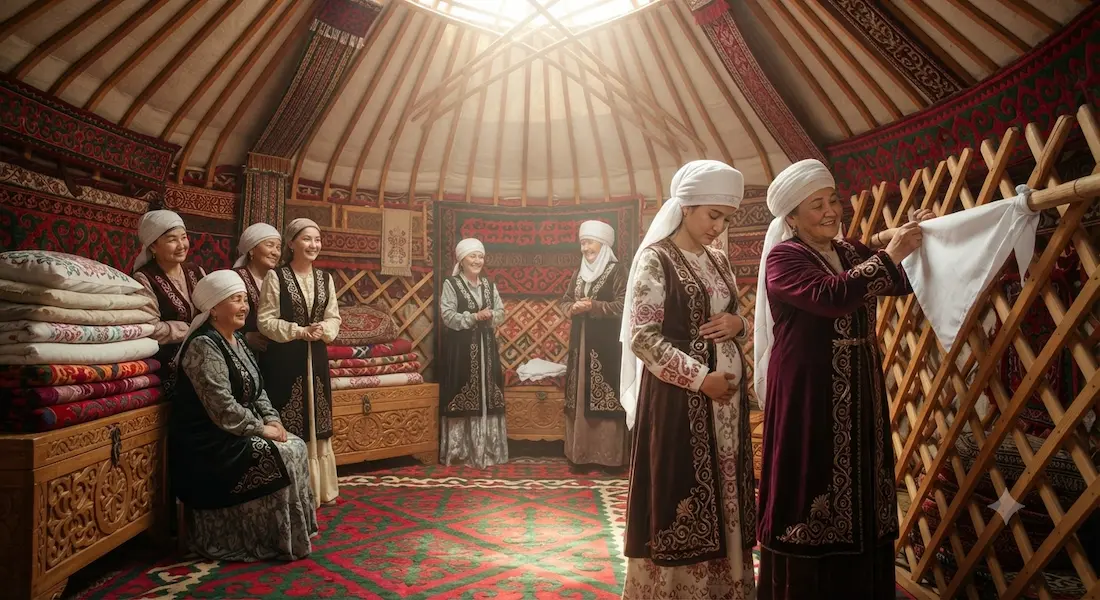
A public ritual where a white scarf is tied to the wooden lattice wall (kerege) of the yurt to announce the pregnancy to the community.
Hoping to welcome a grandson, a protective mother-in-law (ene) will purposefully feed the new bride ultabar (the fourth stomach of a sheep, traditionally associated with bearing sons) from the very first animal slaughtered after her arrival. Later, once pregnant, the young woman will carefully avoid eating any food she brought from her own home to another person's table, adhering to a superstition that doing so might result in giving birth to a daughter instead.
Experienced village women easily detect the earliest signs of pregnancy simply by observing subtle changes in the bride's behavior and appearance. Instead of speaking directly, they poetically hint to the mother-in-law:
"Your daughter-in-law’s womb has had its fill of white ayran (yogurt), and she has received a sacred blessing."
Understanding this delicate metaphor instantly, the mother-in-law rejoices and expresses her deepest gratitude to the woman who brought the good news. To ensure that the spirits of the ancestors recognize and protect the expectant mother, she ties a clean white scarf to the right kerege (the wooden lattice frame) of the family yurt. This ritual, known as Keregege Oramal Tanu, serves as a beautiful, silent announcement. Once the scarf is in place, the entire village knows that a new life is on the way.
Kursak Shashu (The Pregnancy Feast)
A gathering hosted for a pregnant woman where experienced mothers bring various dishes to help satisfy her pregnancy cravings.
When a young bride loses her appetite, experiences frequent nausea, or struggles with morning sickness, Kazakhs call this state zherik bolu (pregnancy cravings). During this phase, she will develop intense, unwavering fixations on very specific foods.
To help her through this, the mother-in-law invites the village women over for a small celebratory gathering called Kursak Shashu (The Pregnancy Feast). The experienced mothers who assemble for this gathering each bring a unique, home-cooked dish from their own kitchens. The purpose of this potluck is to pinpoint and satisfy the exact food the bride is craving.
Traditional wisdom holds that if this specific food is not found—meaning her craving goes unfulfilled—the expectant mother will continue to vomit and reject nutrients for the remainder of her pregnancy. The community refers to this severe, unappeased state as it zherik (a dog's craving). It is believed that a baby born from such a difficult pregnancy will drool constantly during infancy until they grow older.
Conversely, local folklore is rich with legends of legendary warriors and brilliant philosophers whose mothers experienced extraordinary cravings during pregnancy. To this day, stories are passed down about great heroes born to women who craved and consumed a tiger’s heart, bear meat, or an eagle's brain.
Dietary Support and Traditional Nutrition
Ene (Mother-in-law): The traditional guardian, mentor, and protector of the young bride.
The mother-in-law acts as a dedicated guardian to the pregnant bride. She pays close attention to the expectant mother’s meal schedule, focusing heavily on dairy products (ak). During summer, she gathers wild onions to stimulate the bride's appetite, specifically choosing it zhua (a pungent variety of wild onion) over ordinary field greens. To ensure the unborn baby grows up robust and physically resilient, the mother-in-law has the bride chew natural sand resin (kum saghyz), selecting it carefully over other local pine or earth resins. Whenever possible, she also sources wild mountain rhubarb and sorrel; rhubarb is believed to bless the child with sharp eyesight and keen hearing, while sorrel naturally boosts the mother's appetite.
It is a well-known phenomenon that toddlers often crawl along walls to lick chalk or eat small clumps of clay. Modern science confirms that this behavior stems from a mineral deficiency in the child's developing body. Recognizing this instinct centuries ago, the Kazakh people took preventive measures while the baby was still in the womb. They would locate spots where river whirlpools had dried up, harvest the fragrant, clean clay, and bring it home. The mother-in-law would feed measured portions of this mineral-rich earth to the pregnant bride, believing it crucial for forming the baby's skeleton and ensuring the child wouldn't crave chalk later in life.
The expectant mother is also fed fresh meat broths and a specific caramelized, dehydrated cottage cheese known as kyzyl irimshik (red cheese). Traditional wisdom holds that a mother who eats ordinary white cheese will give birth to a child with soft bones, whereas consuming red cheese guarantees a baby with a solid, unbreakable skeletal structure.
Hygiene, Wellbeing, and Mental Health
Great care is dedicated to the bride’s personal hygiene. She bathes frequently with kokemaral (wild marjoram), a sweet-scented herb whose aromatic oils are believed to enhance the baby's respiratory development. Before she bathes, purifying juniper incense is burned in the room. To prevent the facial blemishes and skin pigmentation often triggered by pregnancy, fresh mare’s milk foam is applied to her face.
The mother-in-law also keeps a careful eye on oral hygiene. To prevent food particles from causing bad breath or unpleasant tastes that could trigger prenatal nausea and upset the baby, the bride rinses her mouth twice a day—every morning and before bed—with a warm decoction of black wormwood or mineral-rich rock salt.
A wise mother-in-law ensures that the young wife remains in high spirits, constantly entertaining her with humorous stories and jokes. She occasionally organizes lively youth gatherings called Kelin Konil (The Bride's Joy) and encourages her to listen to beautiful traditional songs and instrumental music. A common Kazakh belief warns that if a pregnant woman cries, her child will grow up timid and weak-willed. Bearing this in mind, the family goes to great lengths to shield her from any tragic news, keeping it hidden until she safely delivers. Her routine is carefully managed to guarantee sound sleep, fresh air, and an active, alert lifestyle.
Traditional Superstitions and Prenatal Taboos
A variety of deeply rooted cultural taboos guide this period to protect both mother and child:
Interacting with dogs: The bride must never yell "scram" at a dog, as this is believed to make her future labor agonizingly slow.
Braiding ropes: Braiding or twisting ropes is strictly forbidden, out of fear that the umbilical cord might wrap around the baby’s neck.
Tying and sealing: Packing tight bundles or sealing bags is banned; instead, the family encourages opening closed items and untying knots to symbolically clear the birth canal.
Eating camel meat: Consuming camel meat is prohibited, as folklore warns it could extend the pregnancy from nine months to a full twelve months.
These taboos originate from ancient, ancestral belief systems passed down through generations.
The Three Stages of Labor Preparation
To prevent premature labor or miscarriage, experienced mothers-in-law historically stitched the hem of the bride's dress as a protective charm and never allowed her to walk outside alone at night. As the due date approaches, the compassionate matriarch has the bride walk barefoot on the bare earth, chanting: "O deep-breasted Mother Earth, grant us your strength and power!" This grounding ritual is believed to forge the mother's physical endurance.
Three months before delivery, the early, long-interval contractions (uzyn tolgak) begin. During this phase, wise elder women have the bride bathe in a lake on clear, moonlit nights, wishing for the baby to be "as beautiful as the moon." However, because the moon is cold, the bride pulls wild grass from the lakeshore and throws it into her home fireplace upon her return. This beautiful custom gave rise to the classic Kazakh blessing: "May your child be as beautiful as the moon, and as warm as a fire!"
Two months prior to the birth, the mid-stage contractions (orta tolgak) set in. To prevent an accidental premature delivery, the bride is forbidden from handling sharp or piercing tools, such as knives, awls, or saws.
In the final month of pregnancy, the final phase of contractions (ai tolgak) begins. At this stage, she is kept away from fresh, raw meat out of fear that the unborn child’s skin will become permanently inflamed or raw. She stops all sewing and needlework to ensure the cord does not wrap around the baby, and she avoids squatting, which could trigger an immediate delivery.
Additionally, a beautiful custom exists where parents lead the young mother to clear the blocked openings of seven natural springs. They pour oil into the fresh water, toss in silver coins, and tie white cloths to sacred trees growing near the water sources. Through these symbolic actions, the village elders reassure the anxious young bride, saying: "Your ancestors drank from these very waters; their spirits will cradle and protect you when your labor peaks." This beautifully restores her peace of mind.
Akkol Ana ("White-Handed Mother")
A traditional midwife with extensive knowledge of obstetrics and timing.
"In every traditional Kazakh village, there were elder women renowned for their 'light hands' who specialized in delivering babies. The community revered them as Akkol Ana (literally meaning 'White-Handed Mother'), the historical counterparts to modern midwives. These experienced women possessed the remarkable ability to predict the exact day an expectant mother would go into labor."
The Midwife’s Calendar and Gender Prediction
A standard calendar month consists of thirty days. According to traditional stargazers and folk calculators, the first three days—when the moon is completely hidden from the sky—are called the "dead days." During this dark phase, marital intimacy is strictly forbidden.
However, the traditional midwives (Akkol Ana) used their own system of calculation for pregnant women, basing a lunar month on exactly 27 days. This cycle begins on the first day of a woman's menstruation and is divided into three distinct nine-day periods:
The first nine days are the menstrual phase.
The second nine days are the purification phase.
The final nine days are the conception phase.
Folk medicine rules forbade intimacy during the first two phases, warning that violating this boundary would cause both partners to fall ill. Interestingly, traditional beliefs held that if a couple united on the odd-numbered days of the final phase, they would conceive a son, while even-numbered days resulted in a daughter.
A revered mother carries her child for nine months and nine days. Following the midwives' math, nine lunar months of 27 days equal 243 days. By adding the final nine days of the conception phase to this sum, they arrived at the exact term defined by the classic idiom "Toghiz ai, toghiz kun." To track this period without error, an experienced mother would place 243 pebbles or sheep droppings (kumalak) into a small pouch. By discarding one pebble each day, she could watch the pouch empty as her due date drew closer.
Readings Signs and Predicting Gender
Three months before delivery, the early Braxton-Hicks contractions (uzyn tolgak) begin, prompting the family to start final preparations for a safe birth. To prevent the mother's pelvic bones from locking up, her lower back and shoulders are thoroughly massaged every evening with warm, rendered tail-fat using a deep, five-finger pressing technique.
Experienced mothers believe that during the mid-stage contractions (orta tolgak), the unborn child begins positioning itself to enter the world. They can often predict the baby's gender simply by evaluating the shape and position of the pregnant belly:
A Boy: The belly appears small, pointed, and sits high up. Movement is usually felt on the right side.
A Girl: The abdomen looks round, prominent, and hangs lower down. Movement is typically felt on the left side.
During the final month, the baby moves constantly, putting heavy pressure on the mother's sides. When active labor hits, the pain often intensifies in a completely unexpected part of her body. For instance, if she experiences a severe toothache, it is called a "tooth labor," which gave rise to the old Kazakh proverb: "Every child takes one of its mother's teeth." Similarly, if the pain manifests in her knees or the back of her neck, it is referred to as "knee labor" or "neck labor."
Preparing the Delivery Room and Ward Off Evil
As the final contractions arrive, a dedicated room or separate yurt is prepared. Fires are lit and water is heated. If the weather is freezing, dry animal dung is laid beneath thick felt carpets to insulate the floor. The entire space and all household belongings are cleaned meticulously.
The midwife and the chosen godmother (Kindik Sheshe) spearhead these arrangements, supported by female neighbors and relatives. They stretch a thick rope between the wooden lattice walls for the laboring woman to pull on for physical leverage.
Near the threshold, they place a whip, a sword, or a dagger. This stems from an ancient belief that weapons block malevolent spirits, such as the albasty or martu (demons in Turkic mythology associated with childbirth complications), from entering the room. Alternatively, they might display the pelts of a brown bear, a tiger, or a wolf—a custom rooted in invoking the protection of ancient ancestral animal totems (kiemiz).
The "On Ba" Ritual for a Smooth Birth
The midwife monitors the dilation of the birth canal using her fingers, measuring it by "finger-widths" (eli). When the opening widens from five to seven finger-widths, she knows delivery is imminent, following the folk medical saying: "Five widths open, the baby descends to the pelvis; seven widths open, the baby drops to the earth."
At this pivotal moment, the women perform a ritual called On ba — on ("Is it turning right?"). The laboring woman is snugly wrapped in a blanket, and the helpers on one side roll her over, calling out, "Is it turning right?" The women on the receiving side call back, "It is right!" and roll her back in the opposite direction.
After repeating this rolling process three times, they lift the expectant mother up and gently touch her head to the top frame of the door three times, chanting, "Right, right, right!" The community firmly believed this symbolic action ensured the baby would turn into the correct position, guaranteeing a safe, unhindered delivery.
Zharys Kazan (The Racing Cauldrons)
A ritual of cooking multiple pots of meat simultaneously during active labor to symbolically hasten and ease the delivery.
Filled with a mixture of immense joy and nervous anticipation, the mother-in-law immediately fetches the finest cuts of meat she had carefully preserved all winter and starts preparing the Zharys Kazan (Racing Cauldrons) ritual. She boils the samovar and puts milk on the hearth to simmer. Throughout the home, wooden storage chests (abdire) are unlocked, packed bundles (teng) are untied, preserved butter is scooped from sheep stomachs, and dried cheese (kurt) is taken from sacks. The women tie long ropes with simple slipknots, only to pull the loose ends and unravel them instantly. They also light purifying juniper twigs to cleanse the laboring woman’s head while burning sulfur near her feet.
Every single one of these actions is a symbolic, sympathetic ritual meant to ease her labor. The psychological intent is clear: just as chests are opened, bundles unfastened, and knots effortlessly undone, the birth canal should relax. The community prays that the delivery happens within the brief span it takes for tea to boil, milk to simmer, or meat to cook—safely racing against the bubbling cauldrons.
As the contractions intensify, village women stretch a thick, multi-colored rope across the yurt for the expectant mother to grip firmly for leverage. The helpers move around her in a flurry of activity, sometimes tripping over their own long skirts in their haste. The elder women offer all their knowledge and practical experience, chanting prayers to Bibatima (Fatima, the patron saint of women and childbirth in Islamic-Kazakh folklore) to beg for divine assistance from all sides.
Simultaneously, a couple of young boys run around the yurt, rhythmically pounding the ground with large wooden pestles, shouting frantically, "Has it dropped yet? Has it dropped?!" Meanwhile, the remaining women prepare the feast from a freshly slaughtered animal to feed the mother and the gathered helpers. In this custom, there is absolutely no room for rationing, hesitation, or holding back; therefore, multiple cauldrons must boil side-by-side in a frantic race against time.
Traditional Emergency Interventions
If a woman faces an incredibly difficult labor and struggles to give birth, a physical intervention called Bel Tartu (Waist Pulling) is deployed. A physically strong man, specifically requested for his strength, stands behind the laboring woman, firmly locks his arms around her waist, and applies a calculated, downward pressure on her abdomen to push the baby out.
If the baby presents transversely (lying sideways), the experienced midwife (Akkol Ana) turns the freshly cleaned intestines of a slaughtered animal inside out over her hands like sterile gloves. She then manually reaches inside the birth canal to gently turn and correct the infant's positioning.
On occasions where the baby presents breeched (feet or bottom first), the midwives use a specialized inversion technique. They carefully suspend the laboring woman from a secure rope with her legs elevated and her head pointing downward. By using gravity combined with external abdominal massaging, they successfully guide the fetus into the correct head-down position, allowing for a swift and safe delivery.
Kindik Sheshe (The Umbilical Mother)
A specially chosen godmother who cuts the umbilical cord and plays a lifelong role in the child's upbringing.
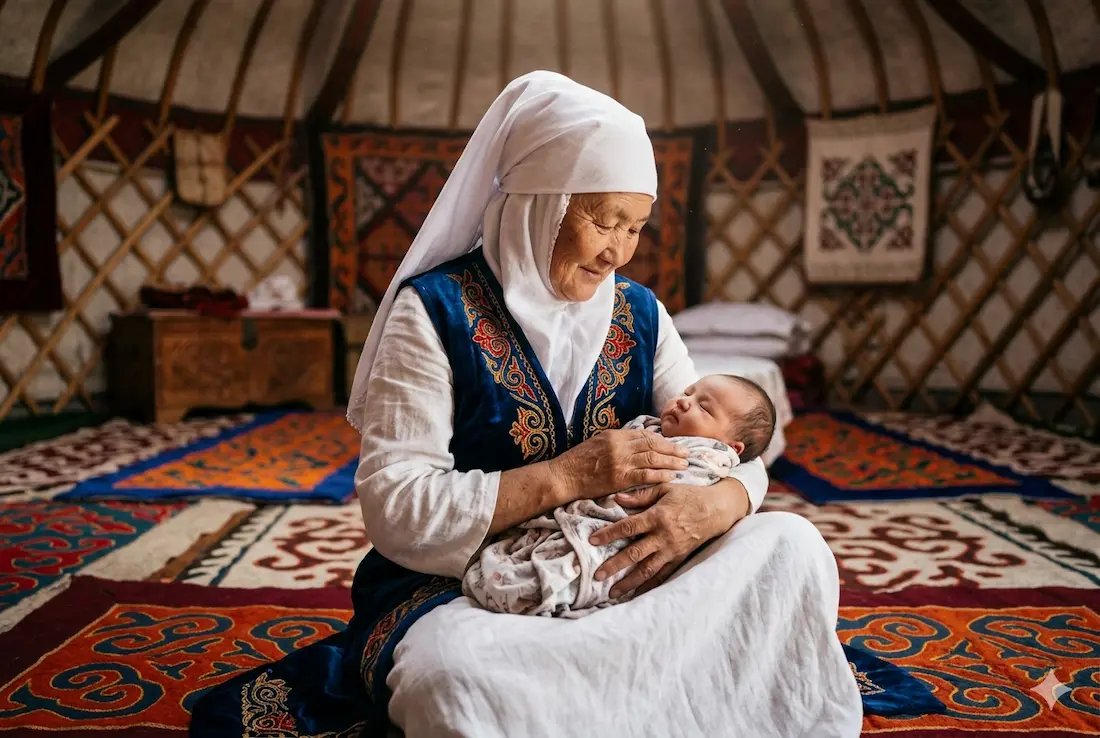
The process of becoming a godmother often begins long before conception, sometimes as early as the couple's wedding. A woman who wishes to claim this honor will invite the newlyweds to her home for a special feast. Following the traditional meal, she will present a playful yet meaningful toast to the groom, saying: "Make sure your bride's womb is always filled with white yogurt (ayran)." This lighthearted blessing cements a close, harmonious relationship between the two households.
The Kindik Sheshe shoulders significant responsibilities: she assists in caring for the pregnant bride, remains by her side throughout the entire labor, and cuts the umbilical cord. When the newborn reaches its forty-day milestone, she brings a specially hand-stitched shirt known as an it koylek (the dog-shirt, a protective infant garment). Her devotion does not end in infancy; she keeps a watchful eye on the child and acts as a dedicated mentor until they reach maturity.
In Kazakh culture, it is firmly believed that a child inherits their personality and temperament from their godmother. Furthermore, if a delivery proceeds smoothly and without complications, the village women will praise her, noting that the godmother has an exceptionally "light hand" (a gentle, lucky touch).
Once the child grows up and achieves independence, they express their profound gratitude by presenting her with a valuable gift called the kindik keser (the cord-cutting tribute). For the rest of their days, the child holds the Kindik Sheshe in the highest regard, treating her with the exact same reverence and love as their biological mother.
Kindik Kesu (Cutting the Umbilical Cord)
The ritual of severing the cord and treating it with symbolic meaning.
The umbilical cord is cut using a special, dedicated small axe called an akbalta (white axe), bound securely with clean thread, and the stump is dusted with sterile hearth ash to promote healing. The blade used for this procedure is never employed for any other household task; instead, it is carefully preserved as a family heirloom.
The tied cord typically dries and falls off within three to four days.
Symbolic Disposals and Blessings
The family disposes of the detached umbilical stump according to the baby's gender and their future aspirations:
For a Son: The cord is thrown far beyond the hills or outer pastures. This is done to ensure he does not grow up to be a "house-puppy" (a homebody), encouraging him instead to become a brave explorer and a protector of the land.
For a Daughter: The stump is buried beneath the hearth or near the fireplace, symbolizing the wish for her to become the kut (the sacred blessing and spiritual core) of the home.
For Intellectual Success: Alternatively, parents might slip the dried cord between the pages of a scholar's book, hoping the child will grow up to be highly educated.
For Horsemanship: It might also be tied to a horse's mane, reflecting the ultimate nomadic wish for the child to ride skillfully, as if "playing on the ears of a stallion."
Cultural Impact on the Concept of Homeland
These deep-rooted traditions gave rise to some of the most sacred and revered idioms in the Kazakh language: "kindik kesken zher" (the place where my umbilical cord was cut) and "kindik khany tamghan zher" (the land where my first drop of umbilical blood fell). For any Kazakh, these poetic expressions are the ultimate definitions of one's beloved homeland, forever binding a person's soul to the exact soil of their birth.
Sabi Keldi (The Baby Has Arrived)
The official announcement of birth.
Announcing the Arrival: Shuyinshi
The baby has arrived. The moment the infant’s first cries echo through the home, a swift-footed woman rushes outside to deliver the news to the father and the other men, who have been waiting in tense anticipation. If a girl is born, she announces her as a "vestments-weaver" (kesteshi); if it is a boy, she proclaims him a "horse-herder" (zhylkhyshi). With this announcement, she claims her shuyinshi—a traditional reward given to the bearer of excellent news.
The entire village celebrates this milestone, with the local women leading the festivities. If the grandparents do not provide the shuyinshi reward immediately, the messenger will playfully snatch the father’s fur hat (tymakh) or the mother-in-law’s white headscarf (kimeshek). She will hold these items hostage, leaving the elderly couple completely at a loss until they hand over a proper gift to redeem their belongings.
On this very day, the designated godmother (Kindik Sheshe) takes charge. She brings a nourishing postpartum meal called kalzha (traditionally made from freshly slaughtered mutton) for the recovering mother. Her own pot bubbles on the hearth right alongside the racing cauldrons, as she assumes full responsibility for the new mother's immediate care. Furthermore, she is obligated to share the organizational and financial burdens of the upcoming birth celebrations (shildekhana). In return for this lifelong devotion, the baby’s parents honor her by gifting her whatever her heart desires.
The First Hours of Life: Auyzdandyru and the First Bath
Before the newborn is allowed to nurse from its mother, the family performs a ritual called auyzdandyru (tasting the first food). They gently touch the infant's mouth with a piece of wolf fur or the pelt of a legendary hunting hound (syrtthan) that has been dipped in clean, boiled water. This symbolic act is meant to instill courage and a fierce, untamable spirit in the child.
Following this, the newborn receives its very first bath with soap. Before immersing the infant in the water, the midwife gently pulls its tongue forward to ensure the baby does not accidentally swallow or choke on it during the washing process.
The bathing technique follows a strict, careful order:
The midwife washes the baby from the crown of its head downward.
She gently dips its feet into the water first, gradually acclimating the tiny body so the infant does not get frightened by the temperature.
She carefully cleanses every single crease and fold, ensuring not a single spot on the skin remains untouched by water.
Once the bath is complete, the midwife applies soothing sheep fat to the umbilical stump, binds it securely, wraps the infant in cozy swaddling clothes (khundakh), and places the newborn safely beside its mother to rest.
Shilde Kaghu (Protection from Postpartum Chill)
Strict traditional care guidelines to protect the new mother from cold and illness. The mother-in-law closely monitors the new mother, wrapping her in warm clothes and strictly shielding her from drafts to prevent a condition known as shilde qaghu (postpartum chills or complications caused by cold exposure). The bride is given special knee-warmers (tize qap) and traditional leather overshoes (kebis), and she is forbidden from touching cold water. Furthermore, she does not take full baths for forty days, as traditional wisdom warns that the body is highly vulnerable to water shock during this period.
To help the distended abdomen return to its original shape, her waist is bound tightly with a sash. Her mouth is wrapped with a scarf to prevent her teeth from loosening, she is restricted to warm drinks, and her hair is tightly braided to stop it from shedding due to hormonal changes.
Tymakka Salu (Placing in a Fur Hat)
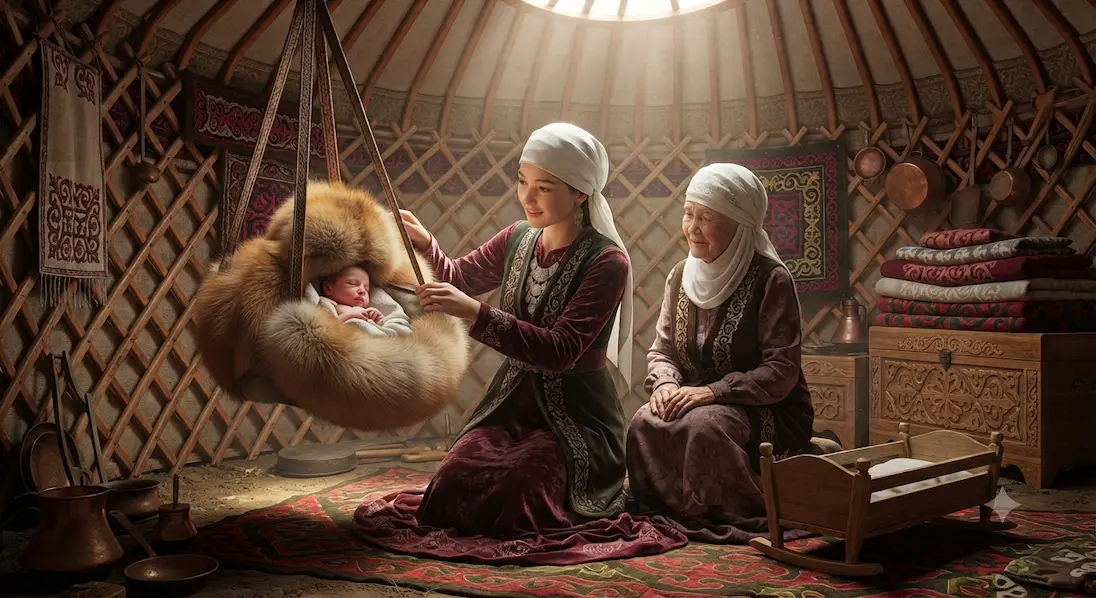
A traditional incubation method for premature babies. If a baby is born prematurely—referred to as shala tugan (half-born)—the family performs a ritual called tymakhqa salu (placing the baby in a fur hat). The tiny infant is nestled inside a warm fox-fur hat and hung from the wooden lattice frame (kerege) in a quiet, inconspicuous corner of the yurt away from prying eyes. The family frequently moves the hat to different spots on the wall, symbolically recreating the days left in the pregnancy. These delicate infants receive extraordinary care and are fed much more frequently than full-term newborns.
Suiindir (The Maternal Joy)
The visit of the bride’s own mother to help her learn childcare and celebrate the new grandchild. When a married daughter gives birth, her own mother is culturally obligated to be the first relative to visit. This is a foundational duty that every Kazakh woman understands. Filled with maternal joy (suyinish), the grandmother shares her wisdom, teaches her daughter the fundamentals of infant care, and joins the in-laws in celebration. She also arrives bearing a complete set of handmade baby gear and gifts. This ancient custom of a mother visiting her newly initiated daughter is called Suyindir (The Sharing of Joy).
Kalzha (The Postpartum Feast)
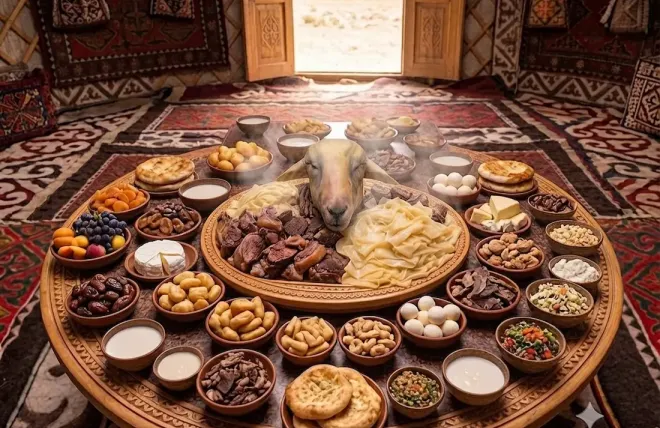
A nutrient-rich meal, typically involving a freshly slaughtered sheep, prepared to help the new mother recover her strength. Kalzha is a mandatory postpartum meal consisting of rich mutton broth and tender meat from a freshly slaughtered sheep. While the godmother provides the immediate dish on the day of birth, other close relatives, neighbors, and friends will continue to bring kalzha in the following days. This feast serves as a profound sign of respect for the new mother, designed specifically to replenish her energy, restore her physical health, and enrich her breast milk.